
Has the War in the Gaza Strip Ended? Chances for Peace
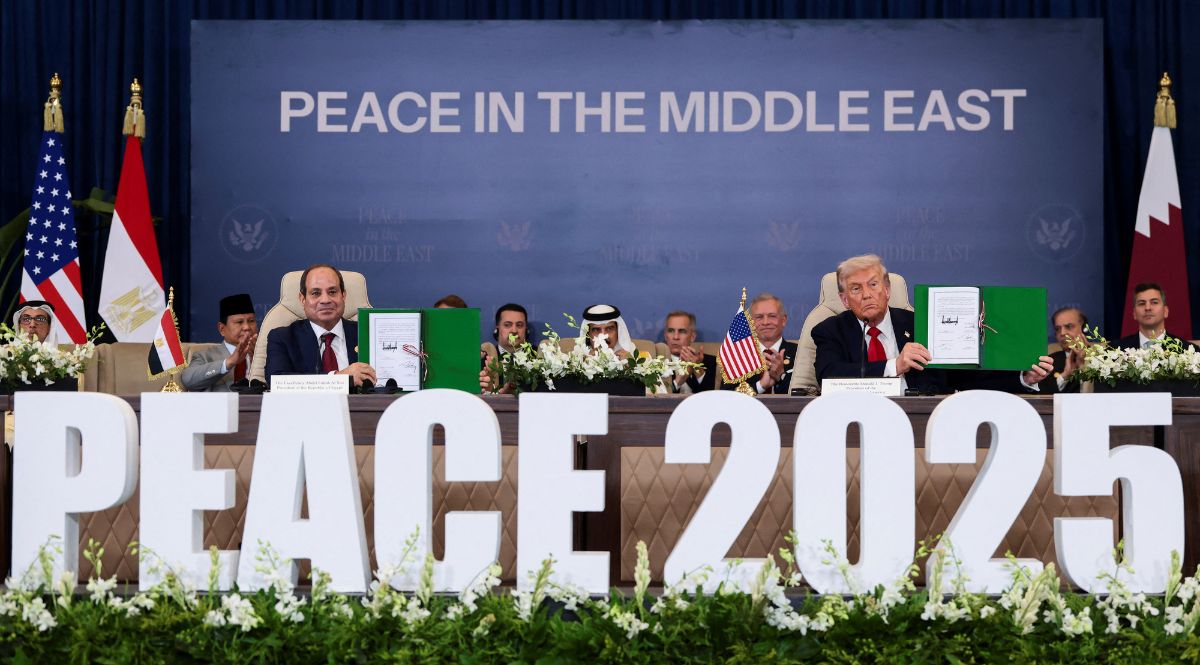
Israel and Hamas have begun talks about ending the war, based on a plan presented by U.S. President Donald Trump. While the first phase—a ceasefire and the exchange of hostages and prisoners—is being implemented, further stages depend on concessions on strategic issues, primarily the disarmament of Hamas and the withdrawal of Israeli troops from the Gaza Strip. The parties are under greater pressure than before from external partners, as seen at the summit of leaders in Sharm el-Sheikh, which increases the chances of at least partial implementation of the peace plan.
 Evelyn Hockstein / Reuters / Forum
The result of the two-year war in the Gaza Strip and Israeli military operations there is widespread destruction of Palestinian infrastructure and a humanitarian disaster. The number of casualties (military and civilian) is estimated at 67,000 Palestinians killed and 170,000 wounded, with several thousand missing. Israel maintains a permanent military presence in most of the Strip. At the end of August, it launched an offensive on the city of Gaza, forcing the evacuation of around 900,000 residents. Despite the severe losses suffered since the beginning of the war, Hamas and other groups are still able to function as urban guerrillas.
At the end of September, the U.S. administration presented a 20-point plan to end the war, which Israel and Hamas accepted as a basis for negotiations. On 9 October, the parties reached an agreement on a ceasefire and proceeded to implement its first stage. Military operations were suspended and Israeli forces partially withdrew, while Israeli hostages were released in exchange for Palestinian prisoners from Hamas and other organisations.
The Assumptions of Trump’s Proposal
The 20-point plan combines most of the existing expectations of the U.S. and Israel with some of the aspirations of countries in the region (although it was not consulted with the Palestinian side). It assumes that after the prisoner exchange stage, the parties will proceed to negotiate further points, ultimately leading to a resolution of the conflict. The content of the proposal remains deliberately vague in many places, which may be used by the parties in subsequent stages of negotiations, and they have already contested some parts.
The key points of contention concern the nature of the future authority over the Gaza Strip. The plan excludes Hamas from participating in it, as it is to be disarmed and its members may be displaced to third countries or granted amnesty if they renounce violence. Administration of the Gaza Strip is to be taken over by a technocratic board composed of local communities, with an international “Board of Peace” chaired by Trump himself, exercising overall authority. The plan also envisages the future participation of the Palestinian Authority (PA) in this process, once it has implemented the internal reforms required by the U.S. and the EU. The U.S., together with countries in the region (including Egypt and Jordan), will co-create a peacekeeping force responsible for security within the Strip. At the same time, increased humanitarian aid is to be sent to the enclave and a reconstruction process is to be launched, although the source of funding for it is unclear.
While the plan directly states that Israel cannot occupy or annex the Gaza Strip, the extent to which Israel's military presence will be reduced and maintained is only partially defined and depends on the progress of subsequent stages of the plan, primarily the finalisation of the first phase—the disarmament of Hamas—and the functioning of peacekeeping forces. Additionally, if Hamas does not cooperate, some parts of the plan may be implemented in areas not controlled by the organisation. The plan also guarantees a ban on the displacement of residents (despite some of Trump’s previous statements) and allows freedom of movement to and from the Strip.
Calculations of the Parties and International Aspects
The agreement between Israel and Hamas and the start of its first phase is the result of external pressure and internal conditions. The most crucial factor was pressure from the United States. The protracted conflict and its growing political and image costs, together with Israel’s destabilising actions in the region (including aggressive policy towards Syria, attack on the Hamas leadership in Qatar), have contributed to a hardening of the U.S. position towards its ally. At the same time, President Trump emphasised that if Hamas refused to accept the plan, Israel would be able to resume its offensive on the unoccupied areas of the Gaza Strip with further U.S. support. A message about the need for a lasting end to the conflict was emphasised during the president’s visit to Israel and at the summit of leaders in Sharm el-Sheikh on 13 October.
For Israel, the provisions of the plan, if fully implemented, remain clearly beneficial, as they fulfil the main objectives set at the beginning of the conflict. The fundamental value remains the return of the hostages, which was the most essential condition for ending the war in the eyes of the public. From a strategic perspective, it is also beneficial because the plan allows for Israel to maintain broad military control in the Gaza Strip, with a withdrawal schedule dependent on Israel’s own assessment, for example, regarding the demilitarisation of the Strip. The governance model outlined in the plan is also consistent with the efforts of Benjamin Netanyahu’s government to limit the PA’s involvement as much as possible.
The adoption of the plan is already generating internal tensions within the Israeli government coalition, which has not had a parliamentary majority since July. The cessation of military operations, combined with, among other things, President Trump’s statements rejecting scenarios involving annexation of Jewish settlements, increases the likelihood of the radical right-wing party leaving the coalition. While this does not threaten implementation of some parts of the plan or the peace negotiations (the parliamentary opposition has guaranteed its support), it increases the chances of early elections again. Netanyahu may therefore prolong the negotiations for short-term political gains, with the main argument the issue of disarming and removing Hamas from the Gaza Strip.
Hamas hopes that the talks will lead to a complete end to hostilities. At the same time, for the organisation, entering into negotiations based on Trump’s plan carries great risk, as its assumptions point to a de facto inability to continue operating in the Strip, including a loss of administrative control and military potential. The Hamas leadership hopes to negotiate a compromise based on earlier proposals (e.g., handing over control of some of its weapons), which would allow the organisation to maintain its structures in the Gaza Strip. Key to these calculations is the assumption that any return to military action by Israel will be met with a tougher response from third countries, such as suspending their support. Hence, there is pressure on the U.S. to act as guarantor of the agreement. Qatar and Turkey may have a significant influence on the flexibility of the Hamas position
Perspectives
A lasting end to the war in the Gaza Strip remains uncertain. The vague wording of the plan and the immediate circumstances affecting Israel and Hamas will prolong and complicate the negotiations. Very likely there will be violations of the truce—both deliberate and unintentional—and these could be used at any time to undermine the entire process. A failure of the talks would mean a return to the Israeli offensive and further pacification of the Gaza Strip, with all the humanitarian consequences that it would entail. However, this would result in Israel losing further support among its existing external partners. In turn, the priority for Hamas, which still holds significant manpower and firepower, is to restore control—already started—and to maintain its dominant role in the Gaza Strip.
The most important factor working in favour of the implementation of the agreement is continued pressure from the U.S. administration. However, there is a risk that the immediate political benefits of releasing the hostages will also be crucial for President Trump. The role of countries in the region (especially Turkey, Egypt, and Qatar) is clearly increasing, as they are essential for maintaining dialogue between the parties and directly participating in the implementation of subsequent stages of the agreement. Here, too, however, there is a risk that, in the face of rising costs (including financial ones) and possible obstruction by parties, their involvement may decline.
The short-term effect of the start of peace talks may be a slowdown in diplomatic efforts, undertaken, among others, by EU countries, to increase Israel’s international isolation. However, this does not change the need for the EU to address the long-term effects of the war by increasing political and material support for the Palestinian people and responding to Israeli violations and breaches of international law over the past two years, including allegations of genocide. With the permanent end of the war in the Gaza Strip, it will be necessary to take advantage of the high level of activity of states and international public opinion related to the Israeli-Palestinian conflict to take action towards lasting and comprehensive solutions in this area, ultimately based on the two-state model.


.png)
