
UN System Addresses the Israeli Offensive on Gaza City
The offensive on Gaza City is already exacerbating the catastrophic humanitarian situation in the entire Gaza Strip, as confirmed by UN institutions. Without a change in the U.S. position, the Security Council’s inaction will be prolonged. However, attempts by other states to take more decisive steps at the General Assembly cannot be ruled out. It is in Poland’s interest to promote respect for international law and to communicate to the U.S., which supports Israel, that it cannot tolerate flagrant violations, just as it does not accept them during the war in Ukraine.
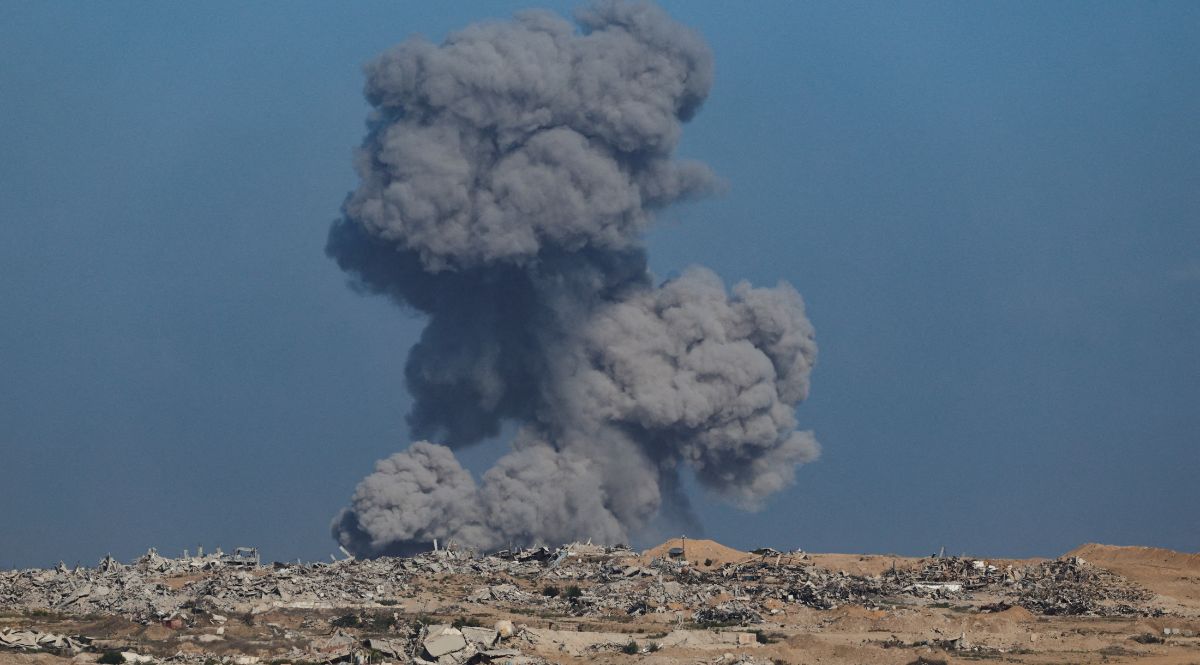 Amir Cohen / Reuters / Forum
The war in the Gaza Strip, which began after the Hamas terrorist attack on Israel on 7 October 2023 in which some 1,200 people, mostly civilians, were killed, has been ongoing for almost two years. According to publicly available information, some 65,000 Palestinians have been killed and about 160,000 injured. Media estimates are that as many as 80% of the victims are civilians (in comparison to around 25% in the war in Ukraine, where Russia repeatedly violates humanitarian law). The humanitarian situation is deteriorating dramatically, including cases of deaths from starvation caused by obstructed access to humanitarian aid, currently estimated by local medical services at around 430 people, including around 140 children.
UN Reactions to the Gaza Offensive
The Israeli offensive on Gaza City, inhabited by around 1 million people, which began at the end of August, is deepening the crisis. Criticism of Israel’s actions by the institutions of the UN system is therefore growing. Agencies dealing with food and agriculture (FAO, WFP), humanitarian aid and child support (UNICEF), or healthcare (WHO), among others, point to the massive displacement of the population and the high risk of starvation for many of the city’s inhabitants (they have declared the highest level of emergency according to the UN classification). Secretary-General Antonio Guterres calls for a ceasefire, criticising, as he puts it, the mass killing of civilians and the collective punishment of the Palestinian people. According to High Commissioner for Human Rights Volker Türk, numerous war crimes and crimes against humanity have been committed throughout the zone, and there was deliberate obstruction of humanitarian aid by Israel. The expert bodies go the furthest, although they do not represent the entire organisation. As recently as July, a report by the UN Special Rapporteur on the occupied Palestinian territories, Francesca Albanese, was released, accusing Israel of genocide and blaming many companies, including U.S. ones, of complicity. Israeli actions were also classified as genocide by the report of the Commission of Inquiry established by the UN Human Rights Council on 16 September.
The Security Council remains paralysed in the face of continued U.S. support for Israel: on 18 September, the U.S. vetoed the sixth resolution since the outbreak of war calling for a ceasefire, drafted in the wake of the offensive and supported by the other 14 Council members. States are therefore attempting to act outside the Council. On 12 September, the UN General Assembly (UNGA) adopted the New York Declaration by 142 votes (including Poland) with 12 votes against (including Argentina, Israel, the U.S., and Hungary). It contains a roadmap for the implementation of a two-state solution with a leading role for the Palestinian Authority (PA) and the elimination of Hamas from Palestinian political life. This was followed on 22-23 September by the recognition of Palestine by several Western countries, including Australia, Canada, France, Portugal, and the UK. Israel’s actions in Gaza were criticised by the majority of heads of state during the annual general debate at the UNGA on 23-29 September, and many delegates left the room during the speech of its prime minister. Some leaders, including those from Chile, Colombia, South Africa, and Turkey, called for the UNGA to condemn what in their view is a genocide taking place in the Gaza Strip.
Israel’s Attitude to UN Action and U.S. Support
Israel responds to UN criticism with accusations of hypocrisy and insufficient condemnation of Hamas actions. It denounced, for example, the New York Declaration, even though it mandates the disarmament of Hamas and the removal of the organisation’s influence on Gaza governance. It also engages in disinformation, arguing that the UN is responsible for the paralysis of humanitarian aid to Palestine—for example, Israel purchased YouTube ads accusing the UN of sabotaging aid deliveries, a claim for which the Polish foreign ministry summoned the Israeli ambassador for an explanation.
At the same time, Israel has been stepping up efforts in recent months to consolidate its control over the West Bank, in defiance of the UN’s long-standing position and resolutions. The government of Prime Minister Benjamin Netanyahu began on 11 September to expand Israeli settlements in the so-called E1 corridor, aiming to separate the area from East Jerusalem, which the two-state solution and Palestine itself intended to be its capital. Israel’s actions should be read as a step towards making the two-state solution impossible. This was confirmed by statements by Netanyahu and others, later justified as an “understandable” response to the new acts of recognition of Palestine by U.S. Secretary of State Marco Rubio. There is also growing pressure from some ministers, including Bezalel Smotrich and Yariv Levin, to fully annex the West Bank. This would be a blatant violation of international law and would undermine the sustainability of Israel’s Abrahamic Agreements with Bahrain and the United Arab Emirates, as their conclusion was conditioned by these states on the suspension of any annexation. It would also make the normalisation of relations with Saudi Arabia more difficult. Finance Minister Smotrich or National Security Minister Itamar Ben-Gwir, for example, also call on the prime minister to ethnically cleanse Gaza and fill it with Israeli settlers.
Israel’s rigid stance has been made possible by the backing of the Trump administration. As early as June and then again in August, it imposed sanctions on a number of International Criminal Court judges and prosecutors involved in issuing arrest warrants against Netanyahu and former Defence Minister Yoav Gallant. In July, the U.S. announced visa-entry sanctions on PA representatives, preventing its head, Mahmoud Abbas, from attending the UNGA in New York. This was a violation of the U.S.-UN agreement on access to the organisation’s headquarters. In response, an overwhelming majority of countries voted for the first time to allow a pre-recorded speech, one by Abbas, to be broadcast at the UNGA. Also in July, the U.S. imposed unprecedented sanctions on Albanese—in contravention of the binding convention on the privileges and immunities of the UN—over her accusation that Israel was committing genocide and her report identifying U.S. companies as aiding it. In a speech at the UNGA on 23 September, President Donald Trump strongly criticised the UN for what he called its inability to contain conflicts—despite the U.S. contributing to that problem—although he declared that he would not allow Israel to annex the West Bank and was also expected to promise this to Arab leaders in a closed-door meeting. On 29 September, he put forward his own initiative to resolve the conflict, proposing, among other things, a cessation of hostilities, the disarmament of Hamas, and the administration of Gaza by a committee of Palestinian technocrats overseen by an international Peace Council with Trump as chairman.
Conclusions and Recommendations
Every state has the right to self-defence and Israel has this right too with regard to the Hamas attacks of 7 October 2023. However, analyses by experts and UN agencies indicate that its response is clearly disproportionate and that the actions of the Israeli army are not currently being carried out in accordance with the principle of minimising civilian casualties, resulting in the commission of numerous war crimes and crimes against humanity, and possibly genocide. In this context and in light of the catastrophic humanitarian situation in the Gaza Strip as a whole, criticism by UN institutions of the offensive on Gaza is justified. Nevertheless, it is up to the organisation’s political bodies to take more decisive steps, and in view of the paralysis of the Security Council, this role falls to the UNGA. If enough states take the initiative as they have announced, the UNGA could, for example, recommend the imposition of sanctions on Israel on economic sectors or cultural and sporting participation.
The validity of the genocide allegations will ultimately be decided by the International Court of Justice, which has been hearing a case brought by South Africa at the end of 2023. Nevertheless, in line with the 1948 Convention on the Prevention and Punishment of the Crime of Genocide, it would be advisable for Poland to consider measures to prevent possible complicity, such as the categorical suspension of arms trade and military cooperation with Israel and supporting outright the implementation of pressure measures on the Netanyahu government within the EU (including those advocated by High Representative Kaja Kallas and Commission Head Ursula von der Leyen, such as the suspension of bilateral aid and the partial suspension of the EU-Israel Association Agreement). The aim of these measures would be to avoid accusations of supporting crimes and to get Israel to stop its actions and return to peace talks. The possible annexation of the West Bank would require a strong response in the form of further-reaching sanctions, among others economic. In this regard, it is necessary to communicate unequivocally in relations with the U.S. that absolute respect for international law is a priority for Poland in view of Russia’s analogous unlawful actions from at least 2022 onwards.

.png)
