
United States Balances Partnerships in the Middle East
President Donald Trump is seeking to develop partnerships with Arab states in the Middle East by strengthening mutual economic cooperation and developing investments with the U.S. The administration is pushing this initiative separately from the issue of the region’s Arab countries normalising diplomatic relations with Israel and is not linking it directly to security. Trump’s May visit to the Middle East was a clear signal of the strengthening of the position of Arab states in his transactional-based foreign policy, which focuses on balancing regional partnerships in addition to improving relations with Israel.
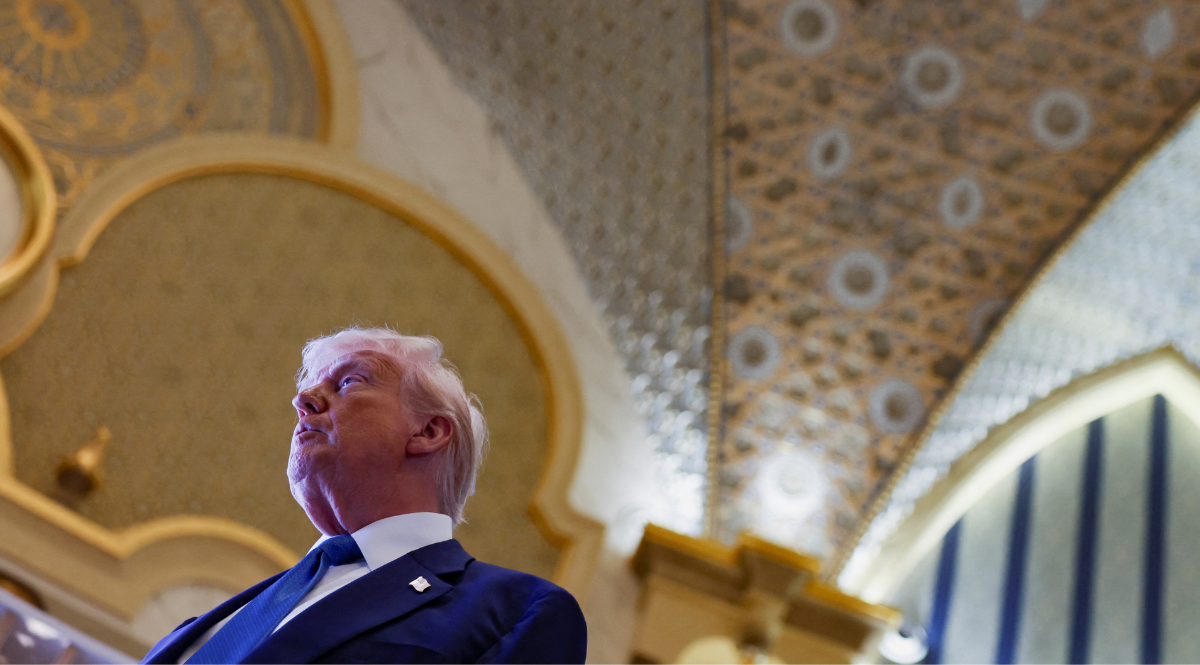 credit: Amr Alfiky / Reuters / Forum
Trump’s Middle East visit—only his second foreign trip of this term, following his visit to Pope Francis’ funeral at the Vatican—took place on 13-16 May and included Saudi Arabia, Qatar, and the United Arab Emirates (UAE). It was focused on planned bilateral investments, indicating a desire to stabilise the region through economic development and prosperity. In Riyadh, Trump also met with new Syrian President Ahmed al-Sharaa, showing his readiness to open a new chapter in bilateral relations and reaffirming the importance of diplomatic efforts in his strategy toward the region. In contrast, the decision to not include Israel on the agenda of the visit was evidence of the rift that existed in the U.S. president’s relations with Prime Minister Benjamin Netanyahu in April and May.
The Political and Strategic Dimensions of the Approach to the Region
The primary objective of Trump’s foreign policy toward the Middle East is to reduce political, diplomatic, and military involvement in the region. This was reflected in the decision to make a massive reduction in foreign aid (implemented by USAID, among others), which also affected the Middle East. Such measures are intended to enable the concentration of attention and use of resources in areas crucial to American interests—the Indo-Pacific and the Americas. The U.S. president wants to achieve this by, among other things, easing Israel’s conflict with Hamas and concluding a nuclear deal with Iran. The normalisation of Arab states’ relations with Israel, through the Abraham Accords, is also expected to help in the long term.
The first meeting in 25 years between an American president and a Syrian leader, as well as the lifting of U.S.-imposed sanctions and the removal of the HTS group (whose leader is al-Sharaa) from the list of terrorist organisations, signal a willingness to reset bilateral relations. This opens up the prospect of the country’s economic recovery and is an important signal for building the international legitimacy of the new government. Aware of the importance of peace processes in Trump’s policies, the Saudis have offered to host part of the talks that are taking place as part of the negotiations leading to a ceasefire between Ukraine and Russia, with U.S. participation. Qatar is also playing a similar role in the talks for the release of hostages held by Hamas and a ceasefire between it and Israel, as well as U.S. negotiations with Iran.
Trump’s approach, however, does not enjoy the full support of the Republican Party. Within it, some members express objections to rapprochement with Qatar, which they see as a sponsor of terrorism because of its close ties to Hamas. They also disagree with a softened approach to Iran, seeing it as U.S. weakness. In contrast, Trump’s critics in the Democratic Party point out that his actions lend additional legitimacy to the authoritarian and sometimes corrupt authorities of Arab states, who often fail to respect basic human rights and collaborate with U.S. adversaries.
Investment and Economic Cooperation with Arab States
Trump’s visit provided a boost to economic partnerships regardless of the course of the political processes in the Middle East. Understanding the U.S. president’s transactional approach to foreign policy, Arab states geared up to invest heavily in the United States and open up to American capital at the same time. Announcements made during Trump’s visit and related business forums totalled more than $2 trillion over several years. In order to improve cooperation in the new technology sector, the U.S. lifted restrictions on Arab countries on the export of advanced integrated circuits introduced at the end of Joe Biden’s presidency.
Saudi Arabia pledged $600 billion in U.S. investment, including in infrastructure projects, healthcare, artificial intelligence, and scientific cooperation. At the same time, it has received approval for arms purchases worth a record $142 billion. Separately, a cooperation agreement is being negotiated in the area of civilian nuclear power, which would lay the foundation for the design of the first Saudi power plant of this type. Bilateral investments with Qatar are expected to yield benefits of up to $243.5 billion, stemming from, among other things, the purchase of a $96 billion fleet of passenger aircraft from Boeing and $42 billion in arms contracts. The UAE will also buy civilian aircraft and invest a total of $200 billion in the U.S. in the energy, metallurgy, and artificial intelligence sectors, among others. However, some of these investments were announced in the form of Memorandums of Understanding, not binding the parties to actual action. Moreover, similar projects, albeit on a smaller scale, were also announced during Trump’s first term in office (especially in relations with Saudis), and not all of them were implemented.
Balancing Political Relations with Israel and the Gaza Issue
The omission of Israel from the visit is not due to a weakening of the two countries’ partnership. It is, however, in contrast to the trip Trump made in 2017 to Saudi Arabia, Israel, and Palestine. The reason is the personal tension between Trump and Netanyahu over Israel’s escalating military action in Gaza, which complicates negotiations with Hamas. Additionally, it has been fuelled by Israel’s pursuit of forceful solutions against Iran as a counter to U.S.-initiated negotiations. Israel’s attack on Iran on 13 June and the following military operation, which lasted several days, indirectly served to block the Trump administration’s diplomatic efforts. The U.S., though, joined the operation and carried out airstrikes on nuclear facilities with questionable international legal justification, seeking to stop further Israeli military action and putting additional pressure on Iran to return to negotiations.
The Trump administration may try to use the rapprochement with Arab states to gain partners for the reconstruction of the Gaza Strip. The plan outlined by the president is to establish American control of it, and a key tenet would be the creation of an exclusive seaside resort. It is unclear how the legal status of the zone itself and the people living there would be resolved. Most likely, implementation of the plan would involve the displacement of hundreds of thousands of Palestinians, which would amount to de facto ethnic cleansing. Increased freedom of action in the reconstruction process would probably be justified on security grounds and to minimise the risks associated with infiltration of the zone by terrorist groups.
Conclusions and Outlook
Despite the rift within the Republican Party on Iran in particular, GOP representatives and senators will not openly oppose Trump’s approach to the Middle East. The willingness of Arab states to make multi-billion dollar investments in the U.S. raises the prospect of economic development. If fully realized, they would be examples of the success of Trump’s campaign promise of a “golden age” for America, which would consolidate even the most sceptical Republicans to his view. The president’s approach, however, will gratify Arab states with the greatest economic potential. The prospect of the announced investments coming to fruition is greater than during Trump’s first term when similar announcements were largely symbolic and ultimately did not materialise. The current involvement of the private sector at an early stage already increases the likelihood that these investments will be made.
Balancing U.S. partnerships in the Middle East does not mean a weakening of the alliance with Israel, nor does it diminish its importance in American politics. The long-term goal of the Trump administration remains the normalisation of relations between Arab states and Israel, including through the Abraham Accords. The biggest achievement in this regard would be the establishment of an agreement between Israel and Saudi Arabia. At the same time, it is uncertain whether the U.S. will pursue the reconstruction of the Gaza Strip at all, as it will be dependent on the further course of Israel’s military operation and its political decisions. While Arab states may want to join the U.S. plans for reconstruction, they will not agree to the mass resettlement of Palestinians, due to their own interests. Therefore, it is not impossible that the status quo will be preserved in this sphere during Trump’s second term in office.
The drive to maintain U.S. interest in the region economically and reduce its military and diplomatic involvement (which the Arab states are trying to counter, including through multibillion-dollar investments) may force European countries to take more responsibility. The normalisation of relations with Syria could become an area of coordination between the European Union and the U.S., which would help demonstrate the European contribution to stabilising the region.



.png)