Von der Leyen's Second Commission Corrects Course in the Face of Historic Challenges
On 27 November, the European Parliament (EP) approved the new European Commission (EC), which will again be led by President Ursula von der Leyen. Its composition indicates an even stronger concentration of power in the hands of the president and a correction of priorities compared to the previous term. The main topics the Commission will deal with will be the competitiveness of the European economy and security.
.png) Yves Herman / Reuters / Forum
Yves Herman / Reuters / Forum
The Formation of the New Commission
Hearings in the EP for Commission candidates are highlighting flaws in the whole process. Its first stage consists of investigating potential conflicts of interest, but the EP committee dealing with this relies only on declarations from the interested parties and cannot refer to publicly available information (including media reports, for example). The candidate is then supposed to be approved by the relevant EP committee. However, as it has turned out, a nominee’s merit as determined by the hearings is secondary to political agreements worked out between the major political forces in the EP to push through their candidates. This is fostered by the division of functions in the Commission proposed by von der Leyen—while the Socialists and Liberals were given positions whose weight went beyond what would have been directly implied by the arithmetic in the EP (both forces came out weaker than in the previous elections) and their representation in the European Council, they did not want to lose positions that were attractive to them just to dismiss candidates they assessed negatively. Among the latter, the most notable is Italian Raffaele Fitto, who came from the European Conservatives and Reformists (ECR, supported by the EP’s largest force, the European People’s Party, EPP), and Hungarian Olivér Várhelyi (seen as a close ally of Victor Orbán). Such a decision would have entailed voting against their own candidates. Consequently, for the first time in the 21st century, the EP has not voted down a single candidate proposed to the EC.
Following von der Leyen’s appointment in July this year to continue as EC president, she called on each Member State to submit two nominees for Commission positions (to be put forward by the authorities of the EU states, in consultation with the future president), one woman and one man each. Only Bulgaria complied with this gender-based request, and in the end, out of 27 EC posts, only 11 are held by women (including the president herself). To partially correct this imbalance in the Commission, von der Leyen decided to give most of the vice-presidency positions (4 out of 6) to women. The president succeeded in more effectively influencing the composition of the new EC in another area—people who were characterised by a more independent and individualistic, but sometimes also conflictual, style in carrying out their function (e.g., Thierry Breton, Frans Timmermans, Nicolas Schmit) were eliminated from the Commission (or left on their own). These changes indicate an increasing degree of centralisation of the EC.
The New Commission’s Main Goals
The priorities of the new EC were outlined by von der Leyen in the political guidelines she presented before the EP on the day of the vote on her candidacy for EC president and in the mission letters to individual commissioners. Compared to the previous term the hierarchy of goals has changed, with the most important no longer the green transition (according to the president, it is now necessary, first and foremost, to effectively implement legislation already adopted) but increasing the competitiveness of the EU. The new Commission is to focus on, among other things, increasing investment, including a project to complete the capital markets union, which the EC calculates could generate an additional €470 billion in investment annually. In addition, the EC will review existing legislation to see if it imposes unnecessary administrative burdens on business (the process is to be overseen by the Commissioner for Implementation and Simplification, the Latvian Valdis Dombrovskis).
The second key topic is defence, with security in the broadest sense to be the benchmark for EU policymaking in other areas. The most important challenge in this area is insufficient defence spending across the Union, with factors such as dispersion and insufficient translation into competitiveness affecting the European defence industry (as a result of purchases of military equipment outside the EU). To counteract this, the EC wants to strengthen the European Defence Fund (EDF), implement the European Defence Industry Strategy (EDIS), and adopt the European Defence Industry Development Programme (EDIP, negotiations are currently underway). In cooperation with NATO, the members are to create “projects of common interest”, with one of the proposals (by Poland and Greece) a European anti-aircraft and anti-missile shield. The other five main aims of the new EC are strengthening the European social model, food security and environmental issues, protection of democracy, EU partnerships with other countries, and EU reform.
Distribution of EC Portfolios
Key thematic areas have been given to six vice presidents, including those responsible for competitiveness (Spaniard Teresa Ribera), industry (Frenchman Stéphane Séjourné), cohesion policy (Italian Raffaele Fitto), and technological sovereignty (Finnish Henna Virkkunen). Compared to the previous term, the structure of the Commission has changed, with differentiation of vice-presidents abandoned (previously there were “executive” and “regular” vice-presidents, where the former had more powers). This means a more horizontal power structure, but also greater direct influence of the president on the work of all EC members. This effect is reinforced by the loss of the most experienced members (Slovakian Maroš Šefčovič and Dombrovskis) as vice-presidents, as in the previous term, and the entire college dominated by people with a political rather than a civil-servant profile.
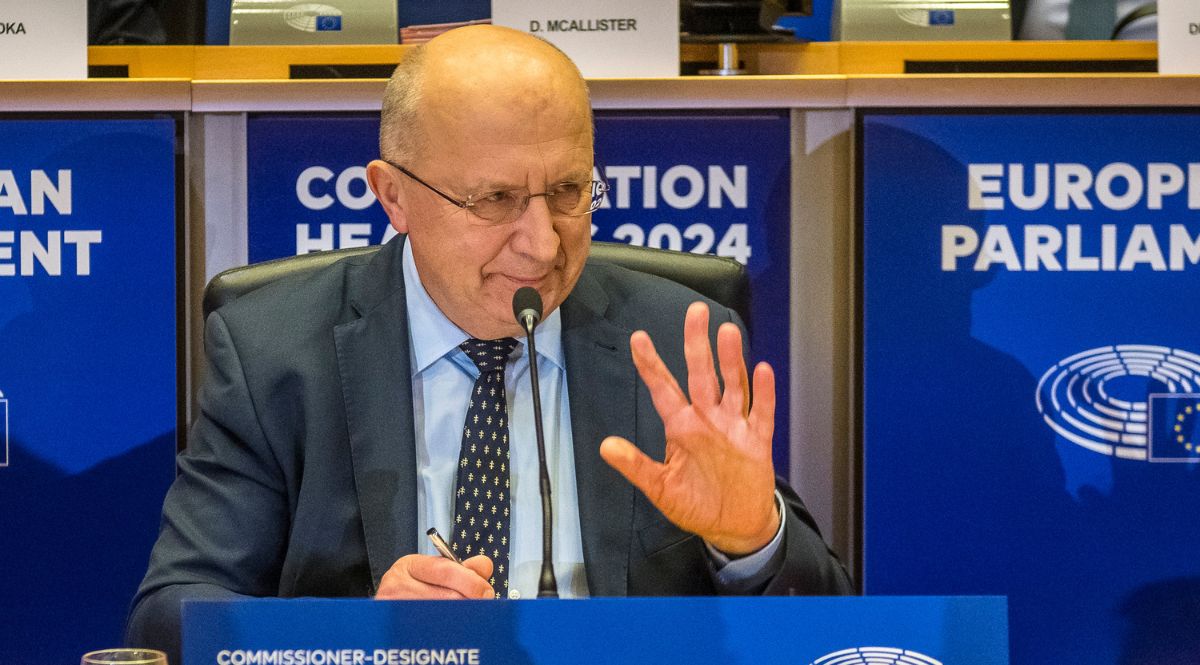
The change in the Commission’s priorities is reflected in the scope and names of the appointed positions: new among them are commissioners for Defence and Space (Lithuanian Andrius Kubilius), Mediterranean Affairs (Croatian Dubravka Šuica), and Energy and Housing (Dane Dan Jørgensen). The creation of these new portfolios is expected to signal the adjustment of the Commission’s priorities and much greater importance attached to the topics they deal with. In particular, the position of defence commissioner is expected to signal a change in the EU’s attitude toward security issues. An important position was given to a Pole, Piotr Serafin, who will be responsible for the budget, public administration, and anti-fraud activities—he will report directly to the president (most commissioners work under the vice-presidents), which indicates the importance of this function in the EC hierarchy.
The substantive scope of the new commissioners’ tasks is not precise, and two or sometimes even three commissioners will be responsible for certain thematic areas. According to critics, this is supposed to make it easier for von der Leyen to govern, while according to the president herself, it is a reflection of the multifaceted reality and a proper response to contemporary challenges.
Conclusions and Outlook
The EC is becoming an increasingly political, rather than merely technocratic, body, whose decision-making centre will be, to an even greater extent than in the previous term, the president. The Commission’s new priorities indicate a shift in thinking about strategic issues in the Union amid unprecedented threats to Europe’s security and doubts about the future shape of transatlantic relations. On the one hand, the EC will focus on defence challenges and competitiveness in an attempt to catch up with China and the U.S. On the other hand, it will place less emphasis on the green transition, the pace and scope of which has raised opposition among the EU public. Attempts to weaken or even withdraw from green regulations enacted in the previous term cannot be ruled out either (this can be seen, for example, in relation to the ban on the sale of cars with combustion engines). For Poland, it is particularly important that defence has been recognised as one of the key priorities of the new EC—as a country directly exposed to aggressive Russian actions, Poland is interested in developing EU competences in this area (especially support for the defence industry and the development of military capabilities), so that NATO’s deterrence and defence potential against Russia is strengthened.
To realise the new EC’s ambitions, it will be necessary to ensure sufficient financing, so the discussion on the shape of the future budget (for 2028-2034) will be crucial to the future of the EU, and here the Polish Commissioner Serafin will be able to play an important role. However, it will not be possible to achieve the set goals without increasing the contributions of the member states to the EU budget or creating new sources of own income, both of which are controversial among the Member States, although it is more likely that agreement will be reached on the latter option. The EPP’s strong support for the ECR-affiliated commissioner also indicates that the Christian Democrats are trying to win the support of conservatives in the EP. This means that the EPP will not hesitate to reach out for support from the right and even the far-right for projects that are controversial with its traditional allies, such as those related to migration. While this may translate into greater efficiency in the implementation of legislation by the new EC, it may come at the expense of trust and cohesion of the ruling informal coalition of Christian Democrats, Socialists, and Liberals.

.jpg)