The US's tougher stance on multilateral formats
The administration of US President Donald Trump will seek to exert greater influence over processes within the UN, whilst reducing its involvement in the activities of several international organisations (IOs) which it considers less important. The reduction in funding for various formats will increase pressure on Poland and like-minded states to increase their contributions towards their maintenance.
 Dado Ruvic / Reuters / Forum
Developments in Recent Months
In its draft budget for 2026, the Trump administration proposed cutting funding for international organisations by up to 83% compared to 2025. Among other things, it proposed cutting spending on UN peacekeeping operations to zero and a radical reduction in funding for most multilateral formats in which the US is involved. However, Congress rejected the change, just as it did during Trump’s first term in 2017, when the president sought similar cuts (but of 44%). Ultimately, it agreed to a reduction of around 10%. However, the US’s arrears to the UN itself stood at around $2.19 billion for the general budget and $2.4 billion for peacekeeping operations at the beginning of February 2026, which was linked, among other things, to the US’s failure to pay its full contribution for 2025 and its failure to meet earlier commitments. Despite the deadline for 2026 payments having passed, the US has so far transferred only $160 million of the $767 million to the UN (whilst the UN budget stands at $3.45 billion). Thus, the organisation’s functioning is hampered for yet another year. In early 2026, UN Secretary-General Antonio Guterres announced that the organisation was facing bankruptcy, and its officials pointed out that 95% of the value of arrears owed to it by member states is owed by the US.
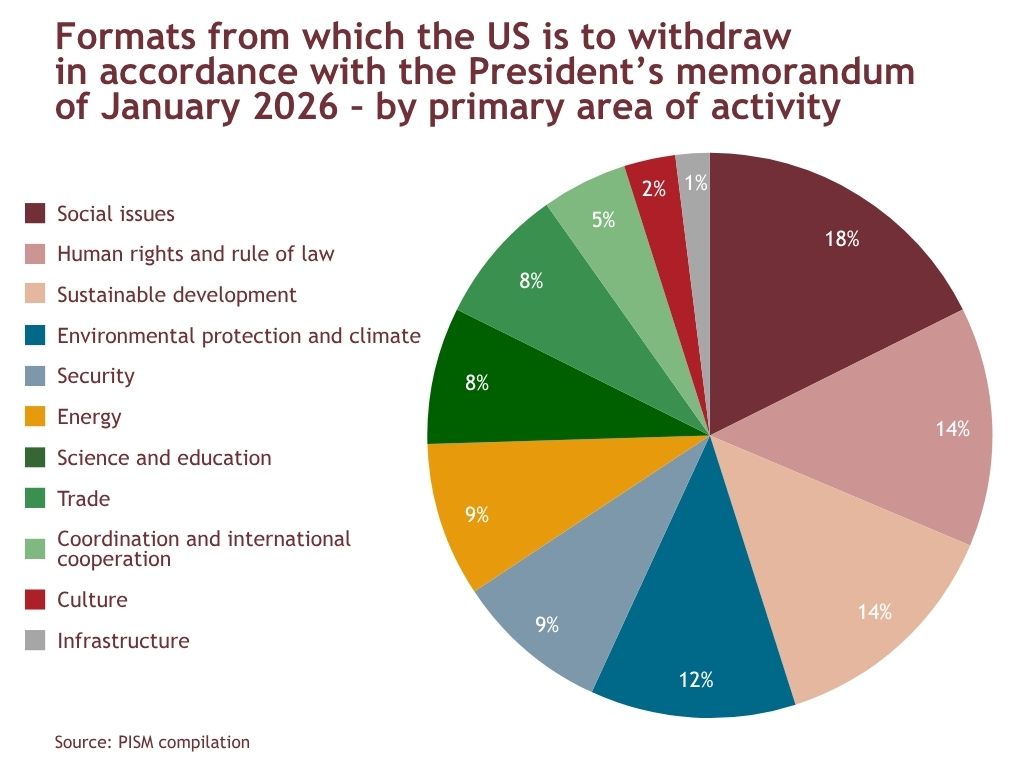
The US administration is also withdrawing from a number of multilateral bodies, in addition to those it had already announced it would leave by 2025, such as the WHO and UNESCO. In January, President Trump announced the US’s withdrawal from 66 organisations, including 31 UN-affiliated bodies, and signalled further similar steps. Key formats being abandoned include institutions dealing with energy and climate issues: the United Nations Framework Convention on Climate Change, the Intergovernmental Panel on Climate Change (IPCC) and the International Renewable Energy Agency (IRENA). Signalling reluctance towards the UN peacekeeping model, international law, and the promotion of the rule of law is, in turn, the withdrawal from, amongst others, the work of the Peacebuilding Commission and Fund, as well as the International Law Commission (ILC) and the Venice Commission. Furthermore, the US is set to leave mainly institutions dealing with sustainable development (such as the United Nations Conference on Trade and Development, UNCTAD), environmental protection (the International Union for Conservation of Nature, IUCN) and social issues (e.g. UN Women, the United Nations Population Fund). Outside those mentioned, the vast majority of these bodies play a negligible role in their respective fields, and from the perspective of budgetary savings, withdrawal from them is understandable.
The Trump Administration’s Policy towards IOs
The measures outlined demonstrate a hardening of the US administration’s stance towards international organisations. Its attitude towards organisations dealing with climate protection and renewable energy stems from the perception that they hinder Trump’s policy of supporting the extraction and export of fossil fuels and promote, as the US president puts it, the “climate hoax.” IOs seeking to liberalise trade, such as the World Trade Organisation (WTO), are unwelcome because they hinder the Trump administration’s ability to pursue its tariff policy. Conversely, organisations dealing with public health, social issues, the rule of law and sustainable development are regarded as wasting money, spreading progressive ideologies and a globalist agenda, or catering excessively to the needs of the Global South. The authorities’ narrative also speaks at length of bureaucracy, poor management, the financial exploitation of the US due to its large share of contributions to the budgets of many UN agencies, as well as the curtailment of the US’s freedom of action and the restriction of its sovereignty. Against this backdrop, criticism of the UN is relatively muted; according to Trump and Rubio, it still has significant but untapped potential. They expect it to make further savings, to focus on preventing and resolving international conflicts, and to limit the scope of its peacekeeping operations to the military sphere (rather than, for example, electoral assistance or the protection of human rights—a point also raised by the US with regard to the OSCE). They also call for supporting the fight against anti-Semitism, though this is understood mainly as limiting criticism of Israel’s actions.
By contrast, the US retained a consistently favourable attitude towards technical organisations, particularly those setting standards for telecommunications (ITU), air traffic (ICAO) and maritime transport (IMO), as well as those dealing with intellectual property (WIPO) and nuclear energy (IAEA). This is evident from the draft budget for 2025, which did not provide for the cuts of funding for these organisations (as one of the few exceptions), and from the statements of the US representative to the UN, Mike Waltz. It appears that the US views them as useful institutions setting standards for communication (ICAO, IMO), enabling influence over hostile states (e.g. on Iran’s nuclear programme through the IAEA), or important for competing with China on issues such as the regulation of space and the internet or the protection of intellectual property (ITU, WIPO). Nor has the US criticised financial organisations such as the International Monetary Fund and the World Bank, in which it effectively holds a veto.
Possible Future Courses of Action
It is to be expected that the Trump administration will continue to intensify its policy of transactionalism and conditionality towards many international organisations. This may involve cutting funding to force them to implement far-reaching reforms in line with its interests, and then either re-engaging with their work or withdrawing from a given framework if there is no prospect of change. US experts sympathetic to the president’s policies point to further international organisations at risk of funding cuts. Within the UN system, these may include bodies dealing with migrants and refugees (IOM, UNHCR), sustainable development and the environment (UNDP, UNIDO, UNEP), labour (ILO), food (FAO, IFAD) and humanitarian aid (WFP). Cuts may also affect other organisations, such as regional ones – in mid-2025, the administration threatened to withdraw from the Organisation of American States and cut funding for some of its programmes. The US will deal with issues such as trade, energy and healthcare outside multilateral frameworks, entering into bilateral agreements with the expectation of political and economic benefits. The paralysis of the WTO will therefore persist. Nor is their pressure likely to cease regarding the dismantling of UNRWA, the UN agency supporting the Palestinians.
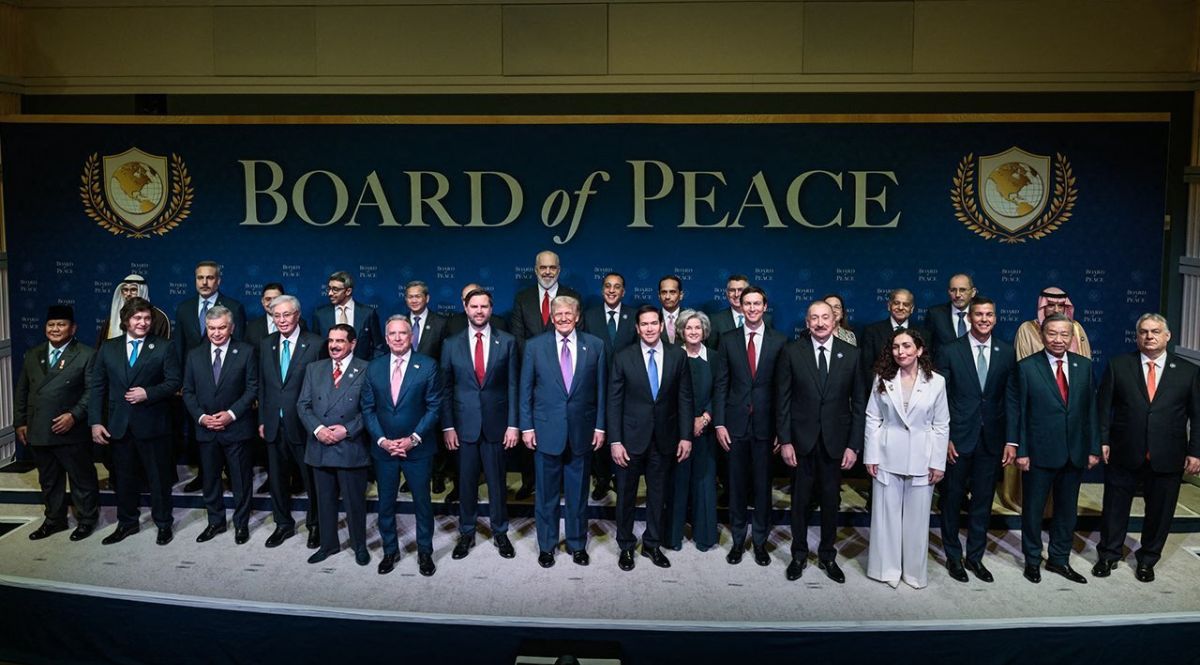
However, even if the pressure fails, the risk of the US leaving the UN is very low. If they do not increase their contributions, they could lose their voting rights in the General Assembly by 2027 (according to the regulations, which allow arrears of no more than two full years). This would be an extraordinary situation for a developed country and a permanent member of the Security Council. However, given that President Trump enjoys appearing at General Assembly sessions attended by heads of state, the US may pay the amount needed to avoid suspension, but so late that the UN will be unable to spend it in 2026 and, in accordance with the applicable regulations, will be forced to return it. Nor can attempts to exert financial pressure on the UN’s activities be ruled out, using the new international organisation established on the initiative of the US, the Peace Council. Trump himself announced that it would “virtually oversee the UN,” and compared with the UN budget, which stands at just under $3.5 billion, the Council has greater financial leeway, as the US alone has pledged to contribute around $10 billion (although at least part of this sum is likely to be used for the reconstruction of the Gaza Strip). At the same time, based on the UN Charter text, the US is not at risk of losing its seat on the Security Council. One should also expect US pressure to ensure the election of a new Secretary-General to their liking in June this year. Among the current candidates, Rafael Grossi of Argentina, head of the IAEA (praised by Trump) and nominated by Trump-sympathising President Javier Milei, stands the best chance of securing their support.
Conclusions
The US’s actions will not lead to a complete collapse of global governance, although in the longer term, it will decline in certain areas, particularly climate protection. They will also significantly hamper the activities of some international organisations, forcing an increase in expenditure to maintain their operations, particularly by developed countries. This is clearly evident in the case of the UN. Given its difficult financial situation, it would be advisable for EU member states, including Poland, to provide unanimous support in the UN General Assembly for changes to the rules governing the accounting of contributions (a two-thirds majority is required), and to urge other states to do the same (so far, despite the Secretary-General’s efforts since 2025, it has not been possible to pass this amendment). This would eliminate the need to return funds unused during a given accounting period to member states (due to their late payment, for example) and would help stabilise the organisation’s budget.
Further cuts by the US to its funding for multilateral organisations are highly likely, particularly given the expected increase in its budget deficit, although Congress will continue to limit the scale of these cuts. To prepare for this situation, it would be desirable for Poland to conduct its own review of multilateral organisations. This would serve to categorise them in terms of their real significance for foreign policy and the pursuit of Poland’s interests, and consequently, to possible increases in support commitments.


.png)