Polish-German intergovernmental consultations: rapprochement of positions without a breakthrough
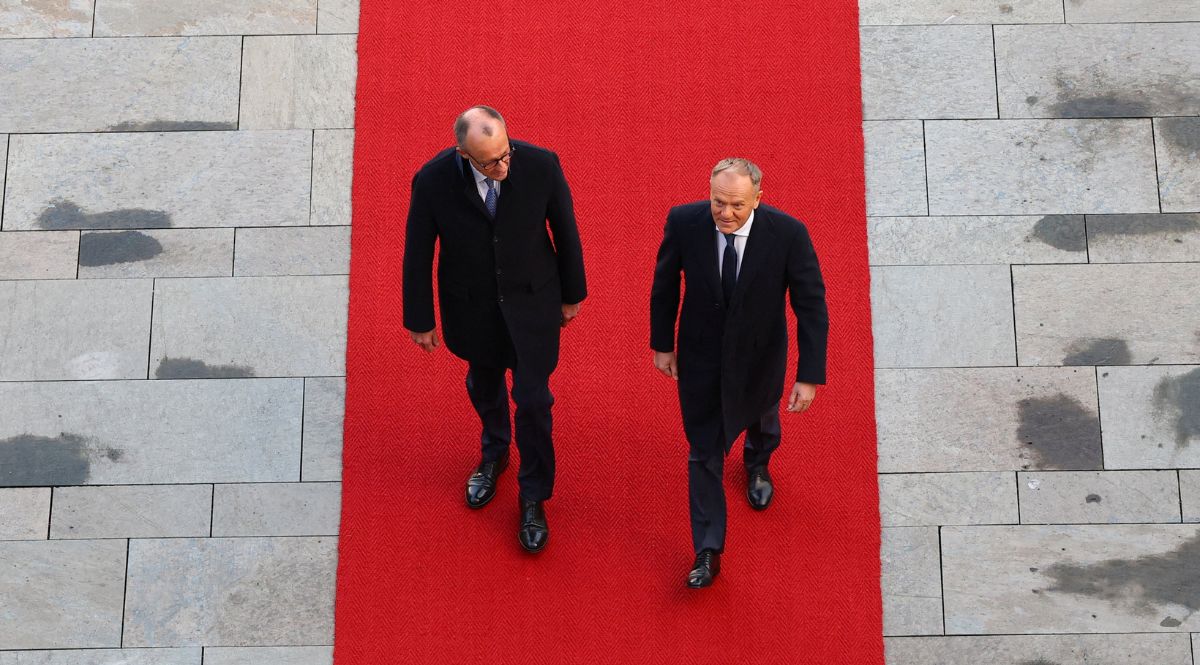
The Polish-German intergovernmental consultations held on December 1 in Berlin focused on cooperation in the areas of security, economy, and infrastructure, as well as commemorating the victims of World War II, including substantive compensation. Cooperation within NATO and the EU will continue to form the basis of mutual relations. In the bilateral sphere, the biggest change is the announcement of the conclusion of a Polish-German defence agreement next year.
 Lisi Niesner / Reuters / Forum
On what legal basis are Polish-German intergovernmental consultations conducted, and what role do they play?
The legal basis for regular consultations, originally at the level of heads of government and foreign ministers, is the Treaty on Good Neighborliness and Friendly Cooperation of June 17, 1991. In 1997, they were expanded to include meetings with representatives of other ministries, in a format analogous to German-French cooperation. In practice, the frequency of consultations depended on the political will of both countries and the state of bilateral relations (e.g., no consultations took place between 2018 and 2024). The consultations provide an opportunity to coordinate positions and develop joint projects, and the final declarations are not binding. For this reason, the Action Plan adopted at last year's consultations, listing more than 40 areas of possible cooperation, has not been implemented. The reasons for this were a lack of will and the political crisis in Germany, which ended with snap elections to the Bundestag and a change of government.
What were the objectives of the governments of both states during this year's consultations?
In the face of US-Ukrainian and US-Russian negotiations to end the war, the Polish prime minister and German chancellor wanted to demonstrate their willingness to continue providing military and diplomatic support to Ukraine. On a bilateral level, given the failure to implement the provisions of last year's consultations, they sought to identify several key areas in which existing cooperation could be quickly deepened, leaving contentious issues for further negotiation. Poland was keen to increase German involvement in the defence of NATO's eastern flank, to make progress on the issue of commemorating the victims of the German occupation of Poland, and to obtain compensation for the living victims of the war. For Germany, economic issues, especially those related to competitiveness, were key. To demonstrate their openness to dialogue on historical issues, even before the consultations, the parties announced measures to return to Poland works of art looted by the Third Reich.
What are the most important arrangements?
The most important arrangements relate to security issues. Germany will continue its involvement in NATO missions such as Baltic Sentry. The German government has also announced investments in road and rail infrastructure on the Polish-German border, including in Frankfurt (Oder), which is important both for economic cooperation and for faster troop movements to NATO's eastern flank, as well as the expansion of the Alliance's pipeline system, which, as before 1989, ends in Germany. In order to combine support for Ukraine with strengthening their own security, Poland and Germany will cooperate on the development of the NATO-Ukraine Analysis, Training and Education Centre in Bydgoszcz. A new element of bilateral cooperation will be the conclusion of a defence agreement in 2026, probably similar to the Polish-French treaty of Nancy. The defence ministries of both countries are also to set up a working group to identify areas where cooperation between, among others, the defence industries of both countries would be particularly beneficial. An important area of coordination will be the economy, in particular, joint action within the EU to promote deregulation and strengthen competitiveness. In the area of remembrance policy, the parties announced the erection of a monument to Polish war victims in Berlin, on the site of the temporary obelisk unveiled on September 1. A new area of cooperation will be the restitution of cultural property looted by the Third Reich, which is currently held by German institutions. To begin with, the return to Poland of over seventy artefacts looted from Warsaw and Malbork has been announced.
What are the perspectives and limitations for further cooperation?
Cooperation in the areas of security and the economy, mainly within the framework of NATO and the EU, remains the cornerstone of Polish-German relations. Some of the projects outlined in the final declaration, such as the expansion of pipelines, are in line with the Alliance's plans. In bilateral relations, the biggest changes may come with the new defence agreement announced for next year, the shape of which will be subject to negotiations. Unlike last year's consultations, the parties did not mention the Weimar Triangle, which indicates the limited role of this format. However, the positive outcome of the consultations does not mean a breakthrough. Existing problems in bilateral relations, such as a lack of understanding of the role of historical memory in Poland and Germany's tendency to neglect Poland in the most important formats, remain unresolved. Despite Chancellor Merz's declaration on the role of relations with Poland, Germany will continue to give priority to cooperation with France and the United Kingdom within the E3 group. Regardless of pressure from the Polish authorities, Germany, based on the erroneous belief that it has completely come to terms with the past, remains unwilling to pay compensation to living victims of the war, which, given the public emotions that this issue arouses in Poland, will undermine mutual relations.