In Run-up to Parliamentary Elections, Moldova is Hovering between European Integration and the Unknown
The parliamentary elections scheduled for 28 September will have a decisive impact on Moldova’s continued efforts to integrate with the European Union. Russia has intensified its influence operations to manipulate the results and remove the pro-EU Party of Action and Solidarity (PAS) from power. Poll results indicate that PAS may lose its majority, which would likely force it into an unstable minority government or a coalition with Eurosceptic or only nominally pro-Western parties.
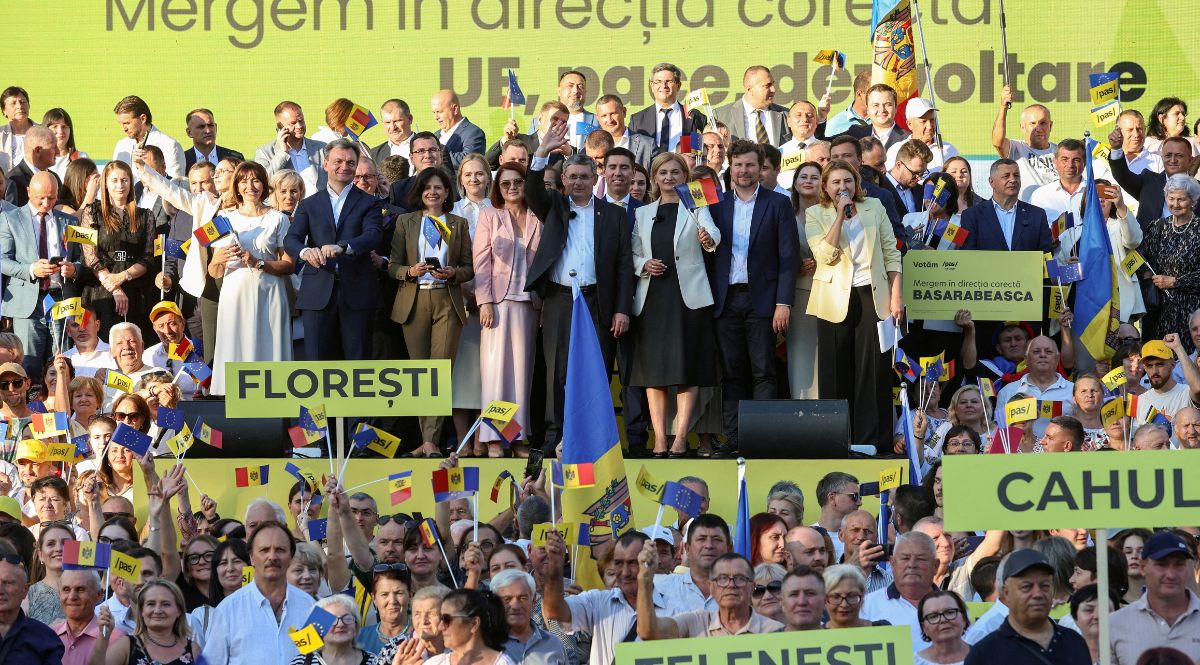 Vladislav Culiomza / Reuters / Forum
During the outgoing term of the unicameral Parliament, President Maia Sandu had a decisive influence on Moldovan politics. Despite the limited prerogatives of her office, she effectively led PAS, which had 63 out of 101 MPs, and the Dorin Recean government. The opposition was the pro-Russian coalition Bloc of Communists and Socialists, with 26 seats, formed by the parties of former presidents Igor Dodon and Vladimir Voronin. Most of the independents are MPs from the former Şor Party, which was banned by the Constitutional Court in 2023 for destabilising the country on Russia’s orders and being illegally financed. Its leader, Ilan Şor, is in hiding in Moscow after being sentenced to 15 years in prison for stealing a billion dollars from Moldovan banks in 2014.
PAS Election Prospects
PAS will probably achieve the highest result in the elections (although about 20-40% of respondents are still unsure of who they will vote for), but this time it may not gain a majority, as, according to polls, it will win 40-50 seats. It has dominated the pro-Western segment of the electorate, which means that no other like-minded party is capable of exceeding the 5% electoral threshold and forming a clearly pro-EU coalition with PAS.
PAS’s main asset in the campaign is the inclusion of Moldova in EU enlargement policy, which led to obtaining candidate status in 2022 and starting accession negotiations in 2024. However, the significance of this success is limited by a society susceptible to Russian propaganda. This is evidenced in a July iMAS poll in which 43% of respondents wanted to join the Eurasian Economic Union (32% were against) and also 43% wanted to join the European Union (41% were against). The poll also found that only 31% predicted EU development, while 9% saw stagnation, and 41% collapse within 5-10 years. Such sentiments are fuelled by the lack of noticeable rapid progress in integration, mainly due to Hungary’s veto of Ukraine’s progress, which is linked to Moldova’s. In order to mobilise the pro-Western segment of society on an ad hoc basis, the EU organised the inaugural EU-Moldova summit in July, and in August, the prime minister of Poland, the president of France, and the Chancellor of Germany paid a joint visit to Chisinău, as well as the president and prime minister of Romania.
PAS is counting on the extraordinary mobilisation in the election of the million-strong diaspora living mainly in the EU and which are not included in the polls. Moldova itself has 2.4 million inhabitants (excluding Transnistria). The diaspora determined the results of the presidential election and referendum in October and November 2024, casting every fifth vote in the 77% for including EU integration in the constitution and the 83% for Sandu’s re-election. That is why her September speech in the European Parliament was actually addressed to the diaspora. A record number of 297 polling stations abroad (231 in the 2024 elections) is expected to encourage the diaspora to vote.
PAS Government’s Achievements
An economic crisis in the country has had a decisive impact on voter sentiment. Although the main causes are Russia’s energy blackmail and the war it unleashed against Ukraine in 2022, it is associated with PAS rule. The party won the 2021 election with its flagship promise to improve living standards. Meanwhile, according to 60% of those surveyed by iMAS, the country is currently “heading in the wrong direction”. Under the PAS government, gas prices have more than quadrupled and electricity prices have almost tripled. In 2022, GDP fell by 5%, in 2023 it grew by only 0.8%, and in 2024 by 0.1%, while the first quarter of 2025 ended down by 1.2%. At the same time, the €1.9 billion Reform and Growth Facility for Moldova announced by the EU in February 2025 and intended to reverse this trend has not yet entered the implementation phase.
In the eyes of voters, PAS has also largely failed to deliver on its second main promise to crack down on the oligarchic and corrupt networks left behind after the 2019 escape of Vlad Plahotniuc, the oligarch who effectively ruled Moldova. Key reforms to the justice system are slow due to the resistance of judges and prosecutors against verification of their integrity. Trust in PAS was also undermined by Sandu’s scandalous personal conflict with the head of the Anti-Corruption Prosecutor’s Office, Veronica Dragalin (to head the office, she resigned from her position as a prosecutor in the U.S.; she has Moldovan and U.S. citizenship), which led to her dismissal. Actions only accelerated in the run-up to the elections. In August, Evghenia Guţul, the Bashkan (governor) of the traditionally pro-Russian autonomous region of Gagauzia, was sentenced in the first instance to seven years in prison for illegally financing the Şor Party and coordinating paid protests. In July, Plahotniuc was arrested in Athens, and his extradition may take place just before the elections.
Pro-Russian Opposition
PAS’s main opponent will be the pro-Russian coalition, Patriotic Bloc, which, according to polls, would win 36-42 seats. It is formed of the Socialists, the Communists, and the Republican Party Heart of Moldova of former Bashkan Irina Vlah and the Party of the Future of Moldova of the former Communists’ Prime Minister Vasile Tarlev. The bloc appeals to pro-Russian sentiments deeply rooted in society and fears of involvement in the war in Ukraine and annexation by Romania. It promises closer ties with the CIS and Russia and cheap gas supplies.
At Russia’s request and backed by €100 million for this purpose, according to the Moldovan authorities, a disinformation network coordinated by Şor intensified its campaign and preparations to manipulate the election results. The Bloc Victorie established by it was not allowed to run as the de facto reincarnation of the banned Şor Party. Therefore, Şor is conducting an intensive campaign in social media in favour of Tarlev and the Greater Moldova Party, which has little chance to enter the Parliament. It also attacks PAS, claiming, for example, that it is planning to rig the diaspora vote, outlaw the majority Moldovan Orthodox Church (Moscow Patriarchate), and that “together with the EU [it will] destroy Moldovan agriculture”. Şor also is misleading voters by promising them an electronic transfer of around €50 for their vote. The effectiveness of its network is evidenced by the bribery of around 130,000 of the 1.7 million voters in 2024.
Potential Unwanted Coalition Partners for PAS
According to polls, Bloc Alternativa would also enter Parliament, winning 9-13 seats. It presents itself as pro-EU social democracy, however it is conservative on social issues and wants good relations with Russia. It declares its readiness to cooperate with PAS on European integration. The bloc was formed around the National Alternative Movement party of the popular mayor of Chișinău Ion Ceban, a former prominent activist of the Socialists and, earlier, the Communists. He was joined by Alexandr Stoianoglo, Sandu’s opponent in the second round of the 2024 elections, Ion Chicu, a former prime minister associated with the Socialists, and Mark Tkachuk, a former Communist ideologue. PAS has rejected a coalition offer, claiming that Alternativa is a creation of Russian services and is designed to break up the pro-Western electorate, evidenced by the ban on Ceban’s entry into the Schengen area issued in July 2025.
Our Party, led by Renato Usatîi, the former mayor of Bălţi, the second-largest city (excluding Tiraspol in Transnistria) will probably win about 10 MPs. An anti-establishment group, it advocates a pragmatic distance from both Russia and the EU. Although Usatîi is particularly courting on the moderately pro-Russian electorate, he remains deeply conflicted with the Socialists and the Communists. He rules out joining any coalition, but promises to cooperate with all parties in an expert government. That is why, like Alternativa, he rejected Patriotic Bloc’s call to sign a pledge to exclude cooperation with PAS after the elections.
Conclusions
Through the Şor disinformation network, Russia can effectively influence the outcome of the elections, including through mass attempted bribery of voters. On election day, they probably will receive coordinated instructions via social media about whom to vote for. At the same time, the network is spreading propaganda and disinformation aimed at reinforcing the electorate’s dissatisfaction with the country’s economic stagnation, rising living costs, and the lack of spectacular results in the fight against corruption. This likely will result in less trust in PAS that may translate into a loss of majority rule after the elections. The political successes in EU integration have had a limited impact on society’s attitude in Moldova itself. However, they may prompt an unprecedented mobilisation of the diaspora, which could once again give PAS the majority.
The election result may prompt PAS to negotiate a coalition agreement, despite declaring it would not. A potential partner could be Alternativa, which is the only group to declare unequivocal support for European integration, although this may be merely for show. A less likely ally would the unpredictable Our Party. A PAS minority government or with these coalition partners would be unstable and ineffective, which would slow reforms bringing Moldova closer to EU membership. This process could be completely blocked in the event of a pro-Russian coalition around Patriotic Bloc—without the participation of PAS—although it is unlikely due to the conflicts between the party leaders. From the point of view of Poland and its EU partners most actively supporting pro-EU changes in Moldova, this result would be an extremely unfavourable situation.


.png)
(1).png)