
China reacts to new dynamics in US foreign policy
The Chinese authorities view recent US actions, including those towards Venezuela, Russian tankers, and Greenland, as confirmation of a unilateral and Western Hemisphere-oriented US foreign policy. This does not change China’s goals, but it does complicate its policy towards the United States. In the short term, China will intensify its criticism of US actions as contributing to global destabilisation. Ultimately, however, it will try to persuade Donald Trump’s administration to intensify talks on the future of Taiwan.
 Evelyn Hockstein / Reuters / Forum
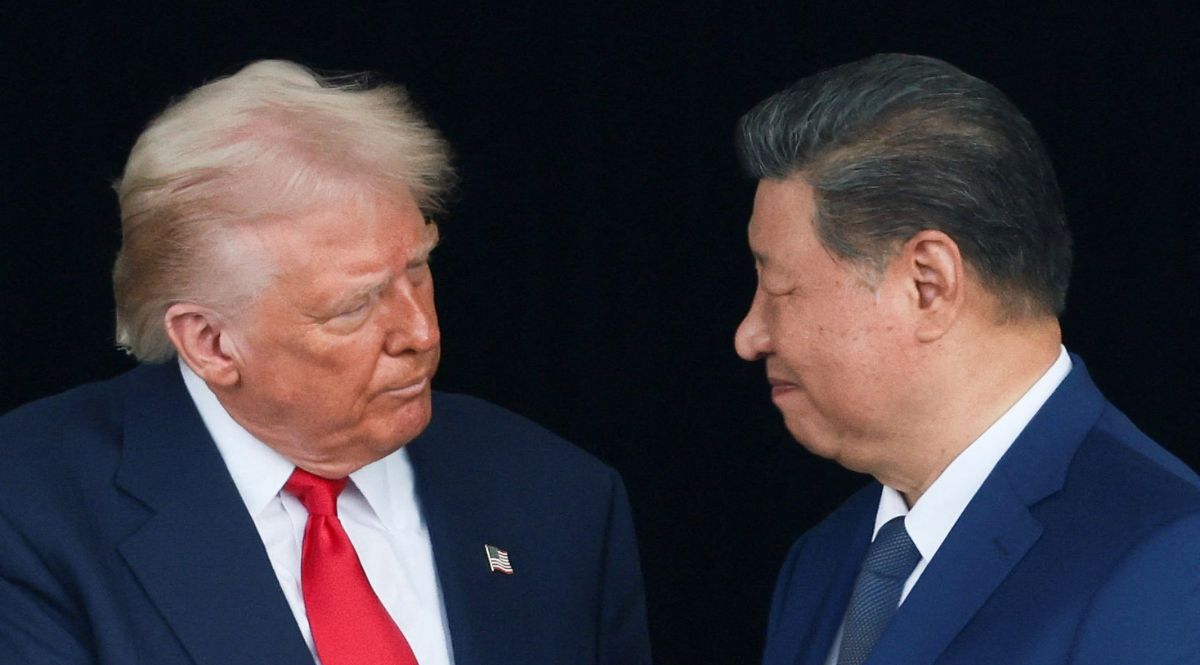
Since Trump’s second term began in January 2025, the Chinese authorities have adapted to the US’s radical actions and the president’s transactional approach, especially in trade policy. At the same time, China has signalled its willingness to reach a trade agreement with the US and engage in leadership interactions, which was intended to be a response to the US president’s political style. As a result of the meeting between President Xi Jinping and Trump in South Korea in October 2025, China managed to ease economic disputes and establish a framework for political contacts, including the announcement of a visit by the US president to China in April this year. The Chinese authorities have become convinced that a firm stance towards the Trump administration is effective and that the president’s transactional approach creates an opportunity for progress on issues such as the status of Taiwan.
Chinese assessments of the US’s actions
The radicalisation of the US’s foreign policy, symbolised by the kidnapping of Nicolas Maduro, the seizure of Russian shadow fleet tankers, and declarations of the desire to take over Greenland, did not surprise China, especially after the Trump administration published its National Security Strategy (NSS) in December 2025 and the National Defense Strategy (NDS) in January this year. Some experts from China pointed directly to the positive implications of the NSS for China, especially with regard to the US’s increased defence funding requirements for its allies and partners in the Indo-Pacific, mainly Japan and South Korea. For China, this was an indication that the level of US involvement is uncertain and dependent on certain conditions being met.
The Trump administration’s actions at the beginning of this year were perceived as a challenge, but also an opportunity for China’s policy towards the US. China’s response was twofold. First, it attempted to secure its interests in Venezuela and Panama, among other places. It established a special group composed of representatives of state institutions. Among other things, this group is tasked with assessing the vulnerability of Chinese banks to Venezuela’s failure to repay loans related to oil transactions. Although US Energy Secretary Chris Wright confirmed the possibility of further purchases of Venezuelan oil by Chinese companies, these will be unattractive to China without the discounts previously granted by the Maduro regime. China will also raise the issue of two ports in Panama in its relations with the US ahead of Trump’s visit in April. The concessions for their use belonged to a Chinese entity, but in January this year, their granting was deemed unconstitutional by a court in Panama, most likely also under pressure from the US. Usage was temporarily transferred to other companies, with new concessions to be awarded within 18 months. China hopes that, in agreement with the US, Panama will reconsider, granting the concession to the Chinese entity or at least compensating it for the losses. China also opposes US pressure on the Peruvian government to take control of the port of Chancay, in which the Chinese company COSCO holds a majority stake, contrary to the ruling of the Peruvian court.
The second area of China’s activity is to strengthen criticism of the US on the international stage. Although this narrative has been present in China’s foreign policy for a long time, its current nature stems mainly from the scale of tensions in transatlantic cooperation. This gives China an additional opportunity to present itself to the global public as a country that is stabilising international relations. This is important, among other things, in the context of jointly emphasising with Russia the negative impact of NATO on European security. The spokesperson for the Chinese Ministry of Foreign Affairs has repeatedly spoken about respect for the sovereignty of states, both in the context of Venezuela and Greenland. During this year’s World Economic Forum in Davos, Chinese Vice Premier He Lifeng emphasised that the world cannot accept the “law of the jungle” and “the imposition of the will of the strong on the weak.” The same message was presented by Foreign Minister Wang Yi at the Munich Security Conference in February. It is addressed both to the countries of the Global South and to middle powers, including the EU and NATO countries. This was reflected, among other things, during the January visits to China by the prime ministers of Canada and the United Kingdom. Each of them emphasised their readiness to develop cooperation with China, and the Canadian leader additionally repeated China’s rhetoric regarding the international situation. China also declared its intention to purchase over 100 aircraft from the Franco-German Airbus group and to allow Irish beef onto its market this year (from December 2025, this also applies to Spanish pork).
However, China is trying to balance its critical assessment of US actions. The tone of the first statement by the Chinese Foreign Ministry after the attacks in Venezuela, which mentioned “deep shock and strong condemnation,” was softened in the next one, a day later, which spoke of “serious concern.” During a conference in Munich after meeting with US Secretary of State Marco Rubio, Minister Wang emphasised the “bright future of relations with the US.” The Chinese authorities are continuing talks with the US on a trade agreement and have not reacted negatively to Trump’s announcement of tariffs on countries supporting Iran, one of China’s close partners. Nor have they directly rejected the invitation to join the Peace Council, although the spokesperson for the Chinese Foreign Ministry emphasised China’s commitment to the UN.
The Taiwan context
China’s response to US actions is also linked to its policy in the Taiwan Strait. The US actions towards Venezuela or Greenland have not changed China’s perspective on Taiwan, which is of key importance to Chinese interests, but they do influence the perception of potential US involvement in the defence of the island. China has therefore reacted sharply (e.g., after the US agreed to sell weapons to Taiwan in December last year) by organising military exercises and demonstrating its ability to control the Taiwan Strait. China interprets the NSS and NDS, as well as US communications with Japan and South Korea in the context of their defence obligations, as a lack of determination on the part of the Trump administration to defend the island and an attempt to alter the US’s approach to its allies and partners in the region. The US position, which undermines Greenland’s status as an autonomous territory of Denmark, may be used by Chinese authorities in talks with the US on Taiwan. Xi raised this issue during a telephone conversation with Trump in November last year, and again in February this year, when he even signalled the possibility of cancelling the US president’s visit to China if the US continued to supply weapons to Taiwan. Later, Trump confirmed that he wanted to reach an agreement with Xi on this issue. During a conference in Munich, US Under Secretary of Defense Elbridge Colby also spoke about a more realistic, i.e., restrained, US policy for supporting Taiwan. These actions are in line with the practices of the Chinese Ministry of Foreign Affairs, which, in its contacts with EU countries, challenges the legality of Taiwanese visits to the EU. It rejects any understanding of Taiwan’s status other than the PRC’s position, falsely pointing to UN Security Council Resolution 2758 (which recognized People’s Republic of China as the legitimate representative of China in the UN) as determining the status of the island, and presenting the “one China principle” as binding, as opposed to the “one China policy.”
Conclusions and prospects
Both the scale of the US’s action and Trump’s de facto disregard for international law require the Chinese authorities to adjust their policy in the context of competition with the United States. The unpredictability of the US administration, and above all, its readiness to take sudden action in the interests of Trump and his political circle, makes China fearful of the use of force against its partners, such as Iran and Cuba. Therefore, in preparation for Trump’s visit, China will reinforce the message of cooperation between the two countries in their own interests in various regions. In this way, it is attempting to neutralise the danger arising from the US assessment of the international situation, in which the US “reserves” the right to intervene both in the Western Hemisphere and in other regions, including the Indo-Pacific.
The dynamics of US-China relations also mean that the EU is becoming less and less influential in Chinese politics. In the Chinese view, the political significance of the European Union is declining, and its demands that China limit its support for Russia, and in the areas of competitiveness and industrial policy, are proof of the EU’s weakness. Representatives of the PRC have also presented this argument in direct contacts with the leaders of member states. The Chinese also suggest that the EU should prepare to resume talks with Russia, and they make such suggestions in conversations with European politicians. The Chinese authorities will therefore welcome any anti-American statements made by EU politicians, but will not come up with any constructive proposals in response to the EU’s demands, including in the economic sphere. For the EU and Poland, this means the need for more decisive use of economic and security policy instruments towards China, both within the European Union and, in the absence of consensus among member states, through a “coalition of the willing.”



.jpg)