Ukraine's Foreign Policy Strategy
The president of Ukraine, Volodymyr Zelensky, approved in August this year the first Foreign Policy Strategy in the country’s history. According to the document, Ukraine’s main goal is membership in the EU and NATO and an end to the conflict with Russia. Like in the National Security Strategy, Ukraine included Poland in the second group of strategic partners. Cooperation with Poland is to be deepened and developed, not only bilaterally but also as part of multilateral formats in the region.
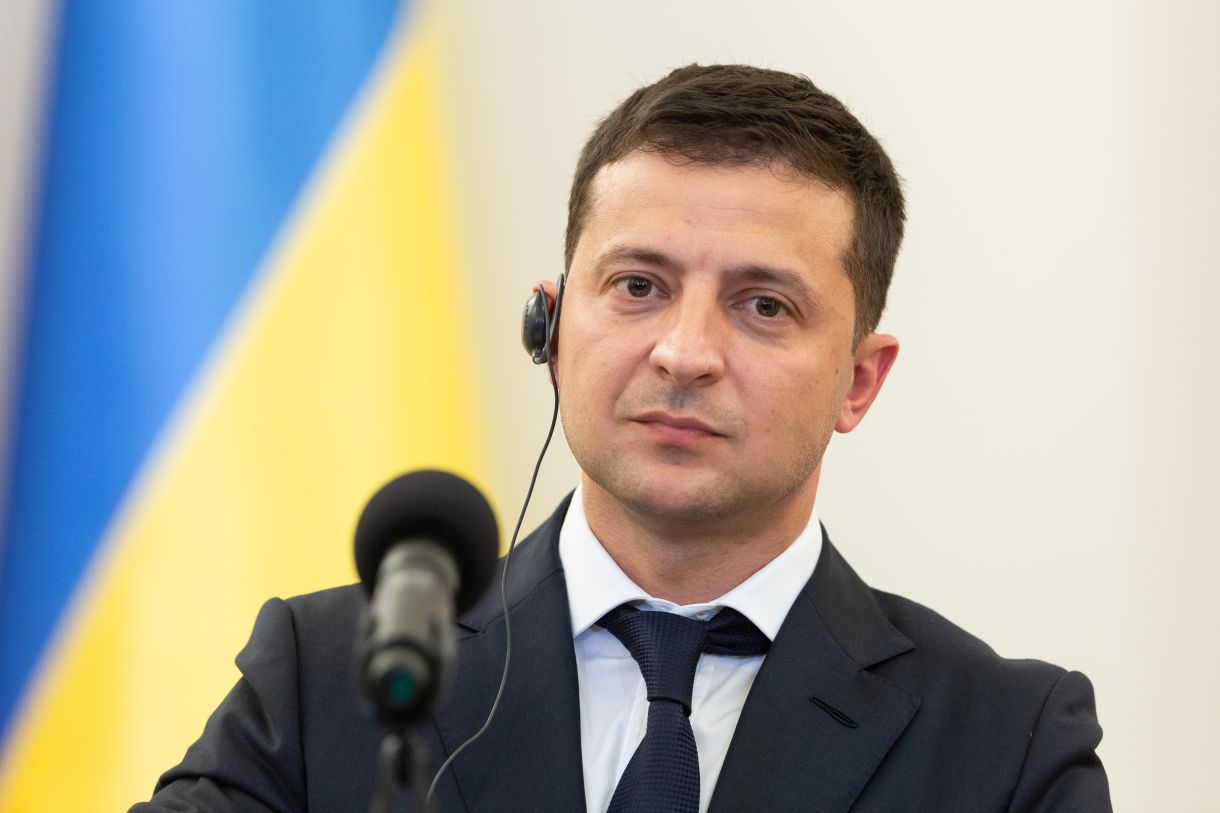 Fot. Mateusz Wlodarczyk/Forum
Ukraine’s Foreign Policy Strategy (FPS) covers three main areas: activity in international politics, building security architecture, and economic diplomacy. It repeats the main assumptions of the National Security Strategy (NSS) approved in September 2020, supplementing and expanding its provisions in the area of foreign policy and international cooperation. The FPS is the first document of its kind in the history of Ukraine. Experts and scientists also from non-governmental circles participated in its preparation.
Aims and Objectives of the Strategy
Ukraine’s foreign policy aims are to ensure state sovereignty and restore territorial integrity. The FPS describes Russia as a country destabilising Ukraine, striving to limit reform and economic growth, attempting to block integration with the EU and NATO, and having a destructive impact on international security. To counter Russia’s policies, Ukraine intends to pursue the issue of Russian aggression in international forums and to seek the continuation of sanctions imposed on Russia. In order to restore territorial integrity and stabilise the security situation in the region, the FPS envisages both the use of existing formats (including the Normandy Format) and the development of new instruments, especially within the framework of multilateral cooperation (including the OSCE, the Lublin Triangle, the Visegrad Group, and the Crimean Platform). The document assumes that the conditions for Ukraine’s “peaceful coexistence” with Russia are an end to the Russian military action against Ukraine and cessation of interference in its internal affairs, restoration of the integrity of Ukraine’s borders, and compensation for losses suffered as a result of the Russian aggression.
An equally important objective of Ukraine’s foreign policy is further European and Euro-Atlantic integration, up to accession to the EU and NATO. The EU has been identified as a key partner both in increasing stability in Europe and strengthening international political and economic pressure on Russia, as well as in implementing internal reforms in Ukraine. The authors of the document are aware of the slowdown in the EU enlargement process and, consequently, of the decreasing chances of achieving the Ukrainian membership aspirations in the short and medium terms. Therefore, Ukraine’s policy is to focus mainly on utilising the potential of the Association Agreement. Similarly, the FPS refers to NATO membership. Ukraine’s policy objective is to use the existing opportunities for cooperation with NATO and to achieve compliance with the membership criteria by the time of accession, for example, through reforms in the security and defence sectors. Ukraine intends to seek an increase in the presence of NATO in the Black Sea region and to intensify cooperation with the Alliance in the fight against hybrid threats.
The strategy also focuses on bilateral cooperation. Like the NSS, the FPS identifies priority strategic partners (the United States, the United Kingdom, Canada, Germany, and France) that are key from the point of view of Ukraine’s security policy. The FPS also extends the list of (regular) strategic partners, including Poland, Turkey, Azerbaijan, Georgia, and Lithuania, as well as China and Brazil. It also assumes the establishment of a strategic partnership with Romania and Moldova. In addition, the FPS mentions India as an “important partner” and defines Japan as a “global partner”.
A separate section is devoted to economic diplomacy. The main goal is to promote and support international investment and foreign trade. This is to be done primarily by creating an appropriate legal framework, including the signing of free trade agreements with third countries. The priority directions of foreign trade supported by the state are Asia, the Middle East, Africa, and Latin America. At the same time, the document emphasises the importance of the policy of protecting the domestic market.
Poland’s Place in Ukraine’s Foreign Policy Strategy
Poland is listed first among the second-level strategic partners. The document identifies it as a state (together with Lithuania) that has a common history and culture with Ukraine and an identical assessment of the current security realities. It was emphasised that Polish-Ukrainian relations need dialogue on historical memory to overcome existing stereotypes and minimise the impact on bilateral cooperation of the tragic pages of shared history. Attention was also paid to the existence of a significant group of the Ukrainian national minority and economic migrants in Poland, which the document assumes require increased care for the protection of their rights and interests.
According to the FPS, Ukraine is interested in deepening the existing cooperation with Poland. This is to be done on the basis of “new large-scale projects” in the fields of security, energy, military, trade, and economy. The document indicates specific projects concerning border infrastructure (reconstruction of existing border crossings and opening new ones, joint border and customs controls). The importance of multilateral formats, including the Lublin Triangle, and potentially a new trilateral format, Poland-Romania-Ukraine, was also highlighted.
Conclusions
The Ukrainian FPS is a subordinate document to the NSS and their assumptions differ in certain aspects. The more diversified bilateral cooperation policy contained in the FPS goes far beyond the assumptions of the NSS. Some of the changes, such as the inclusion in the FPS of the intention of a strategic partnership with Romania, may have been the result of criticism of the NSS by experts and media. On the other hand, China’s presence in the FPS and high position contradict the statement contained in the very same document that bilateral cooperation should be based on democratic values, the rule of law, and respect for human rights.
Bilateral relations are based in the document on various types of partnerships (priority, strategic, global, etc.), which do not, however, have a common base. For some countries, partnership means regional or security cooperation (e.g., Poland, Turkey, or Lithuania), while for others it means solely economic cooperation (e.g., Azerbaijan, China). The multiple interpretations of “partnership” in the document indicate a lack of a clear foreign policy vision and may be a challenge in conducting it, especially with regard to China, Azerbaijan, or Brazil, which do not support Ukraine on the international forum in the face of Russian aggression. It also sends an unclear political signal, especially in view of the attempt to pursue a partnership policy with both the U.S. and China. Nevertheless, the extension of the list of countries with which Ukraine is to have closer relations indicates a diversification of foreign policy, primarily in its economic dimension.
The document contains a wide range of measures aimed at counteracting Russia’s aggressive policy. The main forums for coordinating efforts to restore territorial integrity are to be the Normandy Format and the Crimean Platform. The latter is mentioned several times in the FPS and is intended to be a way to attract political support. Despite Russia restricting the operation of the OSCE mission in Ukraine, the FPS emphasises the role of this organisation as a tool for the peaceful resolution of conflicts in the region and a platform for peace dialogue, so it can be concluded that Ukraine will not resign from talks within the Trilateral Contact Group, in which OSCE representatives sit alongside Russians and Ukrainians.
Poland is not perceived as an important partner from the point of view of security policy, but it is important in Ukrainian regional policy. Its high position among strategic partners and the mentioning of a number of potential areas of cooperation prove that Ukraine is interested in maintaining intensive bilateral contacts. The development of multilateral cooperation with the participation of Poland will be an important element of Ukrainian policy. Moreover, the country may increase its involvement with Ukrainians living and working in Poland, especially since cooperation with the diaspora and migrants is to be the aim of a special state programme, according to the FPS. Poland can expand these programmes with its own integration projects in order to use the potential of the Ukrainian migrants in creating a positive image of Poland in Ukrainian society.