Ukraine's campaign of long-range strikes against targets in Russia
Since May of this year, Ukrainian forces have been carrying out large-scale strikes against targets in selected sectors of the Russian economy, particularly the energy, logistics, and defence sectors. The attacks aim to limit Russia’s ability to supply its troops and expand its military capabilities. They are also intended to influence Russian public opinion ahead of the State Duma elections scheduled for September 20 of this year. Ukraine is attempting to trigger a socio-economic crisis in Russia and shift its cost-benefit analysis of continuing the war.
 Stringer / Reuters / Forum
A stalemate persists on the front lines. The fortified positions held by both sides, combined with the battlefield saturation of drones creating a “death zone” (extending up to 25 km from the front line), make it difficult to wage a war of manoeuvre. Any attempt by either side to expand the territory under its control results in heavy losses of personnel and equipment. With greater human, military, and economic resources at its disposal, Russia is attempting to win by waging a war of attrition. To this end, it has mobilised its economy and, in 2025, allocated 7.5% of GDP to military purposes (according to SWP calculations, this figure reached 12% of GDP in the first quarter of this year). Although this will have a negative long-term impact on the Russian economy, in the short term it allows the country to maintain the intensity of hostilities. Ukraine, in turn, is using offensive operations and external support to delay these operations. Faced with growing asymmetry in military capabilities, Ukraine is shifting hostilities onto Russian territory, which translates into increased social and economic costs of the invasion on the Russian side.
Methods and means
Since 2024, Ukraine has gradually increased its capabilities to conduct long-range attacks through the development of its domestic defence industry (particularly the company Fire Point and the Ukroboronprom conglomerate), as well as cooperation with Western countries (including Denmark, the Netherlands, Germany, and the United Kingdom). Although in June 2025 the Security Service of Ukraine carried out a spectacular special operation, codenamed “Spider’s Web,” using FPV drones against Russia’s strategic air force, the campaign that has been ongoing since May of this year is significantly broader in scope and scale. Ukraine now produces kamikaze/loitering munition drones (including the FP-1, FP-2, An-196 Liutyj, Sichen, Ruta, and Hornet) and cruise missiles (including the FP-5 Flamingo, FP-7, FP-9, and Neptun). Many of the munitions in use combine the characteristics of drones and cruise missiles (e.g., Palanycia, Peklo, and Bars). Their high effectiveness is ensured by increased range and speed while maintaining lower production costs. Ukraine previously used missiles supplied by the US, the United Kingdom, and France (ATACMS, Storm Shadow/SCALP); however, these countries imposed severe restrictions on their use against targets located on Russian territory (partially lifted toward the end of President Joe Biden’s term). Due to high production costs and limited availability, this type of weaponry is used only against targets of high strategic value. Thanks to the development of its own production capabilities, Ukraine now enjoys greater autonomy; however, technology transfer for the manufacture of cruise missiles continues to play a significant role, as does Western intelligence support, which facilitates the identification of gaps in Russia’s air defence system.
Long-range attacks are planned and carried out by the Unmanned Systems Forces of the Armed Forces of Ukraine, which have been commanded since June 2025 by Maj. Robert Browdi “Madziar.” Previously, he commanded “Madziar’s Birds,” formed in May 2022 as a reconnaissance unit and later transformed into a reconnaissance-and-strike formation deployed on key sections of the front (including Bakhmut, Kherson, Kharkiv, and Pokrovsk). Each attack involves approximately 20–30 drones, accompanied by decoy drones designed to confuse and exhaust Russian air defences. Cruise missiles are additionally used for strikes on strategic targets.
Targets and effects of Ukrainian attacks
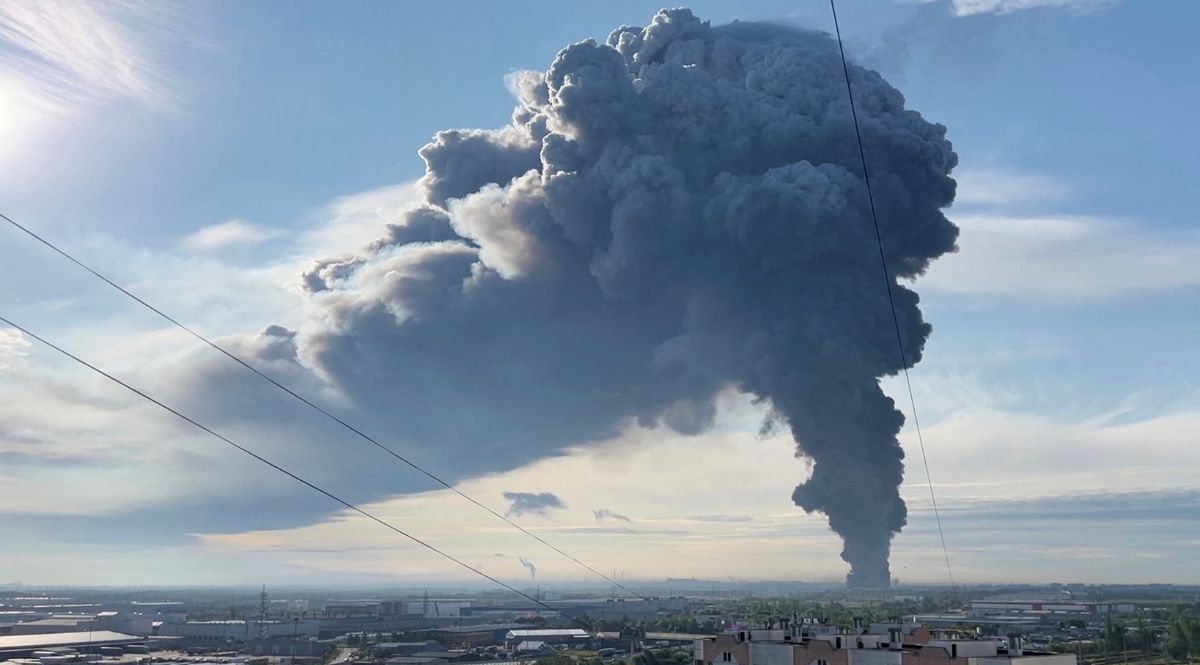
As part of the ongoing campaign, Ukraine is attacking a variety of targets, including energy infrastructure (refineries and fuel depots), strictly military targets (ships, aircraft, air defence systems, radars, and electronic warfare systems), the defence industry, dual-use facilities (seaports and airports), and logistics centres (including the e-commerce company Wildberries, suspected of involvement in sanctions evasion, which suffered an estimated $2–4 billion of damages). Strikes on targets located in occupied Crimea have led to restricted access to electricity, fuel, water, and communications. As a result of the attacks, Russia has also lost its freedom of navigation through the Sea of Azov and was forced to redeploy air defence assets from other parts of the country (including the Kola Peninsula) to protect Moscow and St. Petersburg. This demonstrates the difficulties of defending a vast territory and airspace beyond the immediate area of operations in Ukraine and the major cities.
Attacks on the energy sector, ports, and “shadow fleet” ships were primarily intended to reduce Russia’s revenue from oil trade, which accounted for approximately 17% of the budget (a 10-percentage-point decrease compared to 2022). These revenues gained significance as prices on global markets rose due to the blockade of the Strait of Hormuz. Strikes on refineries led to the shutdown of over 30% of Russia’s production capacity, triggering a fuel crisis in Russia (temporary fuel rationing was introduced in nearly 60 regions). A public opinion poll conducted this August by the FOM Foundation indicates that Russians’ sentiment regarding their financial situation has plummeted, with 28% of respondents believing that their economic situation has worsened over the past 2–3 months. Pessimism regarding an improvement in the situation over the next year has also increased (only 19% expect an improvement).
Russia’s response
In response to the Ukrainian campaign, Russia has increased the frequency and scale of massive airstrikes on civilian and military targets in Ukraine, using drones, ballistic missiles, and glide bombs. Attacks on civilian infrastructure are intended to cause as many casualties as possible, intimidating the public, depleting Ukraine’s stockpiles of missiles for air defence systems, paralysing maritime transport, and destroying energy infrastructure—the effects of which will be particularly severe during the winter. In this way, Russia is attempting to break the public’s resistance and force decision-makers to accept its demands. It is also issuing threats of retaliation against NATO countries cooperating with Ukraine in the production of drones and cruise missiles (e.g., the United Kingdom), which may take the form of sabotage and military provocations. This past summer, a series of incidents occurred in Europe, including an attempted attack on a Ukrainian An-124 transport aircraft in Leipzig, surveillance of a Patriot system maintenance centre at the Bundeswehr base in Mechernich, arson attacks on defence plants in Bulgaria, Italy, Estonia, and Poland, as well as a foiled attack on a drone manufacturer in Slovakia. The number of airspace violations over Romania by Russian drones has also increased, and a Russian Kh-101 cruise missile fell on Polish territory.
Conclusions and Outlook
Despite the increased cost of the invasion for Russia resulting from the shift of hostilities onto its own territory, the authorities in Moscow will most likely not be inclined to accept Ukraine’s proposal for a ceasefire. This means a continuation of massive attacks using ballistic missiles to terrorise the Ukrainian population. Hoping to achieve their maximalist goals—such as intensifying the fighting in the Donbas or opening a new front—the Russians may also announce a military mobilisation.
NATO countries will also be targeted by escalatory hybrid operations, as Russia attempts to force them to pressure the Ukrainian authorities to cease long-range strikes. These actions are already visible in intensified subversion and sabotage attacks on arms manufacturing facilities. Military provocations cannot be ruled out, such as “false flag” airstrikes for which Ukraine would be blamed, or a limited Russian military operation against the Baltic states or Poland.
Deliveries of PAC-3 missiles for the Patriot systems—whose stockpiles are limited, in part, due to their use in the Gulf War—will be crucial to sustaining Ukraine’s defence against Russian air attacks in the coming months. The priority for NATO and EU countries should therefore be to expand production capacity in this area as quickly as possible. From a military perspective, Ukraine’s long-range strikes expose shortcomings of Russia's air defence provision across its vast territory—a weakness that Russia is currently unable to address. To continue Ukraine’s long-range strikes, it will be essential to maintain financial support, technology transfer, intelligence sharing, and drone production—which is already partly taking place on the territory of NATO countries.