TSI Vilnius Summit Focuses on Regional Security
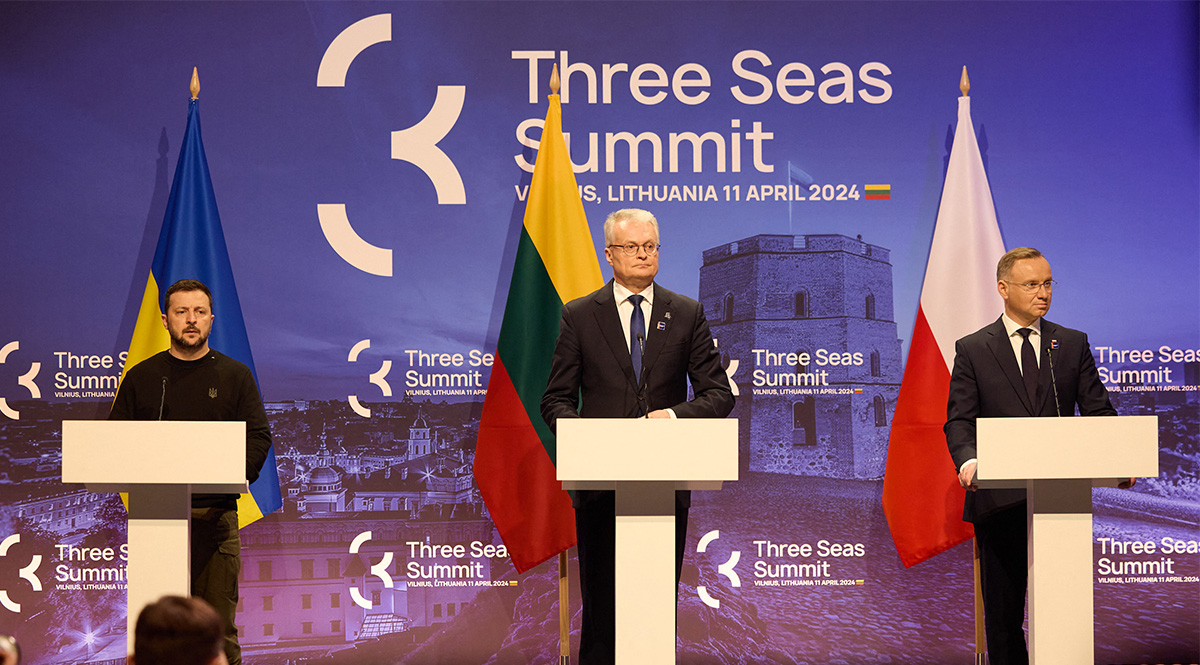
On 11 April, the ninth summit of the Three Seas Initiative (TSI) was held in Vilnius. Wartime circumstances determined the contents of the final declaration, more strongly orienting the Initiative’s future activities towards improving the region’s security. This approach is expected to foster the transatlantic partnership and mobilise the EU to maintain an active Eastern policy and reconstruction efforts in Ukraine. While the main goal of the Initiative is to strengthen regional cooperation, it is increasingly opening up to external partners, for example, Japan has joined the ranks of TSI strategic partners.
 ABACA / Abaca Press / Forum
Under what circumstances was the 9th TSI Summit held?
The atmosphere of the summit was mainly influenced by the situation in the region, including the ongoing hostilities in Ukraine. Lithuania emphasised the growing threat from Russia to effectively mobilise Central European countries, but also the EU, to strengthen Eastern policy and develop the Eastern Partnership, among others. TSI participants stressed the need to isolate Russia internationally and use frozen Russian assets for the benefit of Ukraine. In addition, they welcomed Germany’s continued interest in the initiative and the presence of U.S. representatives and TSI’s new strategic partner Japan. The challenge this year is the elections to the European Parliament, which will make it all the more important for Initiative countries to anchor the undertaking within the EU policy framework, which will not be easy if only because of the divergent interests of individual countries. This could prove especially important should the elections this fall in the United States lead to a reduction in its involvement in Europe.
What are the Vilnius Summit declaration’s main findings?
Influenced by Lithuania, the resolutions of the Summit Declaration were framed as part of strengthening the security and resilience of the region and its countries in the face of the growing threat from Russia and Belarus. It presented, among other things, the continuation of logistics projects, in particular transportation links such as Rail Baltica and Via Baltica and Via Carpatia, which are important for Lithuania and the other Baltic States. In addition, the TSI countries again expressed support for EU enlargement, not only to include Ukraine but also, for example, the Western Balkans. They once again emphasised the role of the U.S. as a strategic partner and guarantor of security in Central Europe, with special support for the countries of NATO’s Eastern Flank. At the same time, TSI expanded cooperation with countries outside the region, with Japan becoming a strategic partner—important in terms of maintaining supply chains and relations with the Indo-Pacific region.
Strengthening cooperation and the implementation of strategic projects is also to be served by the creation of another package within the framework of the Trilateral Fund (a targeted investment vehicle) intended to foster cooperation within the framework of public-private partnerships. At the same time, within the framework of the envisaged investment activities, the priority is on an effective energy transition using green technologies.
What vision for TSI did Lithuania offer?
Lithuania subordinated the summit programme to its own foreign policy priorities. This primarily concerns strengthening the partnership with the U.S. and adhering to its role as the guarantor of security in the region. This involves further reducing relations with China in favour of other Asian partners. Isolating Russia internationally is key, supported by the EU’s tightening sanctions policy and focus on strengthening energy independence, as is increasing Lithuania’s resilience to growing threats, such as in the areas of cybersecurity and critical infrastructure protection. At the same time, Lithuania defined the TSI individual assumptions and projects strictly from a security perspective, including infrastructure, which is recognised as a component of defence. In turn, support for innovation in the field of green technology was important because of Lithuania’s desire to create and expand an attractive investment environment for this sector.
As a group, TSI countries emphasised the role of Ukraine’s energy sector as an element in strengthening security in the region, and given the regional circumstances, it has the potential to become a key partner in its reconstruction. Similarly, the transportation sector and the need to rebuild logistics infrastructure show promise. However, great challenges remain, including wartime insurance guarantees and the still high investment risk, something that Ukraine’s foreign partners were already grappling with before the Russian aggression.
The search for answers to these problems shifts now to Poland, which will hold the presidency of the EU Council in 2025 and host the next TSI summit in Warsaw.