Three Seas Summit Returns to Bucharest
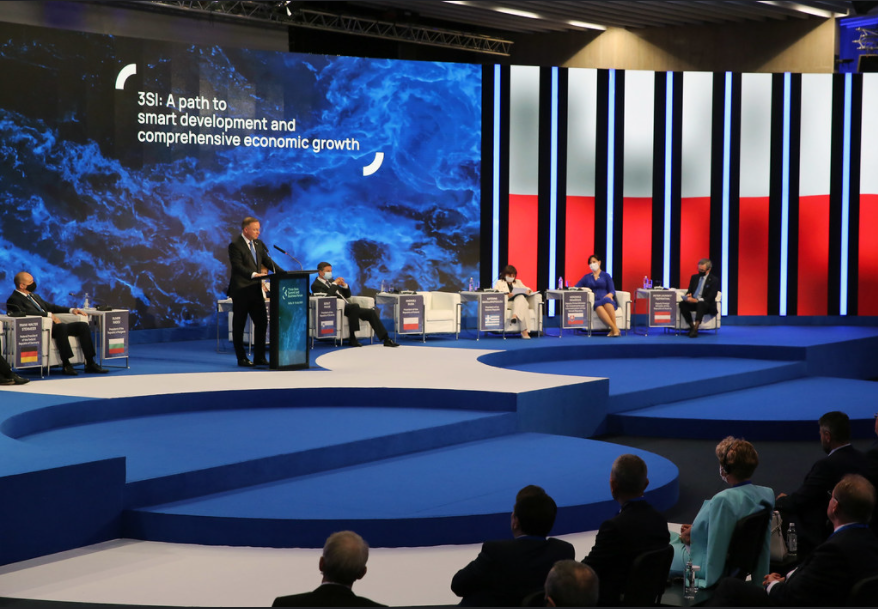
The eighth summit of the Three Seas Initiative (TSI) took place on 6-7 September in Bucharest. The summit’s slogan, “Together we are stronger”, emphasised security issues in regional cooperation and extending the TSI to include Greece in an attempt to involve it in discussions on the further development of transport infrastructure towards the south.
.jpg) Mel Longhurst / Topfoto / Forum
Mel Longhurst / Topfoto / Forum
What was agreed at the summit?
The main change in the functioning of the format is the addition of new member Greece. The Bucharest Summit was also characterised by the participation of numerous partners, including the European Bank for Reconstruction and Development, the European Commission, the World Bank, and the International Monetary Fund. For the first time, representatives of Japan, France, the United Kingdom, and Turkey participated in the discussions. The summit was accompanied by the 5th Three Seas Initiative Business Forum. The further institutionalisation of the TSI was evidenced by the announcement, at the request of the Polish, Bulgaria, Lithuania, and Romania, of the creation of an association of businesses and employers to represent their interests before EU institutions and others. The creation of the Three Seas Innovation Fund, another financial instrument under the initiative, was also announced. Next year’s summit will take place in Lithuania, and a year later, in Hungary.
What does Greece’s entry into the TSI mean?
President Katerina Sakellaropoulou, who represented Greece at the summit, justified joining the initiative with the need to support connections within the EU. She also underlined the potential of her country in its geographical proximity to Asia and Africa. Greece is where some of the TSI transport route projects will terminate, marking its southern limit. The Via Carpatia route leading from the Lithuanian city of Klaipeda is to end in Thessaloniki, while the Greek LNG terminals, including in Alexandroupoli, thanks to the expansion of gas connections on the north-south axis, are to enable more effective diversification of sources of this raw material. The accession of Greece as the thirteenth TSI country confirms the exclusive nature of the initiative as co-created only by EU countries. It also renders outdated the narrative of the TSI as an association of countries which, with the exception of Austria, have joined the EU since 2004.
What is the approach of the summit hosts to the TSI?
Romania is the first member country to host a TSI summit for the second time (the first was in 2018), which demonstrates its commitment to the project. It is based on the personal involvement of President Klaus Iohannis, a proponent of TSI, as well as his desire to use this platform to strengthen relations with the U.S. and to develop national infrastructure, including the road connection with the port of Constanta. During the summit, Iohannis stressed the particular importance of two projects—the Rail-2-Sea railway connection running from Gdańsk to Constanta and the Via Carpatia road connection. He also used the summit to meet on the sidelines with his Austrian counterpart to raise the issue of lobbying for Romania’s accession to the Schengen area. The Austrian government—in opposition to the position of its president—continues to block this process.
How did the Russian-Ukrainian war affect this format?
After Russia’s full-scale invasion, Ukraine received the status in TSI of a participating partner, which was a gesture of solidarity and an indication of the possibility of including it in Three Seas countries’ infrastructure projects. This year, together with Moldova, it obtained the status of an associated country, which allows participation in TSI activities, including projects. In a joint declaration, the members of the initiative again condemned Russian aggression, stressing that it must withdraw its forces from the territory of Ukraine. At the same time, the members declared their participation in the reconstruction of Ukraine and efforts at the EU and international levels to achieve this goal. Ukrainian President Volodymyr Zelensky, in a speech to the summit participants, recalled the impact of the war on the regional situation. In turn, President Iohannis laid out the consequences of Russian aggression, describing an incident preceding the summit in which the discovery of the remains of a drone on the territory of his country was a “violation of Romania’s territorial integrity”.
What are the prospects for further cooperation?
The Three Seas Initiative remains a format focused on regional infrastructural development. Although TSI countries spent €80 billion on infrastructure projects between 2018 and 2021, they did so while primarily focused on national priorities and using EU funds. Therefore, in order to be credible, the initiative needs an increase in the dynamics of the development of infrastructure connections created with its support. To achieve this, it is necessary to involve both the private sector and the members (Czechia, Slovakia, and Austria still have not joined the Three Seas Fund). The will to move away from imports of Russian raw materials increases the potential importance of energy cooperation under the TSI. For example, the aim of a new project proposed by Poland is the production of hydrogen at the Orlen refinery in Lithuania. U.S. interest in TSI was confirmed by Special Envoy for Climate John Kerry, who announced support for the construction of small nuclear reactors in Poland, Czechia, and Slovakia.