The "Patrushevization" of the Arctic Russian Policy in the Region
Russia seeks military dominance over the Arctic, viewing this region as crucial to its great-power ambitions and economic development. This expansion is also part of the pressure on the United States to accept Russia’s terms for ending the war in Ukraine and serves to undermine allied solidarity within NATO. A suspension of military operations in Ukraine would enable increased Russian military and economic investments in the Arctic region, resulting in it remaining an area of tension with NATO and a provocation towards Arctic states.
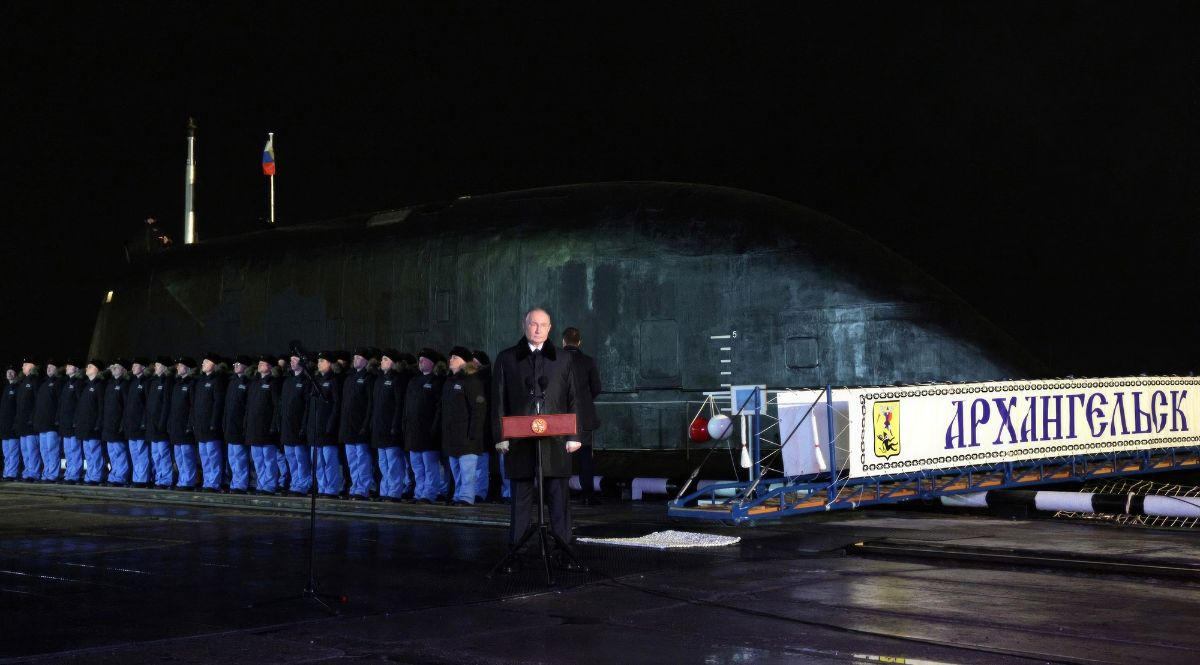 Gavriil Grigorov/Kremlin Pool / Zuma Press / Forum
In Vladimir Putin’s view, after Ukraine, the Russian Arctic is the next most important region of existential importance to Russia’s economy and security. This approach is reflected in documents such as The Concept of the Foreign Policy (2023), the Naval Doctrine (2022), and the Strategy of development of the Arctic Zone to 2035 (2020). In October 2025, Putin ordered an update of the latter, and a day later, Prime Minister Mikhail Mishustin’s government approved a new Arctic development project. The Russian president is willing to temporarily accept a weakening of Russia’s global influence, but continues to increase investments in Arctic development. The authorities refer to this policy of dominating the region as “oswojenije,” meaning colonisation of the northern territories. Russia will therefore strive to seize control of the region, with the same determination it has shown to subjugate the former Soviet states.
Militarisation instead of economics
Competition for funding for the Arctic is raging within the Russian elite. Participating in this process are the economic lobby of Yuri Trutnev, the presidential representative for the Far East and the Arctic, and the war lobby of Nikolai Patrushev, head of the Presidential Maritime College. The budget allocated for the Arctic for 2021-2025 favoured the Patrushev lobby, which received approximately 70-80% of all funds for the region for the militarisation of the Northern Sea Route and the expansion of the icebreaker fleet. The “Arctic budget” (approximately 26 billion EUR) was not balanced until 2025, when funds to halt the depopulation of the northern regions were added to the funds allocated for economic and social projects. However, control of the Arctic Northern Sea Route (NSR), which is 40% shorter than the current route connecting Europe with Asia via the Suez Canal, has been taken over by law enforcement agencies – the Maritime College, the Federal Security Service (FSB), and the Ministry of National Defence.
Patrushevization, i.e., the dominance of the Patrushev war lobby in the Arctic, stems from traditional Russian threat perception. Russia’s northern borders constitute 53% of the Arctic coastline and, according to the elite, are threatened by NATO member states located there. The rate of temperature rise in the Arctic is twice as fast as on the planet as a whole, causing ice to melt and thus making Russia’s borders more accessible. Furthermore, modern radars can more effectively detect Russian nuclear submarines deployed in the Arctic Ocean. The accession of Sweden and Finland to NATO has intensified the perception of “Russia under siege.”
The second reason for the “patrushevization” of the Arctic is the weakness of economic projects, despite the potential of the region, which holds 80% of Russia’s gas reserves and almost 20% of its oil (approximately 30% of the world’s gas reserves and 13% of its oil reserves). In 2014, the Euro-Atlantic community banned (as part of sanctions) the export and re-export of mining technologies used by Russia in the Arctic. In subsequent years, purchases of liquefied natural gas were also gradually excluded, which is why promising LNG projects (Yamal, Arctic, Murmansk) were suspended or operated on a limited scale. Likewise, the only oil corporation in the Arctic, Vostok Oil (a Rosneft subsidiary), is operating along similarly constrained lines, exploring the Payakhskoye, Pizhemskoye, and Kolmozerskoye oil fields. Resuming projects and implementing further plans, such as the extraction of critical raw materials (nickel, lithium) and rare earth elements (some of the world’s largest deposits), requires multi-billion-dollar investments, imported equipment, and foreign contractors, which is unattainable for Russia under the current sanctions regime.
The militarisation of the Arctic has become a substitute for economic development. Russia has strengthened the “A bastion” of nuclear-powered submarines, and restored Soviet military bases to take control of most of the region and the Arctic Maritime District. As a result of this “patrushevization,” Russia has become the most militarised and aggressive Arctic state, owning nearly half of the world’s icebreakers. Furthermore, Russia regularly engages in provocations against NATO Arctic countries (e.g., airspace violations). Control of the NSR is intended to be used to force EU members to lift sanctions in exchange for significantly cheaper transport to Asia of goods “protected” by the Russian fleet, and in the long run, to restore economic cooperation.
Although Russia outperforms other Arctic states in terms of power projection in the region, the plan is to modernise and expand even further. Expanding the icebreaker fleet is unrealistic given the sanctions. Part of the fleet operates using old nuclear reactors, while others should be scrapped, and Russia is struggling to import and produce spare parts. Furthermore, it has had to reduce its Arctic land forces to redeploy them to the Ukrainian front. Continuing the war will therefore prevent the fleet from expanding to a level that would allow for the de facto annexation of the NSR.
Seeking international cooperation
Russia is seeking to overcome the economic weakness of the northern regions by engaging China and India. Despite several agreements, memoranda, and Russian-Chinese bodies dedicated to the Arctic, China’s involvement is limited to military-intelligence cooperation off the Russian coast, purchases of Russian raw materials, and a minority stake of Chinese capital in the Yamal and Arctic LNG projects. Chinese companies are involved in rare earth metal mining at certain locations, but refuse to share their extraction and refining technologies. Ineffective attempts to attract China to the oil and mining projects in the Arctic region stem from Russia’s refusal to sell majority stakes to Chinese companies, as well as from difficult climate conditions that raise operating costs. China is also hampered by Russia’s pursuit of regional dominance, which aims, among other things, to maintain China’s dependence on Russian icebreakers for transport through the NSR. These same factors mean that Arctic cooperation with India is limited to declarations and purchases of Russian oil transported by a “shadow fleet” along the NSR route.
Since the start of Donald Trump’s second term, Russia has been trying to force China to invest more, citing cooperation with the United States as an alternative. Putin wants to capitalise on President Trump’s priorities, such as developing the mining industry. By offering economic cooperation, Russia aims to persuade the United States to accept its ceasefire terms in Ukraine or establish cooperation regardless of the war, which would weaken NATO unity and sanctions policy. Therefore, in November 2025, he instructed the government to develop a roadmap for rare earth metals extraction, which was subsequently shared with the current US administration. Kirill Dmitriev, head of the Direct Investment Fund, is lobbying the US for joint Arctic projects (e.g., the construction of the Chukotka-Alaska tunnel) using frozen Russian assets, as well as for the lifting of sanctions and the return of Exxon Mobil to cooperation with Rosneft in the Arctic. To date, these Russian efforts have not led to increased Chinese investment or the resumption of economic cooperation with the US.
Conclusions
Due to a lack of resources and technology, Russia will not be able to capitalise on the Arctic’s economic potential in the near future. It is doubtful that it will be able to establish deeper cooperation with the US or achieve a balance in relations with China. However, it has the potential to gain military control over parts of the Arctic and the NSR, forcing China into greater involvement and maintaining its dependence on the Russian fleet. If Russia maintains military dominance over the NSR and EU countries seek shorter routes, in the long term, Russia could force them to share mining technologies and coerce Japanese, French, British, and American companies back into the Russian Arctic. This would mean maintaining the current nomenklatura’s grip on power, maintaining an aggressive system based on raw materials and military power projection.
If there is no ceasefire in Ukraine, the war will remain a Russian priority, thus continuing the depletion of Arctic land forces. Conversely, a halt in hostilities in Ukraine would allow Russia to increase its investment in the economic and military potential in the Arctic, which would ensure that it remains an area of tension with NATO and a source of provocation against Arctic Alliance member states. Russia will continue to perceive the Arctic as a region crucial to its security and prosperity, contingent on increased extraction of critical raw materials, metals, and minerals.
Given the changing US policy, the smaller Arctic NATO states should deepen regional cooperation or even establish a new format (e.g., an alliance) to deter Russian provocation and domination in the region. They should also strive to ensure the current sanctions are maintained, preventing Russia from dominating the Arctic.