
The United States Escalates the Crisis Concerning Greenland
Consultations between representatives of the US, Danish, and Greenlandic authorities, which took place on 14 January in Washington, D.C., failed to ease the dispute over the island due to aggressive statements by Donald Trump’s administration. On 17 January, the US president threatened to impose additional tariffs of 10% on Denmark and those European countries that decided to send a small number of troops to Greenland. The lack of agreement may reinforce the American desire to take Greenland by force. This would mean the end of NATO in its current form, creating a need to rebuild the European security system, and could also encourage Russia to attack its European neighbours.
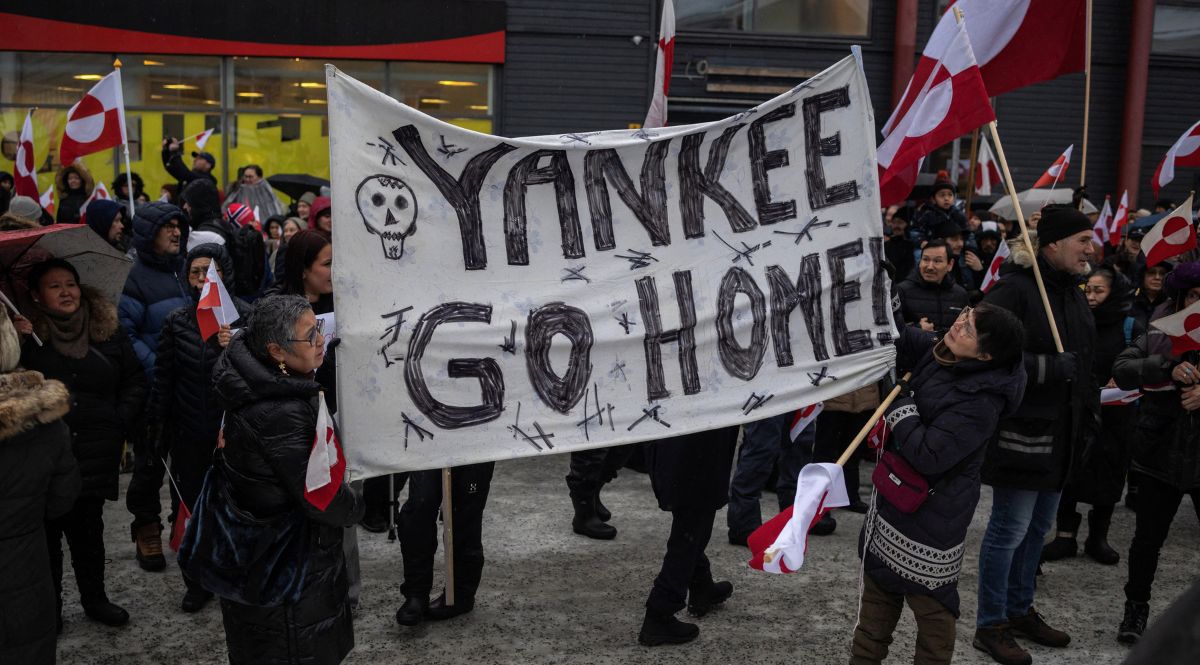 Marko Djurica / Reuters / Forum
Why is the US making demands regarding Greenland?
The Trump administration’s interest in Greenland stems from the growing importance of the Arctic in US strategic thinking over the past decade, caused by shrinking ice cover and consequent greater accessibility of shipping routes for civilian and military vessels. The Trump administration points to potential threats to the North American continent and Greenland itself from China and Russia, whose military and commercial activities in the Arctic have increased in recent years. Although Trump and his administration are interested in re-establishing a greater presence on the island to secure their northern flank (including Alaska and Canada), the US military has not yet signalled such a need, let alone developed plans to strengthen forces in this area. US authorities have also raised the argument of access to critical raw materials as an important element in becoming independent from China in this area and building up their own reserves for the needs of, among others, advanced technologies and the armaments sector. The island is estimated to contain approximately 30% of the world’s rare-earth metal deposits, as well as fossil fuel supplies. However, it is not certain that American companies would decide to make rapid investments on the island without confirmation of their profitability and the establishment of a stable political and legal framework for involvement in Greenland. It is also possible that the motivations behind the demands concerning Greenland primarily stem from the expansionist aspirations of the president, who seems to want to go down in US history by expanding American territory, and hence his personal ambition fuels activities.
How might the Trump administration seek to take over the island?
The persistent raising of numerous political, military, and economic demands by the US against Denmark is calculated to force it to voluntarily relinquish its sovereignty over Greenland. Given this, there is a growing risk that negotiations within the US-Denmark-Greenland working group will fail. Moreover, many US actions in its contacts with NATO and EU countries may be primarily aimed at causing divisions within these forums and paralysing their organisational decision-making processes. Thus, unless options for a forceful takeover of the island are blocked by the US military and Congress, their rapid implementation cannot be ruled out. In such a scenario, the US could carry out a limited special forces operation, preceded by an increase in military presence under the pretext of sending additional personnel to the US Space Force base in Pituffik, and leading to the seizure of key administrative facilities in Greenland. The second option could be a landing and occupation of the island using larger conventional forces, including US Army airborne units or the US Marine Corps. Due to media coverage and the sudden nature of the landing operation, both variants could be implemented jointly or in several stages. However, their success could be hampered by even symbolic resistance from Danish soldiers, the local police, and a broader movement of civil disobedience among the local population.
How have the EU, NATO, and major member states reacted so far?
European reactions indicate that the Trump administration’s actions are perceived as aggressive and threatening to the foundations of Transatlantic relations. European countries supporting Denmark and Greenland have rejected US pressure, including that expressed in the announcement of a 10% additional tariff on Denmark, France, Finland, the Netherlands, Germany, Norway, Sweden, and the United Kingdom, which would take effect on 1 February, and further increase to 25% on 1 June. The EU has convened consultations on reinstating the package of retaliatory tariffs against the US adopted in 2025 and the possible use of the Anti-Coercion Instrument (ACI). France is opting for a tougher trade line, while Germany prefers a more cautious approach. From the outset of the dispute, Britain has politically supported Denmark, with which it cooperates closely within the NATO Joint Expeditionary Force, while emphasising the need for mediation and cooperation of NATO allies with the US in the Arctic. Responding to Trump’s accusations of insufficient protection of Greenland from threats from Russia and China, NATO and some member states proposed the establishment of the Arctic Sentry mission (modelled on Baltic Sentry and Eastern Sentry) to give the allied military presence a more permanent character. At the same time, some NATO countries still hope to maintain the US contribution to the deterrence and defence posture of Europe.
Could the issue of Greenland lead to the end of NATO?
A possible US invasion of Greenland, and even a limited confrontation between American and Danish forces, or those of other European countries, would result in complete paralysis of the North Atlantic Council’s decision-making process and chaos within NATO’s military structures. Violating Denmark’s sovereignty and territorial integrity, as well as Greenland’s legally and internationally recognised right to self-determination, would undermine the foundations of the Alliance, which are based on member states’ compliance with the United Nations Charter and their obligations under the Washington Treaty. American military options against Greenland would therefore call into question the very meaning of NATO as a defence alliance between the US, Canada, and European countries that share common values, in particular respect for international law and peaceful dispute resolution. However, the US, by continuing to exert diplomatic pressure, repeating offers to purchase the island (which is also illegal under Danish law in the light of the already recognised right of Greenland to self-determination) or seeking other contractual forms that would de facto increase US control over the island, will also have negative consequences for Transatlantic relations. This could lead to an escalation of the trade war between the US and the EU, the withdrawal of some US forces from certain European countries, and it cannot be ruled out that some European NATO countries would also decide to terminate agreements concerning the stationing of US forces on their territory. Russia will use the possible illegal annexation of Greenland as a suitable pretext to attempt to legalise its occupation of Crimea and Donbas, and in the future to make further territorial demands on its neighbours. The collapse of NATO structures will encourage Russia to carry out military operations against the Baltic states or increase the number of provocations against Poland and the Scandinavian countries.






.png)