The consequences of the Paris Declaration
The Paris Declaration, signed on 6 January this year, is a step towards institutionalising security guarantees for Ukraine, which are essential if any ceasefire is to become a reality. However, it does not bring the negotiations any closer to a resolution, as Russia has shown no interest in a quick end to the hostilities.
 LUDOVIC MARIN / Reuters / Forum
How did the meetings in Paris go and what were their results?
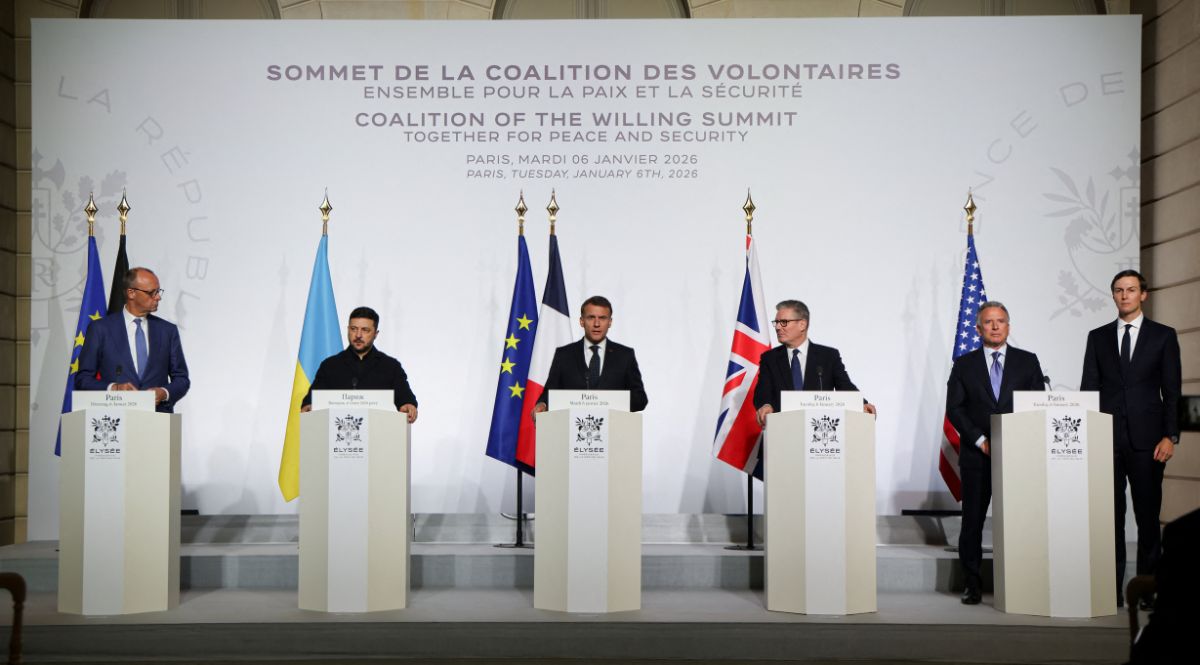
On 6 January this year, talks were held in Paris in various formats (bilateral and multilateral) on the future of Ukraine and the proposed security guarantees, following the acceleration of negotiations on ending the war in Ukraine that has been ongoing since November last year. Volodymyr Zelensky met with French President Emmanuel Macron, British Prime Minister Keir Starmer, German Chancellor Friedrich Merz, and US Presidential envoys Steve Witkoff and Jared Kushner. The French capital also hosted a meeting of the “coalition of the willing”, attended by representatives of 35 countries. It resulted in the adoption of the Paris Declaration, a political document indicating the willingness to provide long-term support to Ukraine in the event of a ceasefire. In addition, the United Kingdom and France signed a memorandum with Ukraine in which they committed to deploy their troops in Ukraine following the end of hostilities. A decision was also made to establish a coalition coordination cell in Paris.
What commitments may arise from the Paris Declaration?
The Paris Declaration provides for the establishment of a mechanism to monitor compliance with the ceasefire; long-term military assistance, including the transfer of weapons to Ukraine; the creation of a multinational force in Ukraine by willing countries after the end of hostilities; binding commitments to support Ukraine in the event of an armed attack by Russia, in order to restore peace; and a commitment to deepen long-term cooperation with Ukraine in the field of defence. These plans envisage that members of the coalition of the willing will undertake a number of initiatives in the areas of training Ukrainian soldiers, building fortifications in Ukraine, and maintaining intelligence and logistical support. These measures are intended to deter Russia from attacking Ukraine again. However, the challenge will be to determine the specific responsibilities of each country. So far, alongside France and the UK, Türkiye (in 2025) and Spain, among others, have declared their readiness to deploy troops in Ukraine, but it is not clear what the nature of these forces will be. Some countries, such as Germany and Poland, have announced other types of assistance. The degree of involvement from the US, which did not sign the declaration and, like some European countries (E3, Poland, Germany), made no clear commitments, will also be of particular importance for the implementation of any guarantees. However, the presence of American representatives during the talks and at the press conference after their conclusion was a sign of support for the solutions that had been worked out.
What might Russia’s response be?
So far, the Russian authorities have rejected all proposals regarding the presence of foreign troops in Ukraine, especially those of NATO members. They have emphasised that one of the “root causes” of the military action they launched in 2022 was the alleged strengthening of cooperation between Ukraine and the NATO alliance. Therefore, there should be no expectation of change in Russia's approach in this regard and no acceptance of such actions by Western countries. Moreover, while broad guarantees from a coalition of willing countries, mainly NATO members, would increase Ukraine's security, Russia would claim this as a violation of its own interests and consider it unacceptable under its concept of ‘indivisible security’. The establishment and functioning of a special commission to investigate possible violations of the ceasefire will also be problematic. The activities of the OSCE Special Monitoring Mission in 2014-2022 have shown that without clear sanctions for violating any truce, guaranteed by the US, Russia will continue to breach it. Russian provocations and false flag operations cannot be ruled out either, casting blame on Ukraine for violations of any agreements ending the hostilities.
What do the Paris agreements mean for Ukraine's negotiating position?
Although the implementation of the Paris declaration requires a ceasefire on the part of Russia, the agreements reached by the coalition of the willing mean the consolidation of political and military support from key partners and a signal of their readiness to provide long-term financing and rearmament for Ukraine. The cooperation of the coalition of the willing with the US and its institutionalisation, as well as the potential possibility of sending a multinational force, is also one of the elements of increasing pressure on Russia. The collaboration and commitments of European countries are also a response to American criticism of their alleged low level of involvement in assisting Ukraine. The successful signing of the declaration by so many countries is important for the internal stability of Ukraine. The agreements confirm that despite the difficult situation, including intensified attacks on critical infrastructure, as well as a corruption scandal, personnel changes in the government, state administration and security forces, and challenges on the front line, Ukraine is not alone, and its partners are ready to maintain and expand their support in a coordinated manner.