
State of the EU Address-"Europe is in a Fight"
In her State of the European Union address delivered on 10 September, European Commission (EC) President Ursula von der Leyen focused on the most important challenges facing the Community and called for European unity. She also expressed solidarity with Poland in connection with the recent violation of its airspace by Russian drones. However, the debate revealed significant divisions among the parties that support the Commission.
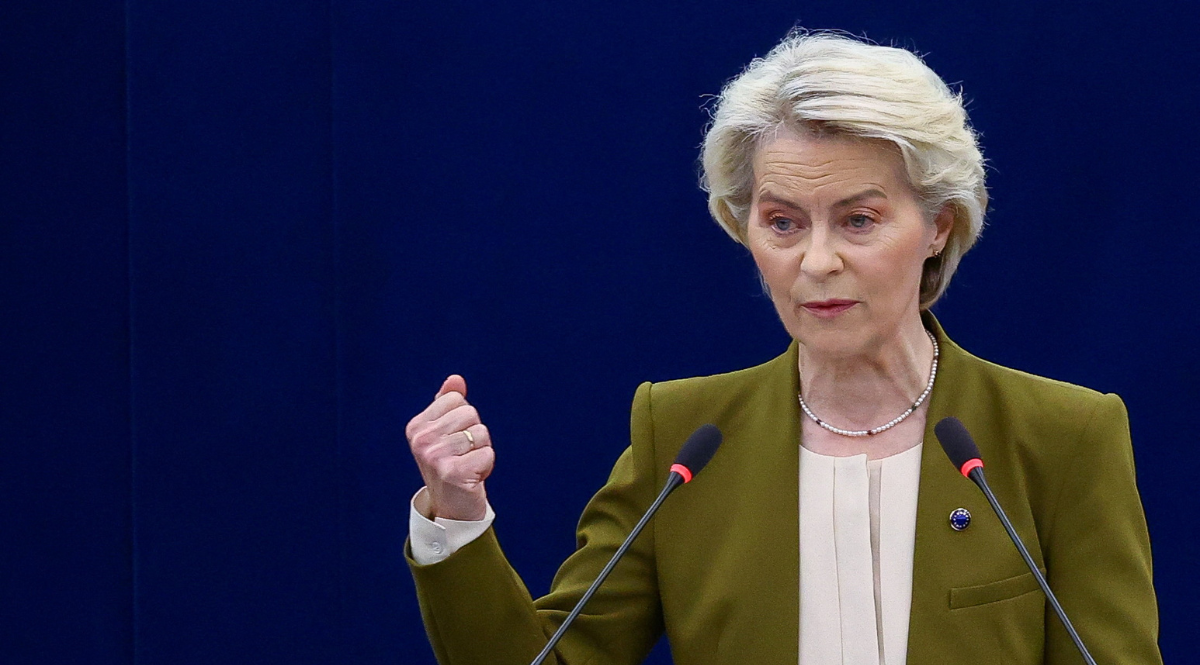 Yves Herman / Reuters / Forum
What were the most important points of the speech and the debate in the European Parliament?
The theses of von der Leyen’s address were in line with the priorities of her second term: strengthening the EU's defence capabilities, increasing the competitiveness of the European economy, and increasing the Community’s importance in international politics. The EC president also used the speech to respond to negative assessments of her policies, in particular those regarding the trade agreement with the U.S. and her stance on Israel’s actions, seen as indecisive. She has been criticised not only by some Member States but also by political parties in the European Parliament that comprise the informal coalition supporting her Commission, especially the Socialists and Democrats. The focus on the competitiveness of the EU economy can be seen as von der Leyen’s response to criticism of the pace and scope of economic reforms (recently expressed, for example, by Mario Draghi) as slow and limited.
During the debate in the EP, the main parties supporting the Commission (Christian Democrats, Liberals, and Socialists) did not contest the main points of the speech, but accused each other of undermining EU unity, with the left charging the Christian Democrats with engaging in an informal alliance with the far-right and criticising the trade agreement with the U.S. The centre-right, in turn, argued that such remarks undermine the cohesion of the mainstream forces.
What new defence initiatives were announced?
Von der Leyen called for the creation of a special loan fund to finance Ukraine’s war effort. It would be sponsored by EU countries, backed by frozen Russian assets but which would not be directly used for this purpose (Belgium and Germany, for example, fear the negative financial consequences of such a decision), with the repayment of liabilities taking place only after Russia had paid reparations. In addition, von der Leyen announced the EU would develop drone-related capabilities, including support for an initiative to create a “drone wall” on its eastern border and an alliance with Ukraine in this area, as well as €6 billion in loans for that country. However, the address did not contain any groundbreaking announcements regarding security, partly due to the lack of funds to finance new large-scale initiatives. The SAFE programme adopted during the Polish presidency of the EU Council in the first half of this year, remains key to increasing the EU’s defence capabilities. A new programme of similar scale would require new funds, which will most likely only be available in the next financial perspective for 2028-2034.
What was the most important topic concerning EU foreign policy?
The EC president focused on explaining the reasons for concluding a trade agreement with the U.S. She argued that it is most important to ensure the economic stability of European business and to avoid a trade war with the United States, which would benefit the Union’s rivals. She emphasised that when it comes to setting standards for the operation of technology companies in Europe, the EU will make decisions on this matter autonomously. This was a polemic against President Donald Trump’s threats of additional tariffs on countries introducing regulations on U.S.-based tech companies.
The second primary topic was the announcement of efforts to suspend the trade agreement with Israel and a proposal for the Council to impose sanctions on those responsible for the humanitarian crisis in the Gaza Strip (e.g., Israeli government ministers).
What proposals concerning the EU economy did the speech contain?
Von der Leyen emphasised her desire to further increase the competitiveness of the EU economy, including through the implementation of deregulation packages (so-called omnibuses). She also announced that she would introduce an additional criterion for production in Europe, which would apply to public procurement, and allocate €1.8 billion to support battery production in the EU. She also advocated the creation of a European electric car. The announcement of a plan to improve access to housing in the EU can be interpreted as an attempt to win over the Socialists and Democrats, who raised the importance of housing issues during the 2024 European Parliament election campaign.
How does the speech respond to Poland’s foreign policy interests?
It is beneficial from the point of view of Poland’s interests that von der Leyen is maintaining a pro-Ukraine stance among the EU’s top priorities and is attempting to obtain new funds for the country to repel Russian aggression. However, the final assessment of these actions will depend on how the mechanism for loans secured with Russian assets is constructed and on the implementation of the other proposed initiatives. The announcement of the creation of a “drone wall” is also in line with the objectives of Poland’s foreign policy, which emphasises a common European character to the EU’s eastern border (the president’s speech included a statement that the Eastern Flank secures the whole of Europe).

.png)
