Stability for Putin: Year-End Review with the Russian President
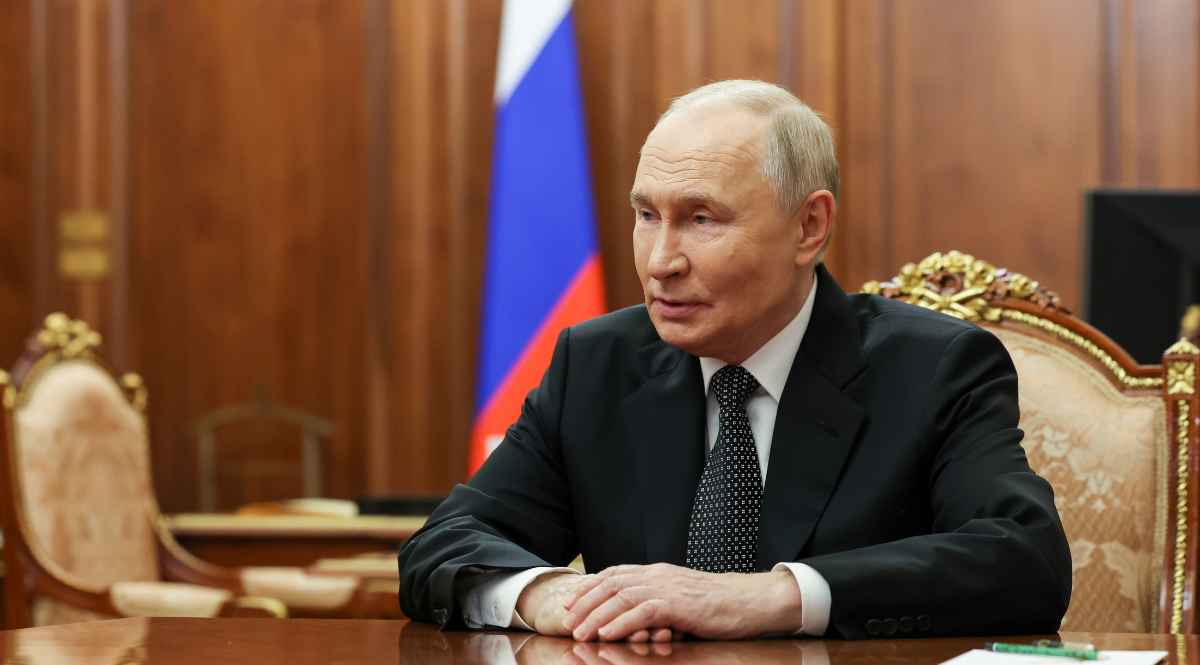
On December 19th, the annual “Direct Line with Vladimir Putin” took place, during which the Russian President answered questions from journalists and citizens. Putin’s message this year boils down to three claims: Russia is dominating the battlefield in Ukraine and will not yield to its demands, Russia is “ready” for peace talks, and Russians should not fear a decline in living standards. Additionally, ritual threats of full-scale armed conflict with EU countries were made.
 Mikhail Metzel/Zuma Press/Forum
What form does the annual conference take?
Putin’s annual press conferences are a staged spectacle in which he answers questions from carefully selected journalists and “ordinary Russians,” thus communicating primarily with the Russian public and, secondarily, with foreign leaders. To create an impression of spontaneity, Putin tries to joke, and there are also “unplanned” events, such as an on-air proposal or questions from children. This year’s conference was dominated by topics related to the war in Ukraine and socio-economic issues. Questions from foreign journalists about internal repression and Russian aggression against neighbouring countries were deliberately allowed so that Putin could rhetorically attack Western countries.
What domestic issues dominated Putin’s conference?
Putin attempted to assure Russians that, despite the VAT increase (from 20 to 22%), the elimination of tax breaks for small businesses, and the growing federal budget deficit (2.6% of GDP), living standards in Russia would not decline. He devoted considerable attention to the declining demographics, repeatedly appealing to the public to get married and decide to have children, assuring them that state support for large families and subsidised mortgages would continue. According to Russian data, the birth rate in Russia has fallen to its lowest level since 1999 (1.22 million births, against 600,000 deaths). Putin also assured non-Russian ethnic groups (Dagestanis, Tatars, and Yakuts) of their rightful place in the Russian Federation, likely dictated by the need to continue recruiting them into the Russian army in Ukraine, and the associated ethnic social tensions.
What did Putin say about the war in Ukraine?
The Russian president is convinced of the overwhelming Russian advantage on the battlefield, which he presented in a detailed account of the situation on the front line, asserting that it was only a matter of time before the Russian army drives Ukrainian forces out of the entire Donbas region. He also, once again, blamed Ukraine for its unwillingness to engage in peace talks. On the one hand, this was intended to reassure Russians that their years of sacrifice would soon be rewarded. Equally, this was also meant to convince Western leaders that any attempts to renegotiate the Russian ceasefire terms will be futile. It’s difficult to say to what extent Putin understands the real situation on the front. Despite progress in some areas, many sources indicate that the military command may be deliberately echoing his expectations in official reports, which would reinforce Putin’s belief in his own propaganda and harden Russia’s negotiating position.
What was Putin’s message on foreign affairs?
Putin tempered his statements about the US, complimenting Trump and his administration’s commitment to peace talks, which is consistent with his priority of resuming Russian-American relations. On the other hand, he identified EU countries as adversaries who are using Ukraine’s weapons to fight against Russia and want to plunder frozen Russian assets. This confirms the continued shift in Russian aggressive propaganda from the US to EU countries that oppose the Russian ceasefire terms. It is also a gesture toward MAGA politicians in the US administration, who are betting on the fragmentation and subjugation of the EU. Questions from foreign BBC and NBC journalists provided the opportunity for a lecture on the reasons for Europe’s “death” (e.g., the abandonment of traditional values and energy sources) and the so-called root causes of the war in Ukraine, which, from Russia’s perspective, are NATO’s eastward expansion and Western support for the alleged “coup d’etat” in Ukraine. Putin also addressed a question from a Russian journalist regarding a potential blockade of the Königsberg Oblast by EU countries, stating that if that were to occur, Russia would respond with a full-scale conflict.
What do Putin’s statements imply?
The Russian leader’s statements indicate that he is not willing to compromise regarding Ukraine and does not intend to adjust his confrontational foreign policy course. The continuation of Russia’s hybrid aggression against EU countries, including provocations and sabotage, is expected over the next year. Regardless of the outcome of the peace talks, Russia will continue its efforts to establish deeper relations. The US will also attempt to capitalise on the current Trump administration’s resentment towards the EU by taking intensive actions to deepen divisions within the EU and paralyse its actions, particularly towards Ukraine (e.g., by directing a conciliatory and transactional message towards anti-EU alt-right parties and supporting Hungary and Slovakia). In Russia’s domestic policy, the policy of repression and buying the favour of soldiers through large payments for participation in the war against Ukraine will continue – the aim of these actions will also be to secure over 60% of the votes for the United Russia party in the parliamentary elections in September 2026, fulfilling the presidential administration’s expectations.