South Korea and Russia: motivations and challenges
South Korea is interested in resuming its cooperation with Russia, which was severely curtailed following Russia’s invasion of Ukraine in 2022. The country’s motivations are primarily security-related, including the desire to limit Russia’s cooperation with North Korea, as well as economic, linked to South Korean companies’ interest in returning to the Russian market and participating in infrastructure and logistics projects. However, a rapprochement with Russia could have negative implications for the Republic of Korea’s cooperation with European countries, including Poland.
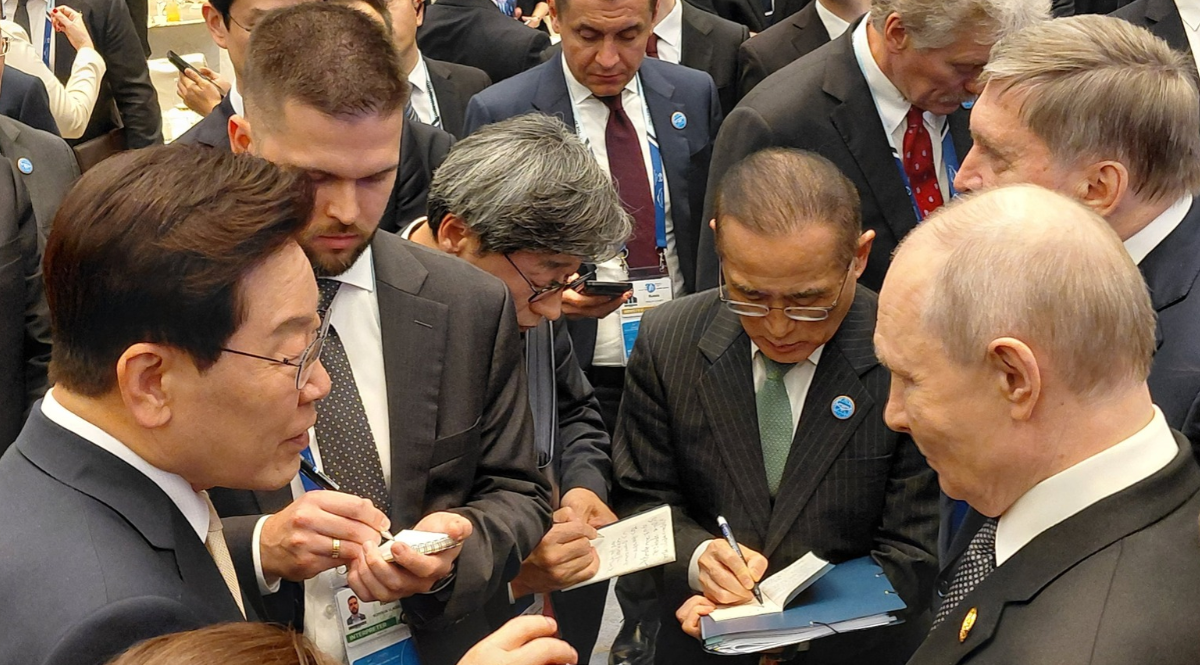 president.go.kr
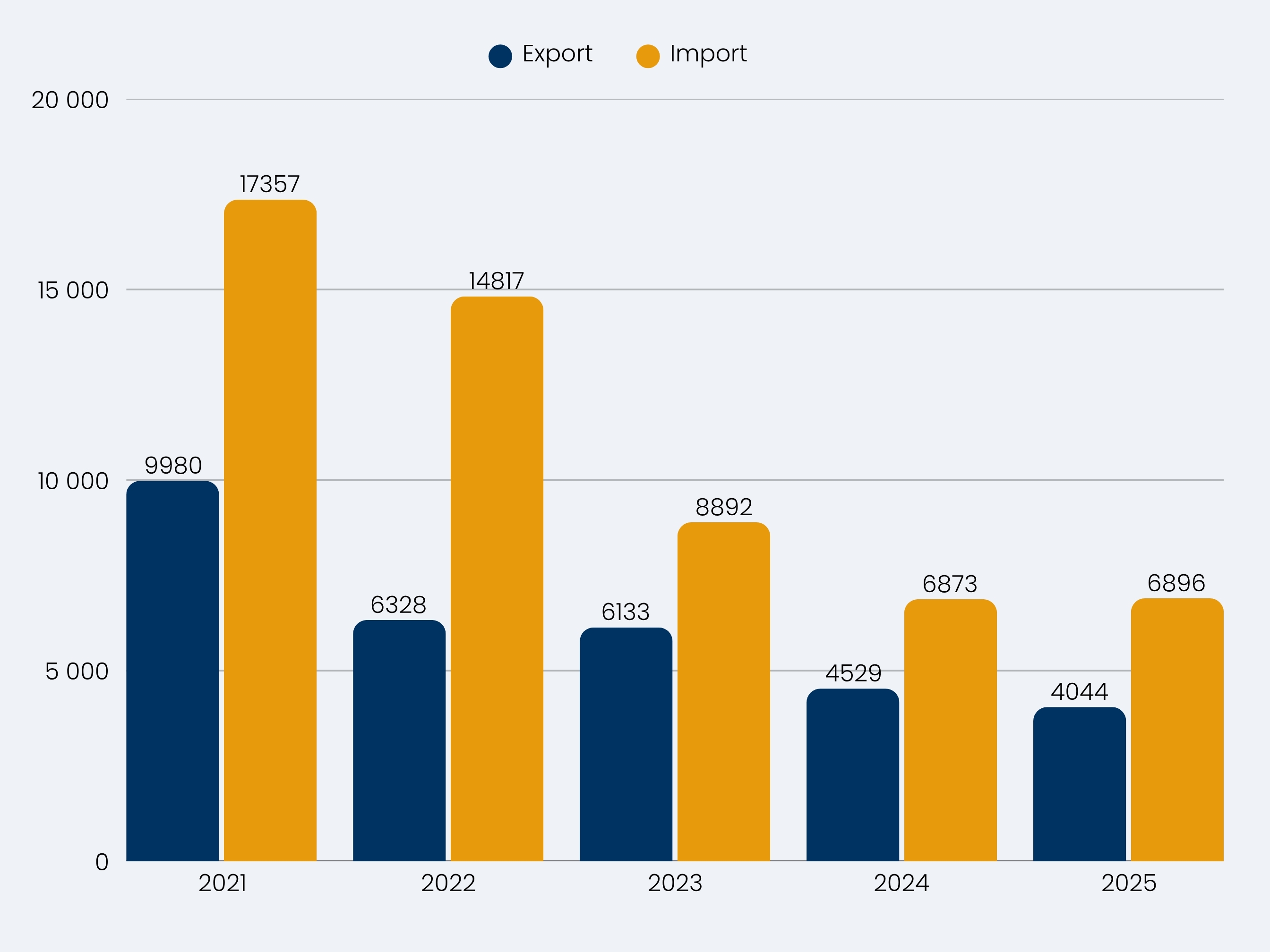
Russia’s full-scale invasion of Ukraine in February 2022 led to the most serious deterioration in South Korean-Russian relations since the establishment of diplomatic ties in 1990. Guided both by its assessment that Russia had violated international law, as well as by the need to coordinate its response with the United States and European partners, South Korea joined the international condemnation of Russia and adopted some Western sanctions, particularly regarding export controls on specific technologies. It also significantly reduced both exports and imports, including imports of Russian energy resources. Compared with 2021, bilateral trade declined from $27.3 billion to $10.9 billion in 2025 (see Figure 1). New South Korean investments in Russia were suspended, while most companies scaled back their operations, seeking to preserve the option of returning to the market, for example by selling their assets to Russian entities for symbolic sums while retaining buyback rights. South Korea’s stance on the invasion resulted in its inclusion on Russia’s list of “unfriendly states” and a reduction in high-level political contacts. Tensions grew further following the formation of the Russia-North Korea alliance. Meanwhile, Yoon Suk-yeol’s administration (2022–2025) strengthened cooperation with the US, NATO, and some European countries—including Poland.
Signs of South Korean interest in improving relations with Russia
Since taking office in June 2025, Lee Jae-myung’s administration has signalled a desire to improve relations with Russia. In a list of diplomatic priorities published last September, Russia was identified as one of the main foreign policy directions alongside the United States, China, and Japan. The administration declared its goal of pursuing the “stable management and development of relations with Russia.” While South Korea continues to criticise Russia and maintain economic sanctions against it, officials have increasingly emphasised the need to lay the groundwork for renewed engagement under more favourable international conditions—namely following a ceasefire or the end of the war in Ukraine.
In October this year, Lee appointed Song Young-gil as adviser on peace diplomacy. During the Moon Jae-in administration (2017–2022), Song was responsible for dialogue with Russia. He has advocated intensifying diplomatic contacts, restoring air links between Incheon and Vladivostok, and easing export control measures on Russia. However, Song’s appointment does not necessarily indicate an overall pro-Russian shift in South Korean policy. His views have been met with scepticism by key figures including Wi Sung-lac, the presidential national security adviser. Nevertheless, the resumption of academic and expert exchanges with Russia, including between public think tanks linked to intelligence institutions, suggests a willingness to rebuild communication channels between the two countries.
South Korean companies are also exploring the possibility of returning to the Russian market and participating in infrastructure and logistics projects involving Russia. For example, between August and October this year, a South Korean container vessel conducted a pilot voyage along the Northern Sea Route in the Arctic, travelling from Busan to Gdańsk and back. In addition, across July and August, 14 shipments carried aboard seven tankers departed from South Korean ports for Russia’s Far East. Three of these vessels are subject to UK and EU sanctions. Together, they transported 176,000 tonnes of petroleum products, primarily diesel. While these shipments did not involve the export of South Korean petroleum products, they raise questions about the consistency of South Korea’s policy with that pursued by its partners towards Russia.
At the same time, serious diplomatic tensions emerged between South Korea and Ukraine. In October, South Korea recalled its ambassador and halved the number of staff at its embassy in Kyiv. This followed President Volodymyr Zelenskyy’s public disclosure during the September session of the United Nations General Assembly that North Korean prisoners of war had been transferred. South Korea regarded this as a breach of a confidential understanding on the matter. Russia may have interpreted the strong reaction of the Lee administration as a signal that South Korea now places less importance on political support for Ukraine.
South Korea’s Motivations
South Korea is interested in renewing its contacts with Russia due to Russia’s alliance with North Korea. The intensification of Russia–North Korea cooperation, including the transfer of Russian military technologies to the DPRK, poses a direct challenge to South Korea’s security. South Korean policymakers may calculate that engaging in dialogue with Russia could prevent the further expansion of military cooperation with North Korea, particularly in areas most detrimental to South Korean security, such as missile technologies, and create conditions for limiting such cooperation.
South Korea also continues to regard Russia as a major power with which it should maintain stable relations. This reflects the traditional approach of South Korea’s liberal governments, which view Russia as an important actor in the regional security architecture of Northeast Asia and as a potentially useful player in improving inter-Korean relations. Another factor encouraging engagement with Russia may be the conciliatory approach of the Donald Trump administration towards Russia, which reduces the perceived need for a policy based primarily on pressure and sanctions.
Improving relations with Russia would also align with Lee Jae-myung’s pragmatic foreign policy of diversifying partnerships and securing economic benefits. South Korea may wish to facilitate the return of its companies to the Russian market, increase imports of Russian energy resources and critical minerals, and participate in infrastructure and logistics projects. Beyond developing Arctic transport routes, South Korean firms may seek opportunities to modernise Russia’s transport, energy, and port infrastructure once the war has ended and sanctions have been eased.
Constraints and Costs of a South Korea–Russia Rapprochement
South Korea hopes that improving relations with Russia will become possible once a ceasefire is reached or the war in Ukraine has ended. However, even in such a scenario, Russia's relations with the West are unlikely to normalise, nor would all sanctions necessarily be lifted. Furthermore, any resulting ceasefire could prove far less stable than the armistice arrangement that has endured on the Korean Peninsula since 1953.
South Korea also appears to underestimate the significant shift in Russia’s policy towards the Korean Peninsula since 2022. Russia has largely abandoned its previous calculated approach between the two Korean states, in which economic cooperation with the South played a significant balancing role, in favour of an explicit alliance with North Korea. Even after the war in Ukraine ends, this mutually beneficial partnership may remain an important instrument of Russia’s strategy of confrontation with the United States and its allies. South Korea may be overestimating its ability to influence Russian policy. Russia is unlikely to abandon its alliance with the DPRK simply in response to South Korean encouragements. Indeed, Russia may seek to gain access to South Korean technologies and investment without making any meaningful concessions regarding North Korea.
The economic rationale for closer cooperation with Russia is also questionable. European experience has shown that Russia is willing to exploit economic dependencies, including energy supplies, to exert political pressure. South Korea may likewise overestimate the attractiveness of the Russian economy, which remains a high-risk market characterised by declining purchasing power, the risk of nationalisation, and regulatory unpredictability. Furthermore, even prior to the large-scale invasion of Ukraine, Russia’s relevance as a South Korean trade and investment destination was already decreasing, with an increasing proportion of South Korean investment flowing to countries such as Poland (see Tables 1 and 2). Ambitious plans for closer economic ties between South Korea and Russia have repeatedly failed to materialise.
A rapprochement with Russia could also impact negatively on South Korea’s relations with European countries, including Poland. Importantly, if it undermines South Korea’s credibility as a security partner for the European Union and NATO, this could cause difficulties for political, defence-industrial, and intelligence cooperation between the Republic of Korea and European states. Increased economic engagement with Russia would undermine the effectiveness of Western sanctions and contribute to Russia’s ability to rebuild and expand its military capabilities, which could threaten the security of Central and Eastern European countries, alongside posing risks to South Korean investments in the region.
| 2017 | 2018 | 2019 | 2020 | 2021 | 2022 | 2023 | 2024 | 2025 | |
|---|---|---|---|---|---|---|---|---|---|
| Poland | 222 | 643 | 1187 | 773 | 608 | 919 | 414 | 791 | 402 |
| Russia | 85 | 107 | 133 | 152 | 151 | 97 | 26 | 22 | 132 |
| 2017 | 2018 | 2019 | 2020 | 2021 | 2022 | 2023 | 2024 | 2025 | |
|---|---|---|---|---|---|---|---|---|---|
| Poland | 3116 | 4334 | 5315 | 5639 | 6596 | 7858 | 9022 | 8910 | 9005 |
| Russia | 6907 | 7321 | 7774 | 6899 | 9979 | 6328 | 6133 | 4529 | 4044 |