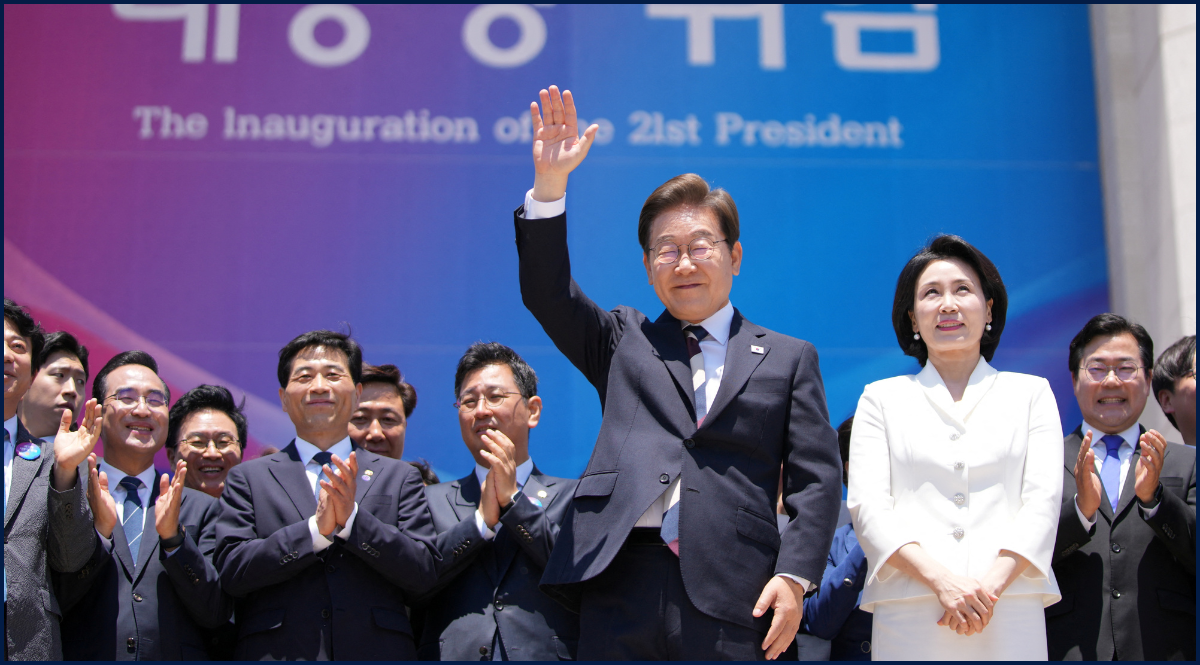
South Korea's Lee Jae-myung Aims to Pursue Pragmatic Foreign Policy
South Korean President Lee Jae-myung, who took office in June 2025, intends to pursue a pragmatic foreign policy, with the alliance with the U.S. remaining its cornerstone. Unlike his predecessor Yoon Suk-yeol, he believes that close cooperation between South Korea and the U.S. should not result in deteriorating relations with China. The new administration’s credibility and effectiveness will be tested by its ability to maintain cooperation with Japan and improve inter-Korean relations. Guided by the primacy of economic interests, the Republic of Korea will continue to seek closer ties with European countries, including Poland.
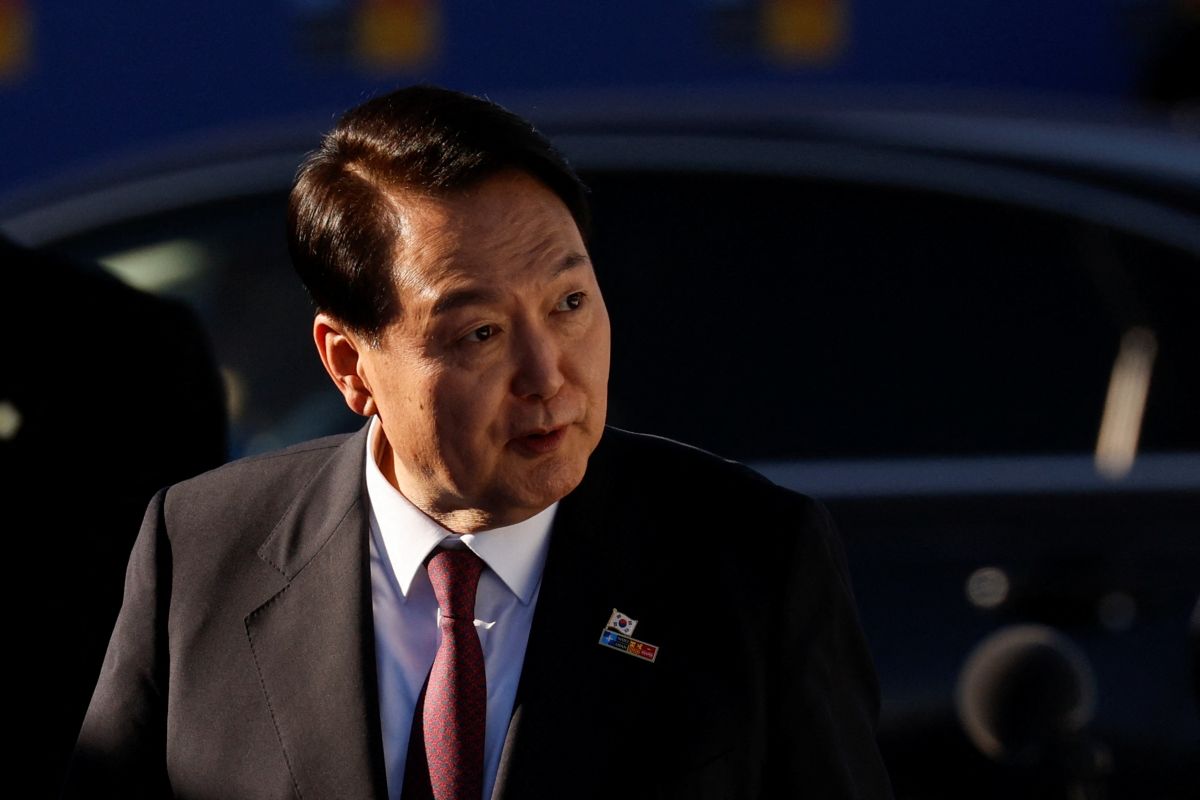
 Ahn Young-joon / Reuters / Forum
Lee’s Foreign Policy Assumptions
In the coming years, the Republic of Korea’s foreign policy will attempt to reconcile the conservative views of close cooperation with the U.S., rapprochement with Japan, and strengthening national deterrence capabilities with the liberal views of seeking dialogue with North Korea, increasing autonomy in relations with the U.S., and maintaining an assertive stance towards Japan. This is evident in the statements made by the liberal leader, Lee Jae-myung, during his successful election campaign. During this time, he distanced himself from the traditional slogans of his political camp and softened his criticism of the foreign policy of the conservative Yoon Suk-yeol. Lee considered it crucial to move away from Yoon’s alleged ideologisation and bloc-think, including “values-based politics” and unequivocal support for the U.S., which resulted in a deterioration of relations with China and Russia, in favour of pragmatic cooperation with all partners. This may boil down to a transactional approach focused primarily on obtaining economic benefits.
The Lee administration’s assumptions are reflected in the initial appointments to roles overseeing foreign and security policy. Lee Jong-seok, the former Minister of Unification who supports dialogue with North Korea and reducing security dependence on the U.S., has become director of the National Intelligence Service. Wi Sung-lac, the former South Korean ambassador to Russia and the country’s envoy to the six-party talks on the North’s nuclear programme, has become national security adviser. He favours close cooperation with the U.S. Cho Hyun, an experienced diplomat and former UN ambassador who advocates closer cooperation with ASEAN and the EU, has become foreign minister. The administration’s desire to diversify foreign policy is also evident in the announcement of the appointment of 14 special presidential envoys to organisations and countries with which South Korea has recently developed ties. Park Jie-won, who was head of intelligence from 2020 to 2022 and was involved in organising the first inter-Korean summit in 2000, has been appointed as the envoy to Poland.
The Alliance with the U.S. and Relations with China
The Lee administration considers the alliance with the U.S. to be the pillar of South Korea’s security and prosperity. The administration intends to continue military cooperation and strengthen collaboration in sectors such as shipbuilding and semiconductors. Furthermore, Lee may seek to transfer operational control in the event of a conflict, currently exercised by the U.S., to South Korean forces to a greater extent than under Yoon’s government. Such a move would increase the autonomy of the armed forces and strengthen their position in the alliance. Unlike their predecessors, the liberals are not considering developing their own nuclear weapons.
South Korea is facing many challenges in its relations with the Trump administration. These include tariffs, the cost of stationing American troops in South Korea and ensuring that the alliance aligns with U.S. strategic objectives in the region. If tensions in the Taiwan Strait escalate, the Lee administration may be reluctant to side with the U.S.
At the same time, South Korea is keen to improve relations with China due to their economic interdependence. China is its largest trading partner and main supplier of critical raw materials, such as tungsten and gallium. China also plays a key role in maintaining stability on the Korean Peninsula, including through its influence on North Korea.
Improving relations with China will be hindered by structural issues. Not only is China an economic competitor but also it is viewed with criticism by around 70% of South Koreans. This is partly due to the economic pressure that China has exerted on South Korea since the deployment of the THAAD system on South Korean territory in 2016-2017. Furthermore, in the disputed area of their exclusive economic zones (EEZs) in the Yellow Sea, China is constructing structures similar to those in the South China Sea, which could exacerbate territorial disputes. Furthermore, Chinese warships regularly violate South Korea’s EEZ and, together with Russian ones, violate its air defence identification zone.
Inter-Korean Relations
Lee intends to ease the tensions caused by Yoon’s confrontational stance, among other things, and to achieve peaceful coexistence between the two Koreas. He is inclined to make conciliatory gestures towards the North. For instance, he has decided to suspend propaganda broadcasts from loudspeakers along the border and prohibit activists from distributing anti-North Korean leaflets. He also intends to restore inter-Korean communication channels, offer humanitarian aid and support the resumption of talks between the U.S. and North Korea. At the same time, however, he intends to continue expanding South Korea’s conventional deterrence capabilities, as pursued by previous governments. In doing so, he distances himself from traditional liberal demands such as resuming large-scale inter-Korean projects (e.g., the Kaesong Industrial Complex) and holding meetings with the North Korean leader. This stems from a realistic assessment of the international situation: the UN sanctions regime prevents the resumption of economic cooperation with North Korea, whose leader rejected the possibility of resuming any contacts with South Korea at the end of 2023, declaring it to be the “main enemy”. The focus on peaceful coexistence rather than Korean unification also reflects the declining support for reunification within South Korean society.
Relations with Japan and Russia
Lee has declared his willingness to continue cooperating with Japan, considering it an important partner in responding to military threats from North Korea and economic uncertainties resulting from U.S.-China rivalry. The president is also adapting to public sentiment: the easing of tensions during Yoon’s term, which escalated in 2019, means that currently over 60% of Koreans have a positive opinion of Japan (compared to 12% in 2020). Lee intends to deepen cooperation with Japan to increase supply chain resilience and regional stability, including through the trilateral format of the U.S., Japan, and South Korea. However, it may abandon its predecessor’s conciliatory approach to contentious bilateral issues, for example, by demanding compensation for historical wrongs more frequently.
Lee does not rule out improving relations with Russia, which liberals view as both an influential power and an attractive economic partner. This is despite the fact that its alliance with North Korea, including the transfer of Russian military technology, threatens South Korea’s security (a fact that some liberals downplay). The new administration hopes that a ceasefire in Ukraine would allow for the resumption of business activity on the Russian market, increase imports of energy resources from Russia and develop transport routes with Russia in the Arctic. While Lee does not intend to supply military equipment to Ukraine, he hopes that South Korean companies will participate in its post-war reconstruction.
Conclusions
Announcements from Lee Jae-myung’s administration reflect changes in South Korea’s liberal foreign policy vision. It is moving away from previous assumptions, particularly the primacy of dialogue with the North, in favour of prioritising security and economic interests. This redefinition of principles is an adaptation to new circumstances brought about by North Korea’s nuclear and missile programme development and the U.S.-China rivalry. It also responds to shifts in public opinion regarding China, North Korea, and Japan.
Despite facing significant challenges in its relations with the Trump administration, South Korea views its alliance with the U.S. as the most valuable tool for ensuring its security and prosperity. However, to avoid worsening relations with China, South Korea may distance itself from U.S. efforts to involve its allies in a policy of containing and limiting the influence of China. The deepening of the U.S.-China rivalry and the existence of structural problems in relations with China will make it very difficult for South Korea to pursue a balancing policy between the two countries.
It is unclear whether Lee’s declared pragmatism in relations with Japan will endure, or indeed how long it will last. South Korea’s ruling party may stir up anti-Japanese sentiment for domestic political reasons, or in response to the growing popularity of far-right parties in Japan. Conversely, the North Korean authorities’ refusal to engage in dialogue with the South and their dismantling of the achievements of the inter-Korean dialogue may undermine Lee’s efforts to stabilise the situation on the Korean Peninsula.
The Lee administration will continue to cooperate with the EU, NATO, and European countries such as Poland primarily with regard to economic interests, including the export of military equipment. However, improving South Korea’s relations with Russia would be detrimental to Poland. Therefore, it is in Poland’s interest to convince South Korea that investing further in Poland and Central and Eastern Europe would be more economically beneficial than investing in Russia.

.png)