Not Only Iskanders: Nuclear Threats to NATO’s Eastern Flank
Comprehensive analysis of Russian nuclear strategy, deterrence, and intimidation tactics towards NATO allies.

Authors
Anna Maria Dyner
Head of International Security Programme at PISM
Artur Kacprzyk
Nuclear Deterrence Analyst at PISM
Łukasz Kulesa
Deputy Head of Research at PISM
[Diagram 1: Overview of Russian nuclear posture and vectors toward NATO’s Eastern Flank]Key Takeaways
For Russia, nuclear weapons are not only a deterrent against a potential aggression, but also a tool of intimidation. Russia applies its nuclear threats to try to coerce its adversaries into making concessions and acting according to Russia’s demands.
Although Russian actions to date suggest that the Kremlin regards the decision to use nuclear weapons as a last resort, the thresholds declared in the country’s nuclear doctrine leave considerable room for interpretation.
Attempts at nuclear intimidation have been a constant feature of Russia’s strategic communication towards NATO and have seen particularly extensive use since the start of the full-scale invasion of Ukraine.
In an extreme scenario, Russia may employ nuclear intimidation to back up overt or covert aggression against NATO members. A direct military clash would carry the risk of the use of nuclear weapons, especially if Russia were to find itself losing on the battlefield. A key factor in Russia’s assessment of the costs and benefits of such a move would be the potential international response and associated risks, particularly the likelihood of the retaliatory use of nuclear weapons by the US and other NATO members.
If Russia opted for nuclear escalation, Poland and other countries on NATO’s central-eastern flank would be particularly exposed to Russian nuclear attack.
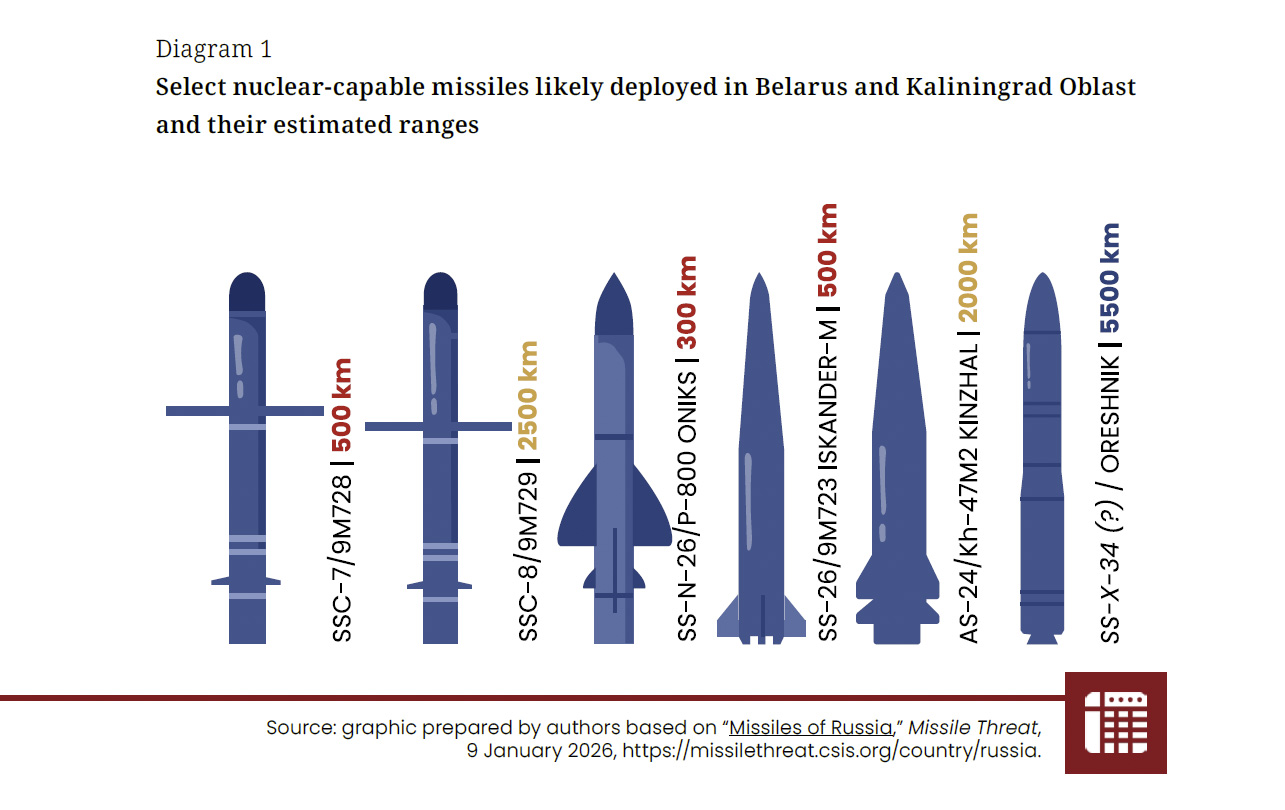
Russian nuclear-related capabilities deployed in Belarus and Kaliningrad Oblast
[Map 1]
[Map 3]Main recommendations
Click on each recommendation title below to view full details.
[Map 4]REPORT IN ENGLISH
Read the full report on nuclear threats to NATO's Eastern Flank.


safe%20Waters%20The%20Baltic%20Sea%20Region%20and%20the%20Redefinition%20of%20Security%20in%20Europe.jpg)