
Niger Ends Military Cooperation with the U.S.
After the July 2023 military coup and the adoption of an anti-Western political line, the junta ruling Niger demanded that the United States withdraw its military contingents from the country. This applies primarily to the operation of the drone base at Agadez, the most important American military installation for anti-terrorist and intelligence activities in the Sahara and the Sahel. The decision, which is part of the Niger government’s aim of “regaining sovereignty”, will qualitatively weaken the ability to contain jihadist groups in the region.
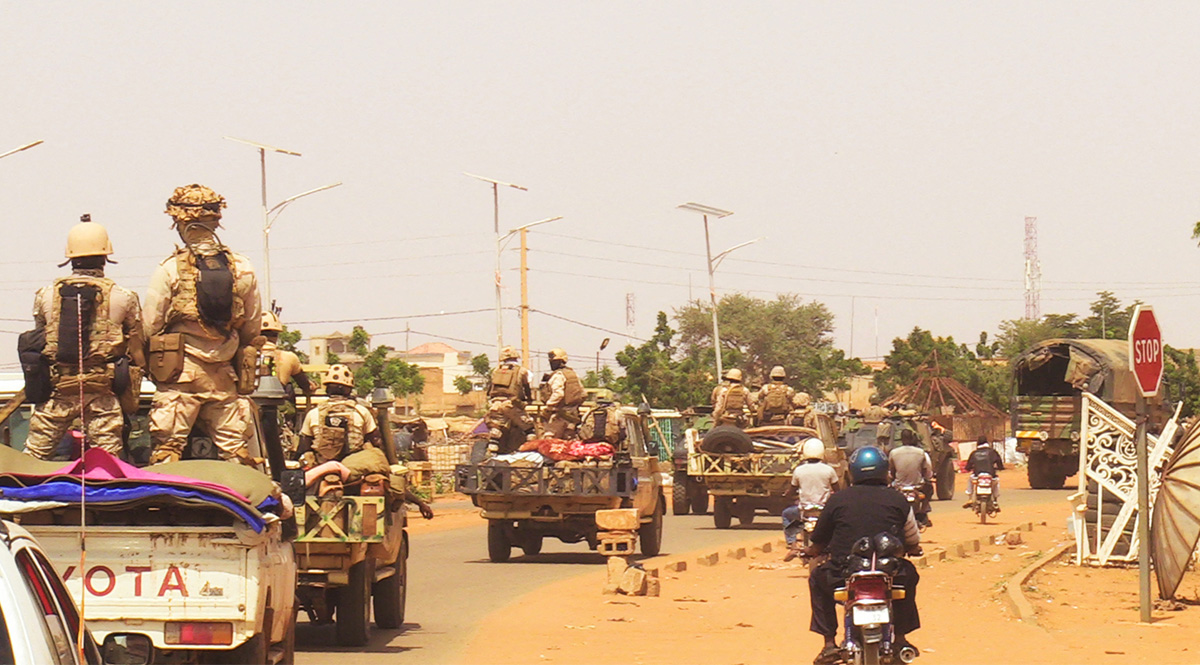 AA/ABACA / Abaca Press / Forum
What was the U.S. presence in Niger and what was its purpose?
The United States supports anti-terrorist activities by Sahel countries and their allies fighting against groups linked to Al-Qaeda and ISIS. For this purpose, the Americans built a $100 million reconnaissance drone base near Agadez, named Air Base 201. It was the largest foreign installation built independently by the U.S. Air Force. It was primarily intended to provide intelligence support for French military operations, initially in northern Mali. In practice, thanks to its convenient location in the centre of the Sahara and Sahel region, it allowed monitoring the movements of armed groups from Libya, across West Africa, to the Red Sea. Bilateral cooperation also included training Nigerien forces. Before the coup, there were about 1,100 American military and support personnel in Niger. As part of bilateral cooperation, the Americans provided military and training aid worth over $500 million since 2012.
How did the political context of the U.S. military presence change after the 2023 coup?
While Niger had been considered the West’s most reliable ally in the region, the officers that seized power in July 2023 took the opposite course, taking advantage of the growing anti-French sentiment. After the expulsion of several thousand troops from France and EU countries, the future of the American contingent became uncertain. The U.S. limited the base’s activity and reduced its staff. However, it tried to maintain it because of its military value and the cost to build it. The Americans signalled their willingness to cooperate pragmatically with the junta. However, the military rulers of Niger complained that the Americans did not share intelligence information obtained from reconnaissance flights from Base 201 and that they were pressing Niger to break off contacts with Russia with which it talked about military cooperation since last year. This irritated the junta ruling under the claim of “regaining sovereignty”, which it views as the freedom to choose Niger’s partners.
What consequences will the Nigerien authorities’ decision have?
By completely giving up military support from Western countries in the fight against extremist groups, Niger will be unable to replace them with forces of similar quality. Although Mali, Burkina Faso, and Niger—now all ruled by military juntas—announced the creation of joint anti-terrorist forces as part of the newly established Alliance of Sahel States (AES), it is difficult to expect effective cooperation between such weak countries that were unable to cope with the jihadists so far. The emerging gap in capabilities will not be filled by Russia, although the Niger authorities see it as their most important new ally, but it is probable that its forces will symbolically take over the base (as they did in Mali following the withdrawal of French troops). Therefore, extremist activity is likely to increase in Niger. Authorities will likely be turning to the Burkina Faso’s risky policy of arming local ethnic militias to support the central army, which will generate new local conflicts. For the junta, the security situation will be a credibility test and it will intensify repression to limit criticism from the opposition.
What does the change mean for U.S. activities in the region?
The United States had already calculated the possibility of losing its presence in Niger, so it researched possible directions for the relocation of its resources to countries friendly to its policies. The most likely destinations are Ghana and Côte d'Ivoire. In recent years, both of these countries have been struggling with jihadists penetrating from Mali and Burkina Faso into their northern borders and they criticise military coups and fear Russian imperialism. The U.S. transferring some resources to neighbouring Chad, where there are American troops, may also be considered, but this country is at great risk of destabilisation via processes similar to those in Niger. Regardless of location, the U.S. is unlikely to recreate the Agadez base infrastructure in another country because it would require a firm political decision, which is difficult to make in an election year, after several years of building up the Niger base and expending significant resources. Therefore, for the foreseeable future, the loss of the ability to operate in Niger, especially from Base 201, will severely weaken the U.S. ability to conduct anti-terrorist activities in a region that is becoming the global centre of jihadism. However, both the U.S. and the EU should be prepared for the possibility of returning to Mali, Burkina Faso, or Niger after a political change, which is likely if the juntas’ actions against extremists turn out to be ineffective.


.jpg)
