Lee Jae-myung's Inter-Korean Policy
South Korea’s attempts to improve relations with North Korea have been unsuccessful. Although this is mainly due to the Democratic People’s Republic of Korea’s (DPRK) reluctance to resume contacts with the Republic of Korea (ROK), an additional problem has been caused by the inconsistent actions of President Lee Jae-myung’s administration, which has been in office since June last year. The administration’s goal of ‘peaceful coexistence’ effectively means accepting reunification as unlikely, a prospect that is losing support in South Korean society. To avoid an escalation of tensions on the Korean Peninsula, South Korea could seek to cooperate with countries that regularly engage with the DPRK, such as Poland.
 Mike Segar / Reuters / Forum
Following a brief improvement in 2018, relations between the two Koreas began to deteriorate dramatically after the Hanoi summit between Kim Jong-un and Donald Trump failed in 2019. The DPRK authorities concluded that further dialogue with the Republic of Korea would not facilitate an agreement with the US and that closer ties with the democratic, capitalist state posed a threat to North Korea’s totalitarian regime. In December 2023, the DPRK leader declared an end to inter-Korean dialogue, labelling the Republic of Korea the ‘main enemy.’ The confrontational approach of Yoon Suk-yeol’s administration towards the DPRK also contributed to increased tensions between the two countries. This was demonstrated, for example, by the drones flown over Pyongyang in October 2024, which were intended to lead to an escalation that would justify the introduction of martial law and the promotion of unification through the de facto absorption of the North.
North Korea’s determination to push forward with its ‘two hostile states’ policy suggests that a new phase of hostility and growing risk of escalating tensions in inter-Korean relations began in 2024. In response, President Lee has declared his willingness to improve relations with North Korea.
Policy Objectives and Attempts at Implementation
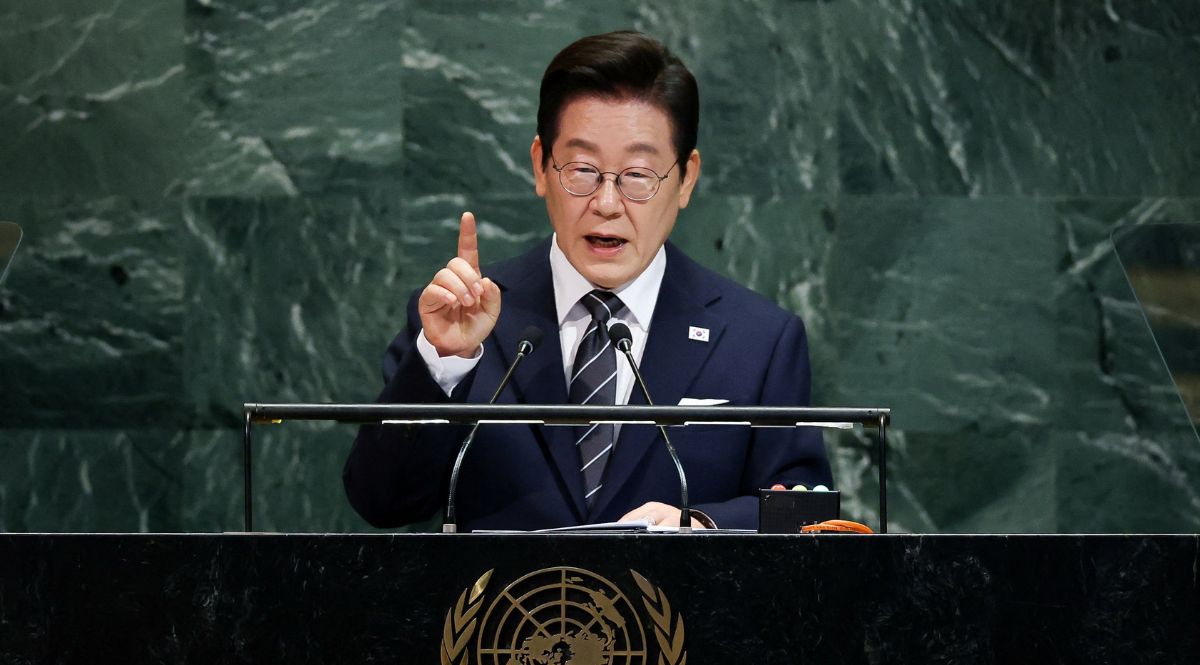
During the UN General Assembly session in September 2025, Lee announced his policy objectives regarding North Korea. The END initiative envisages resuming exchanges, normalising relations with the North, and denuclearisation. Regarding the latter issue, the president supports a three-stage approach: first, freezing the development of the DPRK’s nuclear programme; second, reducing it; and finally, dismantling it. Lee’s inter-Korean policy emphasises peaceful coexistence between the two states rather than unification. However, reunification is not explicitly rejected on constitutional grounds: according to Article 3, the Republic of Korea encompasses the entire Korean Peninsula, while Article 4 sets out the goal of unification.
The Lee administration rejected the previous government’s inter-Korean policy, renouncing unification through absorption and hostile actions. The suspension of propaganda broadcasts on the border and the cessation of the sending of anti-regime leaflets to the DPRK, both of which were announced in the first weeks of the Lee administration, served to reduce tensions. The government is also offering the DPRK the resumption of humanitarian aid, as well as economic and tourist cooperation, which is currently impossible due to UN sanctions. Furthermore, Lee has declared South Korea’s support for resuming talks between the US and North Korea, and is seeking China’s mediation to improve the situation on the Korean Peninsula. The Ministry of Unification is being reorganised to facilitate the revitalisation of inter-Korean communication channels. Meanwhile, the Ministry of National Defence is set to resume work on agreements concerning confidence-building measures and the easing of tensions between the two Koreas, work which was halted during the Yoon administration. Lee’s government intends to reinstate the 2018 inter-Korean agreement, which was suspended by the Yoon administration and subsequently violated by the DPRK in 2024. Lee’s policy is supported by the ruling Democratic Party, which announced in early January that it would establish a committee to promote the restoration of inter-Korean relations. Its members will include former unification ministers and advisers to previous liberal presidents: Kim Dae-jung, Roh Moo-hyun, and Moon Jae-in.
The government is trying to convince citizens to accept its policy of peaceful coexistence by expanding access to information from the DPRK, which is no longer considered a threat. Since the end of December 2025, the North Korean daily newspaper Rodong Sinmun has been made available in selected public libraries for all citizens to read — previously, access was restricted to officials, researchers and journalists, and required numerous approvals. The Ministry of Unification has also announced that it is relaxing regulations on access to online versions of DPRK media, which are currently banned for the general public. In his New Year statement, Lee stressed the importance of easing inter-Korean tensions to enhance the security of the Republic of Korea and ensure its long-term economic development.
Challenges
The most significant challenge to Lee’s inter-Korean policy is North Korea’s reluctance to resume contact with the South. The regime perceives contact with the South as a threat and believes that it has nothing to offer compared to the support it receives from Russia and China. Since 2024, the DPRK has also been demolishing what remains of the inter-Korean economic and tourist infrastructure. It also rejects denuclearisation, a key goal for Lee’s administration.
Divisions within the South Korean government are hindering the pursuit of a coherent policy towards the DPRK. Tensions between ministries are evident in the Minister of Unification’s proposals to limit South Korea’s military exercises with the US and recognise the two Korean states as separate entities. These ideas have been rejected by the Minister of Defence, the National Security Advisor and others. In response to these conflicts, in December last year, Lee ordered regular consultations to be initiated between the ministries of defence, foreign affairs and unification, with a view to developing a unified position towards the DPRK.
From the DPRK’s perspective, South Korea’s security policy does not inspire confidence in its peaceful intentions. While it has declared its readiness to resume talks, it is also strengthening its military potential. This is reflected in increased defence spending, the development of deterrence capabilities, military exercises with the US, and plans to take operational control of its army from the US by 2030. The North also accuses the South of repeatedly violating its airspace with drones, which it claims occurred in September last year and January this year. The South Korean military denies these allegations but has not ruled out the possibility that drones could have been launched by civilians without the government’s knowledge or consent.
Lee’s government policy is also influenced by the South Korean public’s declining interest in North Korean issues, especially reunification. In a 2025 survey by the government-funded Korea Institute for National Unification, more than half of respondents (51%) said that reunification was unnecessary for the first time since the survey began in 2014. Furthermore, 68% of respondents said they were not interested in North Korea at all. Meanwhile, the pursuit of peaceful coexistence enjoyed record-high public support (63%).
Conclusions and Prospects
Unlike previous liberal presidents, Lee does not consider inter-Korean relations to be the most important aspect of foreign policy. His attempts to improve relations with the DPRK, thus far unsuccessful, can be attributed to the structural changes that have occurred on the Korean Peninsula since 2024. Reunification is no longer the main goal defining the framework for inter-Korean policies for either country, even if only in theory. At the same time, the two countries’ approaches are irreconcilable: the South is advocating peaceful coexistence, while the North is pursuing the policy of “two hostile states.”
In the short and medium term, the stalemate between the two Koreas is likely to continue, with both countries developing their mutual deterrence capabilities. Occasional incidents, such as airspace violations, border clashes and cyber-attacks, are possible. As long as the DPRK continues to benefit significantly from its cooperation with Russia and China, it will reject offers from South Korea to resume contact. However, to influence South Korea’s internal politics, North Korea may signal apparent openness to dialogue, deepening disputes between liberals and conservatives, and weakening the cohesion of its alliance with the US. The lack of support for Lee’s inter-Korean policy from other countries in the region poses a problem for his government. Japan is focused on denuclearisation; China and Russia are strengthening their cooperation with North Korea; and the US attaches less importance to the DPRK than during Donald Trump’s first term, no longer identifying it as a priority threat in its National Defence Strategy.
Due to failed attempts to restore inter-Korean relations, South Korea is becoming increasingly interested in cooperating with countries that maintain channels of communication with North Korea. One such country is Poland, which has diplomatic missions in both North and South Korea, and has been a member of the Neutral Nations Supervisory Commission for decades. As with other EU countries, it is in Poland’s interest to support measures aimed at de-escalating tensions and promoting peaceful coexistence between the two Koreas without resorting to reunification.