Breaking the dependency - a shift in Austria's policy towards Russia
Christian Stocker’s government is the most critical of Russia in the last three decades. It is combating Russian espionage, criticising the aggression against Ukraine and supporting certain EU measures targeting Russia. This policy shift has been made possible by the scaling back of bilateral economic relations and the composition of the governing coalition. However, the changes in Austria’s eastern policy may not be permanent, as some political forces wish to return to trade and investment cooperation with Russia.
 Kremlin Pool / Russian Look / Forum
The evolution of policy towards Russia
Since its swearing-in on 3 March 2025, Christian Stocker’s government—backed by the Christian Democratic Austrian People’s Party (ÖVP), the Social Democratic Party of Austria (SPÖ) and New Austria and the Liberal Forum (NEOS)—has significantly revised Austria’s eastern policy. This has been largely attributed to NEOS leader Beate Meinl-Reisinger taking up the post of Minister for Foreign Affairs. She has challenged the status of neutrality used by successive Austrian governments as an argument for maintaining partnership relations with Russia, arguing that it is insufficient protection against Russia’s aggressive actions. Advocating a tougher policy towards Russia than that of her coalition partners and her predecessors, her stance is reflected in the government’s programme, which “condemns Russia’s war of aggression against Ukraine.”
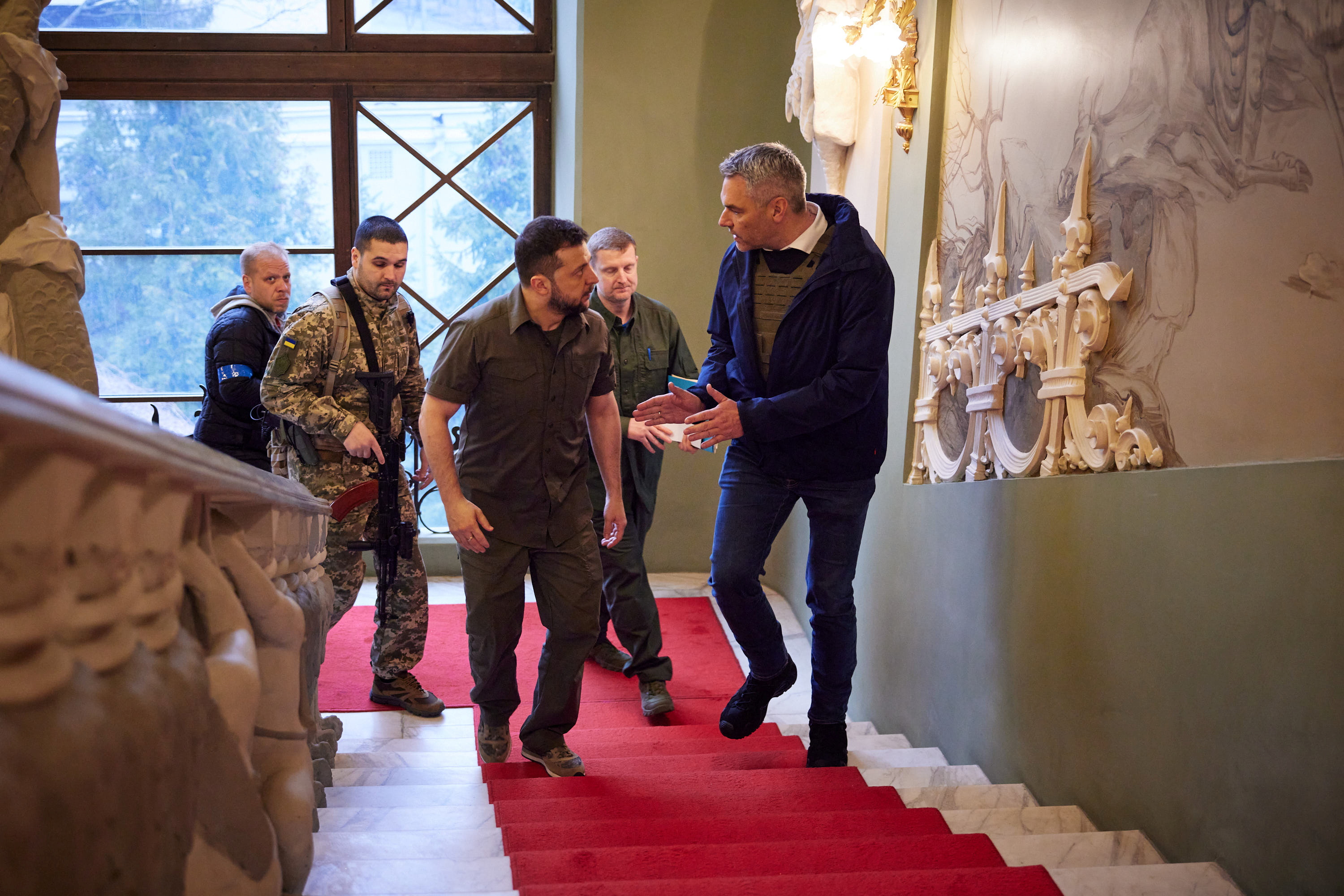
Although the invasion of Ukraine was also criticised by Karl Nehammer’s previous Christian Democratic–Green government (in power from 2021–2025), it emphasised Austria’s conciliatory approach towards both sides of the conflict. This was reflected in Nehammer’s visits to Kyiv and Moscow, which took place in quick succession in the spring of 2022. The openness of the leaders of the far-right Freedom Party of Austria (FPÖ) to contacts with Russian oligarchs led to the collapse of Sebastian Kurz’s government in May 2019. Currently, FPÖ leaders advocate lifting the sanctions imposed on Russia and resuming gas imports from that country, and the party remains both the most pro-Russian political force and the largest party in the Austrian parliament—holding 57 of the 183 seats in the lower house.
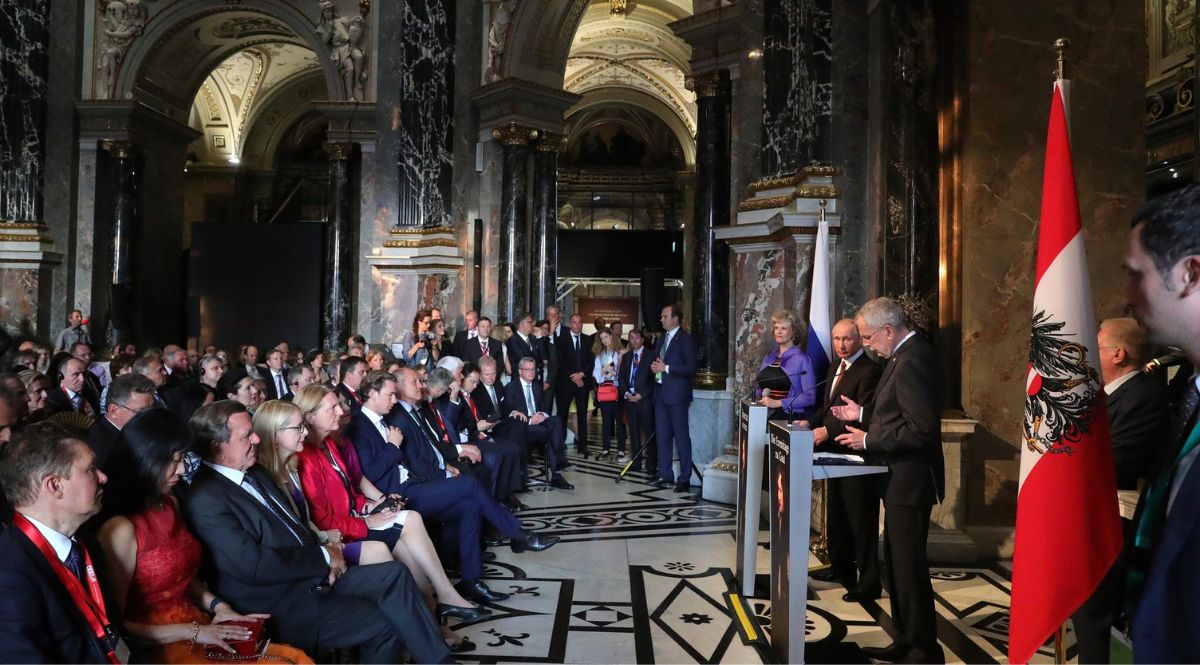
There has also been a shift in attitude towards Russia at the head of state level. Notably, this has taken place without a change in the presidency, with Alexander Van der Bellen holding the post since 2017. Although he hosted Vladimir Putin as recently as 2018 during his state visit to Vienna, following the outbreak of the war he came out in favour of supporting Ukraine and imposing sanctions on Russia. This set him apart from most of the presidential candidates in the October 2022 election and demonstrated a personal re-evaluation of his stance. The evolution of Austrian policy towards Russia has been accompanied by a matching shift in public opinion—in May this year, 64% of Austrians regarded Russia as a threat to the EU, compared with 37% in 2021, before the outbreak of full-scale war.
Changes in Austrian-Russian relations
Following Russia’s full-scale invasion of Ukraine, Austria moved away from its dependence on Russian energy resources, though unlike most EU consumer countries, it was not initially cut off from gas supplies by Russia. In November 2024, however, Gazprom also suspended supplies to Austria, and on 1 January 2025, the westward transit contract that had enabled gas to be transported via Ukraine expired. Austria’s previous heavy reliance on Russian gas (in 2022, the country imported 80% of its gas consumption from Russia, compared with an EU average of 45%) led to its resistance to EU energy sanctions.
Driven by the suspension of Russian gas imports (replaced by imports primarily from Germany and Italy) and EU sanctions, bilateral trade collapsed. Whilst Russia was Austria’s 18th largest trading partner in 2024, the following year saw it fall to 75th place. The halt to gas imports also meant that in 2025, for the first time, exports from Austria to Russia (around €0.9 billion) exceeded Austrian imports from that country (around €0.07 billion). The Austrian government is attempting to compensate for the reduction in trade with Russia by turning to other markets. Chancellor Stocker’s participation in the regular conference on the reconstruction of Ukraine in Gdańsk this June served to promote Austrian companies and expertise. Among the sectors with the greatest potential in this field, Stocker highlighted energy, infrastructure, financial services and modern technologies. Furthermore, the Austrian government has expressed its willingness to host another such conference in 2028.
The banking sector remains the main economic link between Austria and Russia. This is due to Raiffeisen Bank International (RBI)—the largest Western bank still operating in Russia—and despite the losses it has suffered as a result of a decision by the Russian courts (in 2025 it ordered RBI’s Russian subsidiary to pay approximately €2.4 billion to Rasperia, a company linked to the Russian oligarch Oleg Deripaska, for shares in Strabag). To compensate for these losses, the Austrian authorities are attempting to negotiate within the EU the transfer of frozen Russian assets to this bank. Pushing for this demand has slowed down the adoption of sanctions against Russia (including the 21st package). Meanwhile, the Russian capital invested in Austria (including holdings by Lukoil and Rasperia) is the fourth largest after Germany, the US and Switzerland, backed by the Austrian National Bank’s estimate that direct foreign investment from Russia in 2025 was €15 billion.
The Stocker government’s actions towards Russia
Austria’s long-standing extensive ties with Russia made it vulnerable to espionage, including actions under the guise of diplomacy. The likelihood of foreign intelligence activities is heightened by the presence in Vienna of numerous international organisations, such as the OSCE and UN agencies, and consequently by the large number of staff at Russian diplomatic missions (according to media estimates, around 220 people). Austria’s opposition to espionage activities on its territory is reflected by the regular expulsion of diplomats suspected of such practices. The most recent such expulsion took place in May this year following the discovery of satellite equipment used to intercept telecommunications signals, which had been installed on the roofs of Russian diplomatic buildings. In response, three Russian diplomats were expelled (bringing the total to 14 since 2020). Stocker’s government has also announced changes to the legislation governing penalties for espionage, making activities directed against international organisations based in Austria subject to penalties, not just those that undermine national security.
The Austrian authorities have officially criticised Russia’s actions, highlighting aspects of particular importance to Austria’s role on the international stage. In condemning the Russian missile attack on Kyiv on 15 June this year, which damaged the historic Kyiv-Pechersk Lavra complex, Chancellor Stocker emphasised its significance as a UNESCO World Heritage Site. Austria has also drawn particular attention to Russia’s violation of international law, a principle which the Austrian authorities have historically emphasised.
Stocker’s government supports efforts to achieve “a comprehensive, just and lasting peace based on international law.” At the same time, it believes that there is no political will in Russia for peace negotiations. Russia must be persuaded to engage in such negotiations through pressure from third countries, including BRICS members, and the EU should convince them to do so by utilising its network of permanent representations. An attempt to exert such pressure was made in May 2025 when Minister Meinl-Reisinger initiated a letter on this matter to the EU High Representative for Foreign Affairs and Security Policy, Kaja Kallas. Furthermore, in the view of the Austrian authorities, the EU should help shape the peace process and, to this end, appoint its own special representative to take part in the negotiations. In August 2025, Chancellor Stocker offered to host peace talks in Vienna. In doing so, he invoked the country’s neutrality and drew on Austria’s traditional role as a bridge between Russia and the West (the Austrian authorities had made a similar proposal following Russia’s annexation of Crimea in 2014).
Conclusions and outlook
Since 2022, Austria has been gradually moving away from a policy of favouring Russia and strengthening political and economic ties with it. NEOS’s influence on foreign policy since 2025 has also contributed to this shift, which has been accompanied by social change. This process has been facilitated by a decline in Russia’s economic importance to Austria, reflecting the marginalisation of bilateral trade, particularly gas imports. At the same time, Austria will continue to balance EU pressure on Russia against its own interests, which are primarily dictated by the need to protect the banking sector. Consequently, the Austrian authorities are likely to continue to slow the adoption of further rounds of sanctions.
Despite the loosening of Austria’s ties with Russia, a political rapprochement between the two countries is likely should the FPÖ return to power, and the party currently enjoys the highest level of public support (reaching 37–39% in polls from July). The constitutional deadline for parliamentary elections is autumn 2029. For Poland, the Stocker government’s stance towards Russia—notably harsh by Austrian standards—helps to foster a tougher policy towards that country in international forums. It also offers opportunities to deepen bilateral cooperation with a country that has withdrawn from a historical partner.