
After the Alaska Meeting: Russia Breaks Isolation, U.S. Holds Off on New Sanctions
On 15 August, U.S. President Donald Trump and Russian President Vladimir Putin met in Alaska. The talks did not lead to a change in U.S.-Russian relations or to an agreement on the war in Ukraine. However, Russia managed to gain time—especially the postponement of further restrictions by the U.S.—and broke Putin’s international isolation by Western countries.
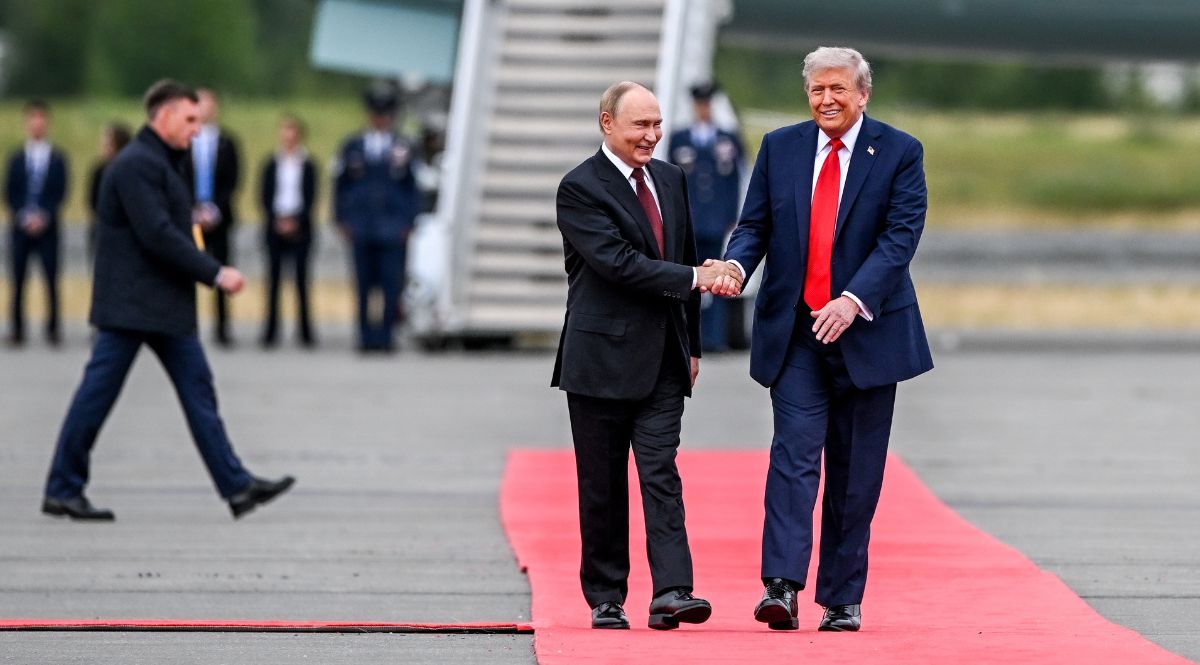 Sergei Bobylev / Zuma Press / Forum
How did the talks between the U.S. and Russian leaders proceed and what did they concern?
Contrary to announcements, the meeting was not held in a one-on-one format. The presidents were joined by representatives of their delegations: Secretary of State Marco Rubio and Special Envoy Steve Witkoff on the U.S. side, and by Foreign Minister Sergey Lavrov and adviser Yuri Ushakov on the Russian side. The meeting lasted almost three hours, but after its conclusion, the announced working lunch talks, which were to take place in a broader format with ministers responsible for the economy, trade, and defence, did not take place. During a joint media appearance, Trump and Putin made only brief statements in which they did not present any agreements and merely pointed to the constructive nature of the talks, without explaining their content, nor did they respond to questions from journalists. From a subsequent interview given by Trump to Fox News shortly after the meeting, it can be concluded that, in addition to the war in Ukraine and European security, issues such as economic cooperation, including joint investments in the energy and mining sectors, and the reduction of strategic arms under the New START treaty were also discussed.
What was Putin aiming for and what did he achieve?
During the meeting in Alaska, Russia managed to achieve its main goal, which was to postpone the introduction of possible new U.S. restrictions that could hit the Russian economy. This gives Putin more time to implement his strategic plans to subjugate Ukraine and, in the long term, to rebuild the security architecture in Europe. The shift in the subject of the negotiations from a ceasefire to a peace agreement was probably a deliberate negotiating tactic on the part of Russia, aimed at complicating the calculations of the U.S. and its Ukrainian and European partners. Russia did not break its economic isolation, however, but the U.S. representatives did not repeat threats of new restrictions against Russia or its trading partners. The Alaska meeting was also a public relations success for Russia, as it broke Putin’s international isolation by Western countries and presented him as an equal partner of the leader of the world’s only superpower. Establishing good relations with Trump will facilitate the continuation of direct dialogue between them, allowing Putin to seek to rebuild and develop relations with the U.S., including in the economic sphere.
Should we expect changes in Russia’s policy?
The lack of agreement confirms Russia’s unyielding position seeking international recognition of the Ukrainian territories it occupies, as well as the “neutralisation” of Ukraine by excluding the possibility of its accession to NATO. The fact that Putin mentioned the need to ensure Ukraine’s security for the first time during the conference in Alaska may indicate that during the meeting he was assured of the U.S. opposition to Ukraine’s membership in the Alliance and its readiness to accept key Russian demands regarding sovereignty over the occupied Donbas. At the same time, it is unclear what concessions Russia would be willing to offer in return, which confirms its strong negotiating position. It will therefore continue to seek to obstruct the negotiations, trying to prove their ineffectiveness, while at the same time attempting to separate them from the talks with the U.S. on bilateral relations, so as to normalise U.S.-Russian relations despite the lack of concessions on the war in Ukraine.
What does Trump want to achieve and what actions can be expected towards Russia and Ukraine?
Trump’s goal is to quickly reach a peace agreement, which would be a personal success for him. A trilateral meeting with Ukrainian President Volodymyr Zelensky in the near future is expected to provide an opportunity for this. According to the administration, the Alaska summit was the first step on the road to trilateral talks, with the second step being a meeting between Trump, Zelensky, and European leaders on 18 August in Washington. Talks in this format allow for an assessment of the real chances—based on Ukraine’s position—for a quick agreement. However, the administration’s inaction in the face of the lack of agreement, particularly the decision not to impose tariffs on countries importing Russian oil and gas (as announced in the ultimatum issued to Putin) weakens the credibility of future threats against Russia and bolster its belief in the effectiveness of its approach. After the meeting in Alaska, Rubio announced that the U.S. would not impose secondary tariffs or new sanctions, as this would reduce the chances of reaching an agreement. It cannot be ruled out that the Trump administration will press for further concessions from Ukraine in order to encourage Russia to compromise. It may also try to convince Putin to accept the U.S. offer through Belarusian leader Alexander Lukashenka, with whom Trump spoke on the phone shortly before the Alaska meeting. The U.S. president will continue to take into account the limited participation of selected European countries in the process, which, if an agreement is reached, will allow the burden of responsibility for maintaining it to be immediately transferred to allies and will be an additional negotiating success for domestic politics.
How does the Alaska meeting affect the security situation in Europe?
Although the meeting did not produce any constructive results that were communicated to the public, the very fact that it took place breaks the principled stance of Ukraine and European countries, which had made a ceasefire a precondition for negotiations with Russia. Russia’s actions indicate that it is consistently seeking to conclude an agreement with the U.S. without the participation of Ukraine and European countries. This stems from the belief that Trump would be willing to make far-reaching concessions in exchange for a quick success in the negotiations and the announcement of a peace agreement, regardless of the details. By making far-reaching territorial demands, Russia also hopes that any potential failure of the negotiations can be blamed on Zelensky and the European countries supporting him, which do not agree to a forceful change of borders in Europe. This would contribute to a breakdown in transatlantic ties and weaken U.S. engagement in Europe, making it easier for Russia to pursue changes in the security architecture that are favourable to it, in line with Putin’s December 2021 ultimatum. To counteract this, it will be important for European leaders (including Poland) to maintain consultations with the U.S. authorities, allowing not only insight into the course of negotiations but also coordination of actions to avoid potentially adverse consequences for European countries and NATO.



.jpg)
.png)
.png)