Legal Issues Related to the U.S. Withdrawal from the Nuclear Agreement with Iran
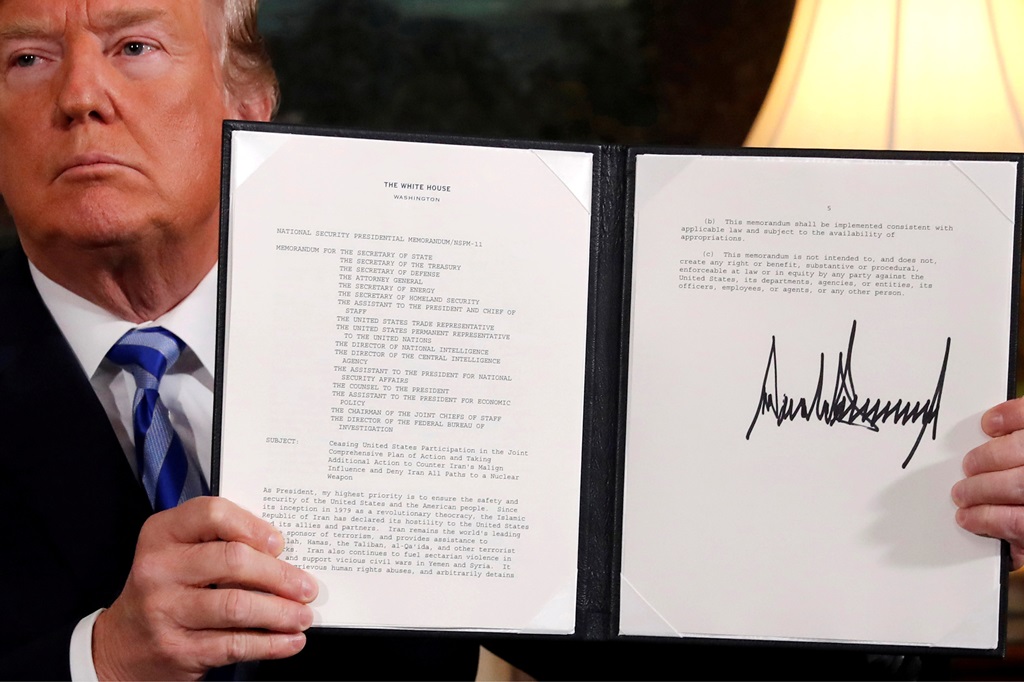
In May 2018, President Donald Trump announced that the U.S. would withdraw from the JCPOA and re-impose sanctions on Iran. They were fully implemented by 5 November 2018, even though International Atomic Energy Agency reports do not state Iran violated the agreement.
Legal Appraisal of the U.S. Decision
The JCPOA is a political agreement that does not impose legally binding obligations on its participants. However, in 2015 it was endorsed by UN Security Council (UNSC) Resolution 2231. The Security Council called for implementation of the JCPOA and lifted UN sanctions that had been imposed on Iran in connection with the development of its nuclear programme. Some countries, including Iran and Russia, consider the U.S. step to be in violation of the resolution, and others, such as China, have suggested the same.
Article 25 of the Charter of the United Nations allows for the UNSC to adopt a decision that imposes binding legal obligations on all UN members concerned and may, for example, transform some parts of a political agreement, such as the JCPOA, into binding obligations on its participants. In accordance with UN norms, a resolution or even just a part carries such weight if it uses the appropriate term (usually “the UNSC decides”) or if it refers to Chapter VII of the charter or a fragment thereof, e.g., Article 41. Resolution 2231 does so, but only with respect to a few paragraphs that refer to certain parts of the agreement. Therefore, it does not transform the JCPOA as a whole into a legal instrument in UN terms. In relation to UN members, only the provisions that impose restrictions on the sale of nuclear weapons, means of delivery, or conventional weapons to Iran are binding, but not those abolishing trade sanctions. The remaining binding provisions relate to the actions of the UNSC itself or to the effects of the agreement. As a consequence, the U.S. withdrawal from the JCPOA and re-imposition of sanctions on Iran does not breach Resolution 2231.
However, the U.S. sanctions may violate the U.S.-Iran Treaty of Amity of 1955. In July 2018, Iran filed a complaint with the International Court of Justice (ICJ), accusing the U.S. of breaching this treaty and demanding the lifting of the sanctions and compensation for resulting losses. Also, it submitted a request for an indication of provisional measures that would oblige the U.S. to suspend the sanctions until the final judgment is delivered. In an order of 3 October 2018, the ICJ ordered the U.S. to remove all restrictions affecting the export to Iran of medicines, medical devices, food, agricultural products, and parts and services necessary to ensure the safety of civil aviation. It ruled that even granting the normal reservation of “security interests” raised by the U.S., the imposed sanctions might irreparably prejudice Iran’s rights under the 1955 treaty by exposing the health and lives of its nationals to serious risk.
The U.S. sanctions had included some exceptions for goods and services specified in the ICJ’s order, but since being issued, the U.S. has not included the remaining exceptions. On the contrary, on the day the order was issued, Secretary of State Mike Pompeo announced that the U.S. would terminate the treaty of 1955. However, the proceedings before the ICJ will continue. If the U.S. does not relent, its sanctions will remain in violation of the order itself. Similar conflicts with U.S. compliance with ICJ orders have happened in the past, such as in the cases LaGrand (Germany v. USA) and Avena (Mexico v. USA), decided in 1999 and 2003, respectively. The U.S. has still not fully complied with them.
Alternatives to Withdrawal
The U.S. had a few options to choose from besides quitting the JCPOA. Under the deal, it could have referred issues of compliance to bodies named in the agreement or to participants’ foreign ministers. In the absence of a settlement and provided that the U.S. deemed the issues constituted significant non-performance of JCPOA commitments, it could have ceased performing its commitments in whole or in part by re-imposing the sanctions but without withdrawing from the JCPOA. The U.S. would then have remained a participant in the agreement, which is still in effect. Other participants, however, likely would have exerted pressure to lift the re-imposed sanctions, arguing that the U.S. allegations were baseless.
Second, relying on Resolution 2231, the U.S. could notify the UNSC of significant non-performance of commitments under the JCPOA by Iran. In that case, the U.S. would have still had to indicate the violations. The UNSC would then be required to adopt within 30 days of the notification a resolution to continue, in effect, the suspension of the sanctions, otherwise, all UNSC resolutions imposing sanctions on Iran superseded by Resolution 2231 would automatically be revived—a “snap-back mechanism.” In that case, Iran would, however, have the right to cease to perform its commitments under the JCPOA. Therefore, everything would return to the point before the agreement was concluded.
The U.S. chose a third option—withdrawal. The JCPOA does not provide that though because it is only a political agreement and one should assume the participants retained that right anyway. This choice allowed the U.S. not to have to prove at all that Iran had violated its JCPOA commitments. At the same time, the JCPOA remains in full force and Iran still has to respect it, even more so since the other participants continue to observe it and are insisting Iran do the same. Further, the U.S. may apply its own sanctions on Iran without being restricted by the JCPOA or Resolution 2231 because it is no longer a participant in the agreement.
Despite these advantages, this option also has its disadvantages. It deprives the U.S. of means of pressure against Iran envisaged in the JCPOA and Resolution 2231. Both instruments grant the right to refer issues of compliance or to use the “snap-back mechanism” only to participants in the agreement. The U.S. lawyers argue these “participants” in the JCPOA are those at the time it was concluded (China, France, Iran, Germany, Russia, the UK, the U.S., and the EU). However, it is unlikely the other participants in the agreement agree that the U.S. can both not be a participant in terms of the obligations under the JCPOA but still enjoy the rights flowing from it. Thus, in the event of a serious violation of the JCPOA by Iran in the future, the U.S. probably will have to persuade the UK or France to use the “snap-back mechanism” or the entire UNSC to adopt a new UN resolution re-imposing the sanctions.
Leaving the JCPOA in force also means that its time limits on restrictions on Iran’s purchase of conventional armaments (2020) and equipment and missile technology (2023) are still running. This makes it probable that by next year the U.S. may consider it necessary to impose additional sanctions on states that would then be legally trading arms with Iran.
Perspectives
The U.S. sanctions make it virtually impossible to cooperate with Iran, even for non-American entities, forcing them to give up trading and investment in the country. This will raise tensions in relations with the EU. In January 2019, France, Germany, and the UK created the INSTEX mechanism, which allows them to bypass restrictions on financing commercial transactions. If, however, the INSTEX activities go beyond transactions that are not sanctioned (e.g., medicine, food), the U.S. will likely extend the sanctions to those using the mechanism. From Poland’s point of view, this escalation would be detrimental, leading to deepening the transatlantic impasse with regard to Iran. Therefore, taking advantage of its good relations with the U.S., membership in the EU and the UNSC, and co-organisation of a conference devoted to peace in the Middle East, Poland could strive to reconcile the EU and U.S. positions.
As long as Iran complies with the JCPOA, one should not expect that the “snap-back mechanism” will be used by the remaining participants in the agreement or that the UN sanctions will be re-imposed. It is also unlikely that a new, broad agreement will be reached, combined with a UNSC resolution replacing Resolution 2231. The return of the U.S. to the JCPOA as it stands now is unrealistic as well. A possible option is a vote in the UNSC on a resolution complementing the JCPOA and Resolution 2231 by imposing additional obligations on Iran, obliging the U.S. to lift its unilateral sanctions, and including a separate “snap-back mechanism” allowing each UNSC member to unilaterally return to the present situation. Whether Iran would comply with newly imposed obligations would probably depend on their scope and expected benefits. One would still need, however, to persuade Russia and China to agree to such a solution.