What are the Goals and Implications of Israel's Airstrikes on Iran?
The Israeli airstrikes on military and nuclear targets in Iran that started on 13 June mark another stage in the long-standing rivalry between the two countries, which intensified after the 7 October 2023 attacks and escalated last year. Israel’s operations so far not have not eliminated Iran’s entire nuclear potential but increase the likelihood of its eventual decision to build its own nuclear weapons. The risk of the U.S. becoming directly entangled in another crisis in the Middle East is also rising, limiting the superpower’s capabilities and options in other parts of the world.
 credit: AMIR COHEN / Reuters / Forum
What might be the goals of Israel’s military operations?
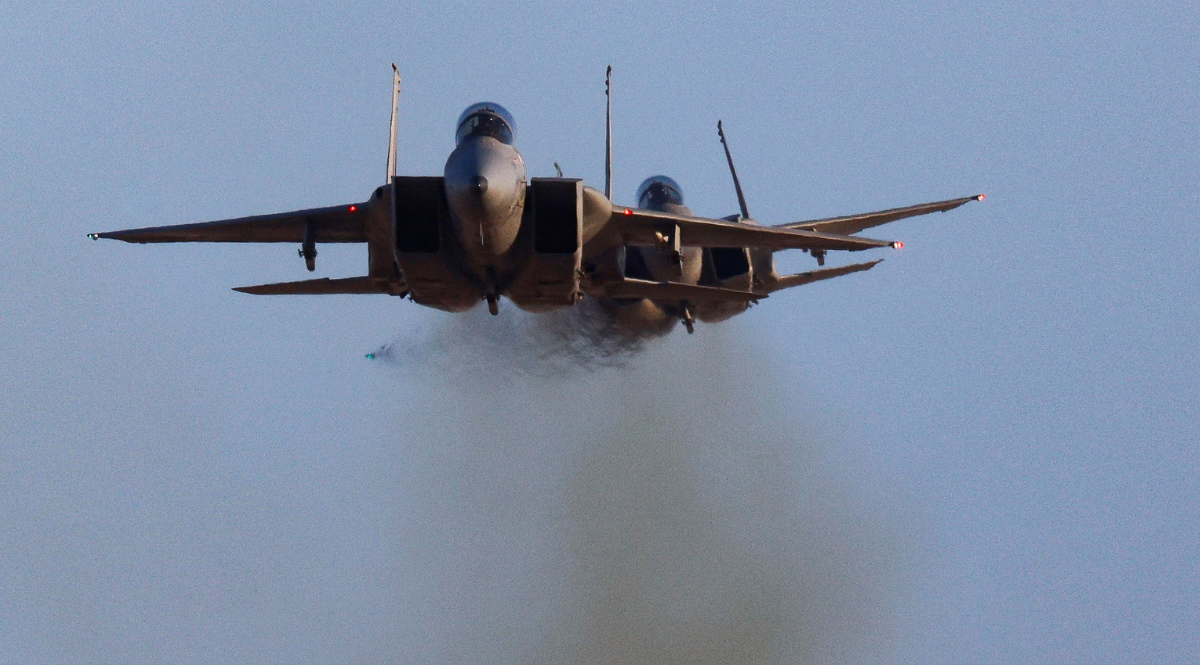
The Israeli government declared that the first phase of the operation is justified by the existential threat posed by the Iranian regime and its nuclear programme. According to the General Staff of Israel, more than a dozen military and nuclear targets have been bombed in the western and central provinces of Iran. During its first day of operations, the Israeli air force struck the headquarters of the Iranian regular armed forces and the Islamic Revolutionary Guard Corps in Teheran and its suburbs, the main uranium enrichment facility in Natanz, the uranium conversion facility in Isfahan, the construction site of planned heavy water reactor in Arak, as well as missile and air bases in the western Iran. These suggest that Israel wants first and foremost to paralyse Iran’s political and military decision-making, and limit its retaliatory capabilities. It is clear that Israel is focused on destroying the nuclear centres that have the weakest security and air protection. The initial waves of Israeli airstrikes avoided the best-protected uranium enrichment facility in Fordow (protected in tunnels below mountain rocks), the research reactor in Tehran, the civilian reactor and power plant in Bushehr where spent nuclear fuel is controlled by Russia). In a speech by Israel’s prime minister and the codename Rising Lion (referring to both the “Lion of Judah” and the Pahlavi dynasty) indicate a focus on a longer air campaign that intends not only to limit Iran’s nuclear potential but also perhaps to weaken or destabilise the regime of the Islamic Republic. Evidence that these are its goals might be confirmed by strikes on the headquarters of Iran’s internal security services and forces, as well as on the main centres of its oil and gas sector.
Is there a danger of a wider Iran-Israel regional war?
Since the Islamic Revolution of 1979, Iran and Israel have been in a state of undeclared war, during which time both countries, separated by other states, have avoided a direct armed clash and preferred unconventional forces and means. Since 7 October 2023, Israel has been systematically combating Iran-sponsored terrorist and paramilitary groups, especially Palestinian Hamas and the Lebanese Hezbollah. Intensive Israeli operations have essentially eliminated the military threat previously posed by Hamas and at least half of Hezbollah’s rocket and missile arsenal. These were accompanied by exchanges of Iran-Israel air and missile strikes in April and October 2024. Moreover, Israel, in deciding to carry out intense strikes on Iran, likely took into account other favourable circumstances related to the unprecedented weakening of the regional “axis of resistance” that the regime in Tehran has been building and sponsoring for a few decades. Other very favourable conditions for Israel include the fall of the pro-Iranian Assad regime in Syria at the end of 2024 and the repeated, intensive U.S. airstrikes on the Houthi militia in Yemen since the inauguration of the second Donald Trump administration. Moreover, Iran does not possess modern air forces that would allow it to respond in an analogical and symmetrical way to Israel. Therefore, the scope of Iran’s conventional retaliation may be limited for now to several dozen salvos of long-range drones and cruise and ballistic missile attacks, which will be mitigated by the missile defences of Israel, the U.S., and their allies in the region. This in turn may encourage the Iranian regime to use terrorist methods in parallel (or at a later time) against Israel’s diplomatic missions or Jewish cultural centres outside the Middle East. The most risk for escalation would be missile attacks by Iran or its allied militias on the still numerous U.S. military bases in the region, as well as attempts to block the transit of oil tankers via the Strait of Hormuz in the Persian Gulf.
What are implications for Iran’s nuclear programme?
Israel’s military campaign may determine the future scale and purpose of Iran’s nuclear programme, which until recently had reached nuclear threshold status. In the very short term the attacks may nullify the purpose of the nuclear negotiations between Iran and the U.S. that began in April this year. Israel’s first strikes did not eliminate the Fordow nuclear centre where uranium is enriched to 60% and stored (warhead cores require weapons-grade uranium at the 90% level), and further strikes will not neutralise Iran’s full nuclear industrial base or knowledge necessary to build a nuclear arsenal. It currently has several tonnes of uranium in various forms, which after enrichment could be used for building a dozen or so implosion warheads with a uranium core. Iran halted weaponisation (work on warheads) in 2003 but retains the capabilities to enrich uranium, so it is difficult to consider Israel’s current operation as preventive strikes analogous to its bombing of reactors in Iraq in 1981 and Syria in 2007. However, the likelihood of further escalation and the need for the Iranian regime to save face may even force the government to exit the Non-Proliferation Treaty and work towards obtaining a smaller nuclear arsenal by using the Fordow centre or some other, better hidden and protected uranium enrichment facilities. This would mean that Israel would have to repeatedly strike Iranian nuclear and missile centres in the future.
What might be the global consequences of Israel’s actions?
The broader effects of Israel’s operation may include first and foremost an increase in oil prices, which may persist if the military crisis escalates to the Strait of Hormuz. Even of the current U.S. administration was not interested in continuing a military presence in the Persian Gulf, it will be forced to do so again. That could strengthen Trump’s desire to reduce its land forces in Europe, while at the same time maintain air and naval assets on NATO’s Southern Flank to support Israeli and U.S. operations in the Middle East. In the short to medium term, it will be necessary to provide additional security and protection for U.S. forces and bases in Europe due to the higher threat of terrorist attacks. Although China and Russia are not formal allies with Iran and will not provide direct military aid or support, their diplomacy will sharply criticise the policies of both Israel and the U.S. In the short term, it may make more difficult to reach further compromises or a comprehensive “reset” in U.S.-Russia relations, which both sides have been striving for since January. However, this does not mean that the U.S. government, in particular President Trump and Vice President J.D. Vance will change their stance against providing military assistance to Ukraine any time soon. With U.S.-Iran nuclear talks still engaged, the policy of EU countries will require high flexibility. First of all, Europeans should appeal for regional and immediate de-escalation, taking into account the possibility of the further entanglement of the U.S. in the conflict between Iran and Israel.


.jpg)