
"Victory Day" Celebrations in Russia
On 9 May, Russia celebrated the 80th anniversary of the end of the Great Patriotic War. The most important events took place in Moscow, where Vladimir Putin, in the presence of dozens of leaders of other states, outlined the course of current international alliances. The celebrations showed that Russia will further develop its alliance with China and continue its militarisation of society and its imperial policy aimed primarily at Western states.
.jpg) Vyacheslav Prokofyev / Zuma Press / Forum
Vyacheslav Prokofyev / Zuma Press / Forum
What is the importance of 9 May in Russia?
For more than a dozen years, 9 May has been the most significant public holiday in Russia. Remembrance of the “great victory over Nazism” in the Second World War is not only intended to contribute to national unity and pride but also to overshadow the memory of the USSR’s defeat in the Cold War. The celebrations have a special significance, accompanied by a series of social and cultural events and a relevant media and propaganda setting to shape the historical knowledge of Russians in line with the needs of the state and to provide a rationale for current foreign policy. From 2022 onwards, the celebrations, through comparisons of participants in the war against Ukraine to heroes of the Great Patriotic War (GPW), serve to justify one of the aims of the invasion, which formally is the “denazification” of Ukraine. In turn, the alleged need for the “denazification” of European countries is used by the Russian authorities to explain why those states support Ukraine and relations with Russia have deteriorated. At the same time, despite media speculation for several weeks that this year’s celebrations would be of a special character, they were—apart from the greater participation of foreign guests and soldiers from the 13 friendly countries that took part in the parade—comparable to previous years.
What did Putin say in his speech?
As in previous years, Putin focused on historical issues, only indirectly referring to the current political situation. He stressed that Russia would not accept the “hypocrisy” of the memory of the GPW and added that the state’s policy would be to act as a “barrier” to Nazism, Russophobia and anti-Semitism, and to the alleged supporters of these ideologies. This was a reference not only to the aims of such states’ actions with respect to Ukraine but also to the claims presented by Russian propaganda that Nazism and Russophobia are becoming increasingly popular in Western Europe. Putin also emphasised that Russia will not allow the “truth” about the GPW to be falsified, which can be read as a prelude to increased disinformation activities in the area of historical policy targeting Western countries, including Poland. The Russian president also focused on highlighting the role of the Soviet people and China in defeating Nazism, de facto depreciating the actions of Western European states and the United States. In doing so, Putin made it clear how he sees current international alliances as shaping up, and where Russia and China are supposed to have an advantage over Western states.
What new military equipment was presented?
Accompanying the celebrations are military parades, with the most important one taking place in Moscow’s Red Square. They traditionally serve to showcase the strength of the state, and over the years have been used to promote new Russian-made weaponry. This year, Moscow’s main display was of equipment used in the war against Ukraine, including tanks, armoured vehicles, and medical evacuation vehicles. For the first time, military drone armaments, including the unmanned systems Orlan, ZALA Lancet, Geran, and Garpiya, were displayed in Red Square, demonstrating their growing importance on the modern battlefield and corresponding with Russia’s plans to expand production capabilities in this area. The equipment parade is traditionally closed with systems capable of carrying nuclear warheads (this year, they were Iskander-M and Yars), the presence of which the Russians have always used for nuclear signalling. At the same time, because of the high risk of a Ukrainian drone attack, additional air defence systems were brought to Moscow, but Ukraine did not carry out any actions against the Russian capital, focusing its attacks in the border region of Belgorod.
Which foreign guests were at the celebrations?
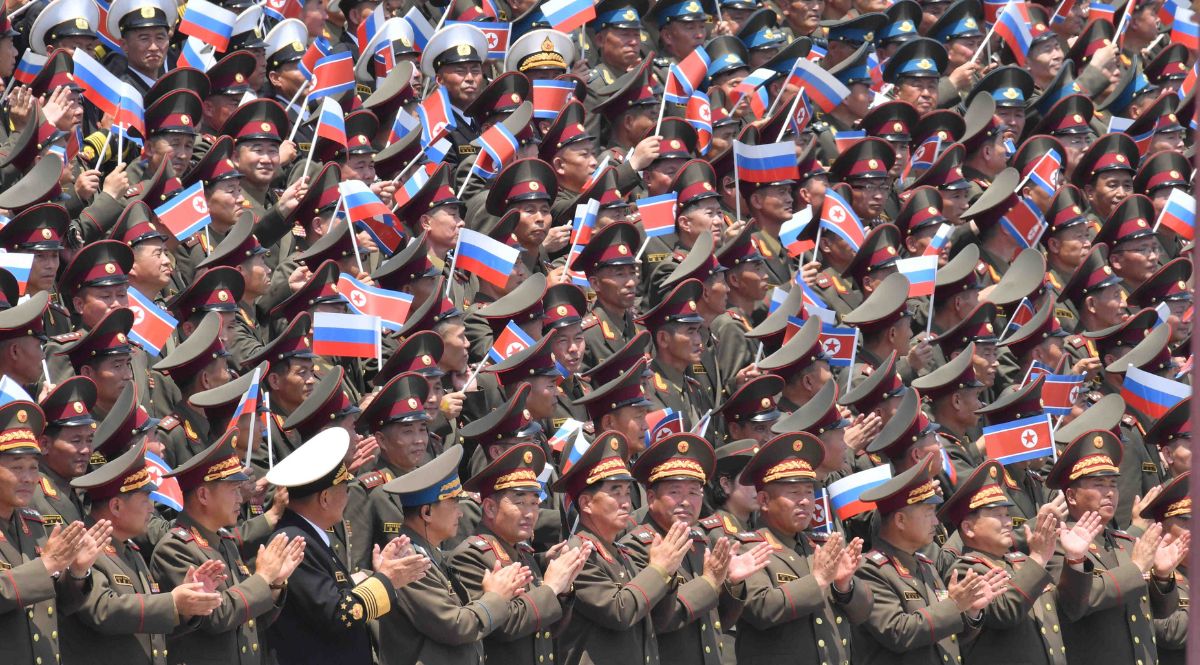
Twenty-nine heads of state came to Moscow, including China’s President Xi Jinping, who was the guest of honour. Representatives from most of the post-Soviet states—Armenia, Azerbaijan, Belarus, Kazakhstan, Kyrgyzstan, Uzbekistan, and Tajikistan—were present, as well as the leaders of Brazil, Burkina Faso, Ethiopia, Egypt, Guinea-Bissau, Equatorial Guinea, Cuba, Republic of the Congo, Laos, Myanmar, Mongolia, Palestine, Serbia and the Republika Srpska (part of Bosnia and Herzegovina), Venezuela, Vietnam, and Zimbabwe. Among the leaders of EU or NATO countries, only Slovakian Prime Minister Robert Fico was present. Also present in Red Square was a military delegation from North Korea, whose soldiers are engaged in a war with Ukraine. However, due to tensions with Pakistan, the Indian prime minister did not attend the parade. Such a wide range of participants was intended to prove that Russia is not only not isolated internationally but also is one of the world’s leaders. Russia maintains close diplomatic, economic and military relations with most of these countries, and most of them share Russia’s desire to build a multipolar world. On the sidelines of the celebrations, Russia issued a joint statement with China “on further deepening comprehensive partnership and strategic cooperation in the new era” to emphasise the two countries’ alliance. It also signed a cooperation and strategic partnership agreement with Venezuela.
What did the events imply about Russia’s plans?
The course of the ceremonies demonstrated the special nature of Russia’s relationship with China and sent a clear signal to the U.S. that Russia’s alliances are not expected to change. Russia will continue to pursue its ambitions of wanting to be seen as one of the world leaders and a power that can shape its international environment. It will also seek to shape a coalition of states aiming to overthrow Western hegemony. NATO, which members are accused of militarisation and hostile actions, will continue to be Russia’s main rival. The celebrations in Moscow and other Russian cities also showed a significant militarisation of Russian society. This will have an impact on the way Russia conducts its foreign policy, for the authorities of which the ability to use military force is a fundamental element. Russia will therefore continue its hostile policy towards Western countries. It will also pursue its objectives in Ukraine, including during the bilateral negotiations it has proposed to hold in Istanbul.

.png)