
US-German relations in the Trump and Merz era
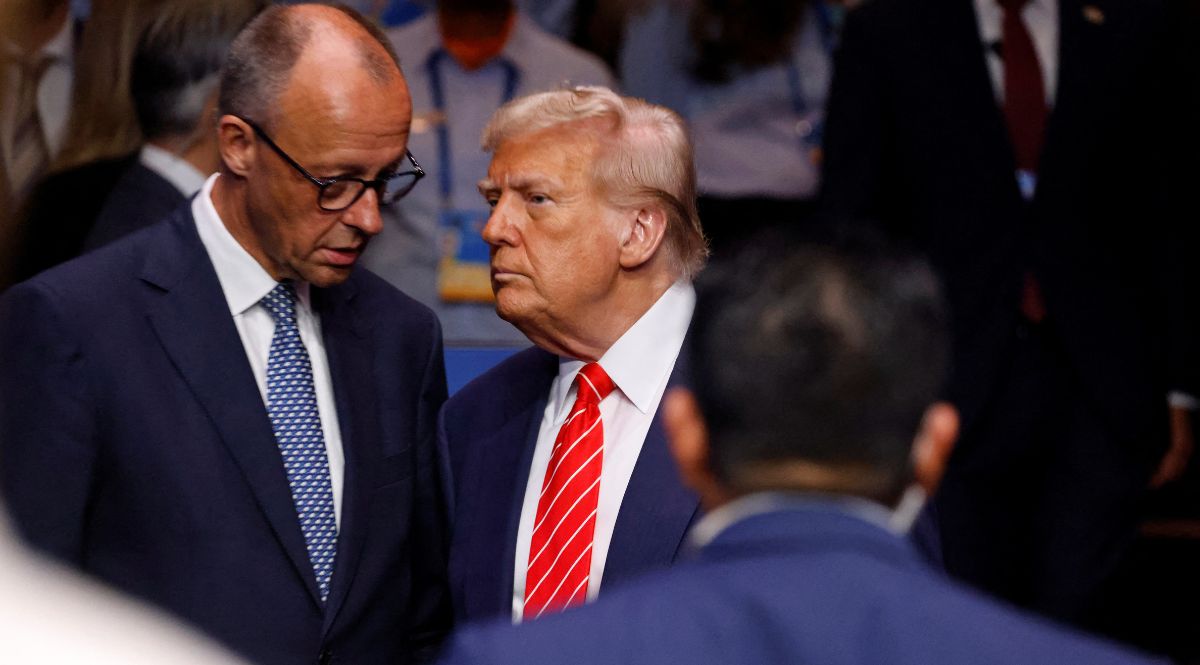
Unlike Donald Trump's first term, when his personal dislike of Chancellor Angela Merkel caused numerous tensions in relations with Germany, the US administration has now adopted a more pragmatic course. At the same time, Friedrich Merz's government is pursuing a policy of concessions on selected issues, such as trade policy, where it faces pressure from the Trump administration's protectionist approach, in order to maintain transatlantic ties. Close cooperation in the fields of energy and defence, as well as an increase in German military spending, will stabilise Germany's position at the forefront of the US's European partners.
 LUDOVIC MARIN / Reuters / Forum
US-German relations are an integral part of broader transatlantic relations, which is particularly evident in security and economic issues. Approximately 39,000 of the 85,000 US troops stationed in Europe are currently based in Germany – the largest number of any European country and the second largest in the world after Japan. Germany is also one of the five NATO countries participating in the US nuclear sharing program. In trade relations, in 2024 the US surpassed China and became (for the first time since 2015) Germany's most important economic partner, while Germany stands as the fifth most important partner for the US. The total value of trade in 2024 amounted to over €253 billion, accounting for as much as 15% of all trade between the US and the EU.
The Merz government's policy
Due to its dependence on US security guarantees and the need to deter Russia, Germany's strategic goal is to preserve transatlantic bonds. Fearing Trump's unpredictability, Germany adopted a financial package in March this year that allowed for a significant increase in defence spending. The chancellor also unequivocally supported the conclusions of the NATO summit in The Hague regarding a significant increase in member states' spending in line with US demands, to a total of 5% of GDP.
At the same time, Germany is preparing for a scenario in which the US will be increasingly involved in the Indo-Pacific and the Americas, accepting that this will be at the expense of support for Europe. In order to maintain its status as a key partner for the US, Merz has signalled that Germany is ready to gradually take on greater responsibility for security in Europe. The Chancellor declared his intention to expand the Bundeswehr to the level of the largest conventional army on the continent. Aware of the barriers to implementing these declarations, such as problems related to military bureaucracy and public sentiment (according to an August FORSA poll, only 16% of Germans strongly declared their willingness to defend their country in case of an armed attack), Merz's government will seek to persuade the US to gradually change the nature of transatlantic cooperation in order to avoid a sharp reduction in its involvement in Europe.
The Chancellor is conducting a policy of tactical concessions towards the US on trade and customs issues in order to avoid tensions in relations with the American president. Despite regulations that are unfavourable from the point of view of German business, the federal government supports the agreement concluded in July on a framework trade agreement between the EU and the US. In parallel with the concessions made to the US, and bearing in mind the interests of the export-oriented German economy, Merz's government is looking for alternative markets. An example of the ongoing diversification of trade relations is Germany's support for the EU-Mercosur trade agreement and for further agreements, including with India.
A potential area of conflict between Germany and the US is their approach to China. While the US administration continues to view the PRC as a major threat in terms of both security and trade, Germany, like the European Commission, sees it as a partner, competitor, and systemic rival, with the latter element being emphasised. Merz has stressed that the PRC's foreign policy is part of the global rivalry between democratic states and autocracies. Foreign Minister Johann Wadephul warned that China's policy in the South China Sea threatens the interests of Germany and Europe.
In trade relations, Germany will try to stay neutral in the US-China rivalry. The scale of German companies' involvement in China (they invested €14.6 billion between 2022 and 2024) remains a problem, as they are pressuring the chancellor to maintain cooperation with China, as is Germany's dependence on imports of many products (including electronics) and rare earth metals. The pace of implementing de-risking measures remains slow, as it was under Chancellor Scholz.
A change in Trump's approach to Germany
Between his first and second terms as president, Trump's attitude toward relations with Germany shifted. The main factor influencing this change was the absence of Trump's personal animosity toward Chancellor Angela Merkel. This was due to his assessment of her as being guilty of cooperating with Russia, insufficient defence spending, an energy policy that Trump found incomprehensible (the so-called phasing out of nuclear power plants, investments in renewable energy sources), and liberal migration and social policies, which Trump saw as evidence of Western Europe's dysfunction. Although Merkel retired from politics in 2021, the MAGA community surrounding Trump continues to harbour animosity toward the German government and, more broadly, the liberal EU. This was evident both in Vice President J.D. Vance's critical speech on Europe in Munich in February this year and in the MAGA community's support for the far-right Alternative for Germany (AfD).
Yet, changes in the German government's approach to key policy issues argued in favour of the Trump administration's pragmatic approach to cooperation. On the one hand, increased military spending is expected to result in increased purchases from American companies – the Merz government has presented a plan to finance, among other things, the purchase of 15 additional F-35 Lightning II fighter jets, four P-8A Poseidon maritime patrol aircraft, three Typhon launchers, and 400 Tomahawk missiles. On the other hand, the focus on importing hydrocarbons from the US, which is a broader European trend, also benefits the American economy – almost 80% of the LNG imported by Germany in 2023 came from the US. As a result, Merz met with Trump at the White House in early June, just one month after taking office as chancellor. He returned there in August as one of the leaders of a European coalition of willing countries who accompanied Ukrainian President Volodymyr Zelensky to a meeting with Trump shortly after the summit in Alaska. In October, Germany managed to obtain an exemption from US sanctions imposed by the Treasury Department on Lukoil and Rosneft against the latter’s German subsidiary, Rosneft Deutschland.
Still, Germany is bearing the costs of Trump's protectionist policies and widespread tariffs. Like other EU countries, under the July agreement, goods imported by the US are subject to a 15% tariff, as are passenger cars and car parts, as well as wood, timber, and wood products (other countries outside the EU and Japan are subject to a 25% tariff). In other cases, EU countries are subject to the same rates as the rest of the world: 25% for trucks; 50% for aluminium, copper, and steel.
Conclusions
The attitude of both Merz and Trump enables the development of constructive cooperation between the US and Germany. However, it is not certain that this cooperation will continue throughout Trump's presidency. On the one hand, it may be disrupted by MAGA sentiments towards the far-right AfD and attempts to influence the internal situation. The US administration's approach to economic issues may also escalate to a level that becomes unacceptable to the German political elite. The issue of their close cooperation with China, which is viewed negatively by the US authorities, may also begin to play a greater role in the approach to Germany. At the same time, the Trump administration's protectionist approach to economic cooperation will not make it easier to reduce Germany's dependence on China, and will also encourage the forging of new partnerships with countries viewed ambiguously by the Trump administration, such as India or Brazil, which are part of BRICS.
Merz's government has acknowledged that the eventual weakening of transatlantic ties is inevitable. It is crucial for Germany that this should take place gradually as a political process, with as little conflict and friction in bilateral relations as possible. To achieve this, they will take a two-track approach. In the short term, we can expect a continuation of the policy of ad hoc economic concessions and avoidance of political disputes. In the longer term, Germany will seek to maintain its status as the US’s most important partner on the continent, even if American involvement in Europe weakens, by modernising its armed forces and consolidating other European countries around itself.
From Poland's perspective, positive German-American relations are beneficial as long as they enable the US to maintain as much of a military presence in Europe as possible. It is also in the interests of Poland and Germany to strengthen NATO's European pillar as a deterrent to Russia. In the long term, there is a risk that Germany's growing military and political role could weaken Poland's position as an important US ally.



.png)
.jpg)
.jpg)