Trade and Technology Council's Future in Question under Trump
Donald Trump’s second term marks a return to a policy of scepticism towards international institutions and transatlantic cooperation. This puts a question mark over the future of the Trade and Technology Council (TTC), the main format for EU-U.S. cooperation in the area of new technologies, established under President Joe Biden. In light of Trump’s rhetoric towards the EU, it seems that the Council’s importance will be less than before.
.png) Win McNamee / Reuters / Forum
Win McNamee / Reuters / Forum
TTC’s Activities. The TTC was established by the EU and the U.S. in June 2021. Its goal was to strengthen transatlantic cooperation on new technologies (especially artificial intelligence, or AI, 6G networks, and semiconductors), which had weakened during Trump’s first term. It was also intended to foster the development of trade and investment, while promoting sustainable development and decarbonisation of industry. The Council met twice a year with the participation of relevant EU commissioners and the secretaries of relevant U.S. federal departments.
The Council’s successes have been limited, including the adoption of a roadmap for 6G development or a declaration setting common standards for green public procurement. The TTC has significantly improved information exchange between the EU and the U.S. It also unified approaches to issues such as AI terminology and countering disinformation (adoption of a common methodology for analysing foreign information manipulation and interference, or FIMI, including the DISARM and STIX disinformation analysis standards). In the area of cybersecurity and supply-chain protection, among other things, an early warning mechanism for threats to semiconductor supplies has been established.
The format has also stirred controversy, primarily in the United States. Think tanks associated with Trump, such as the Heritage Foundation, directly question the point of the TTC, arguing that it is ineffective. A lack of efficiency was cited by some representatives of the Democratic Party, and a review of the Council’s functioning was also expected in the event Kamala Harris won the presidency. Indeed, based on its name, the TTC was supposed to deal with trade issues, but these were rarely the subject of its work.
Risks and Opportunities for the TTC. Trump’s return to office could significantly affect the operation of the council due to serious disagreements and interests between the EU and the new administration in several areas. The first is regulation. The EU seeks to create a regulatory framework to limit undesirable uses of technologies (it wants to eliminate high carbon-emission ones in its energy and industrial policies, for example), while setting standards to counter potential threats from new technologies (e.g., through the Artificial Intelligence Act). Meanwhile, under Trump, the U.S. is focusing on deregulation—on his first day in office, the president repealed an AI security regulation. The new administration favours limited legislative interference and subsidising technologies deemed desirable to accelerate their development. An example of one of his intended targets is the promotion of the low-carbon economy with tax credits introduced by the Inflation Reduction Act (IRA). Regulatory tensions are exacerbated by the influence of tech industry leaders, particularly Elon Musk, who is personally involved in disputes with the EU over, among other things, the need for the X social media platform he owns to comply with the EU’s Digital Services Act (DSA). On the other hand, the EU is beginning to recognise that overregulation is stifling technology development. The Draghi Report on EU Competitiveness suggests reducing regulatory pressure and funding innovation more, following the example of the United States. The new European Commission (EC) and the U.S. administration adopting a convergent stance on support for the digital economy could positively affect cooperation within the TTC.
Another potential area of contention in the council is climate policy. The EU, as the global leader in this area, hoped that the council could be a format for mobilising joint efforts for the research and development of low-carbon technologies or setting transatlantic standards for low-carbon production, which would facilitate so-called green trade between the EU and the U.S. Trump, critical of climate regulation, sees standardisation as a form of overregulation of the economy.
The rivalry with China, meanwhile, presents an opportunity to develop the TTC as a platform to combine EU and U.S. capabilities in strategic sectors such as semiconductors and electromobility. Cooperation in electromobility may be fostered by Musk, who is personally interested in Europe as a market for electric cars produced by his company Tesla. Cooperation may further be driven by the joint development of 6G networks and quantum technologies, as well as system interoperability, which is key to further network development and cybersecurity. Here again, the China angle may be a motivating factor as neither the U.S. nor the EU wants China to gain the upper hand in any of these areas. To counter this, however, a significant softening of Trump’s course towards the EU would be necessary. At present, this seems unlikely. The United States would also have to recognise the benefits of the TTC’s work, especially as a tool in its rivalry with China. It would also be important to overcome the EU’s previous reluctance to turn the council into an anti-China format. An indication that this stance may be changed is the imposition of EU tariffs on Chinese electric cars.
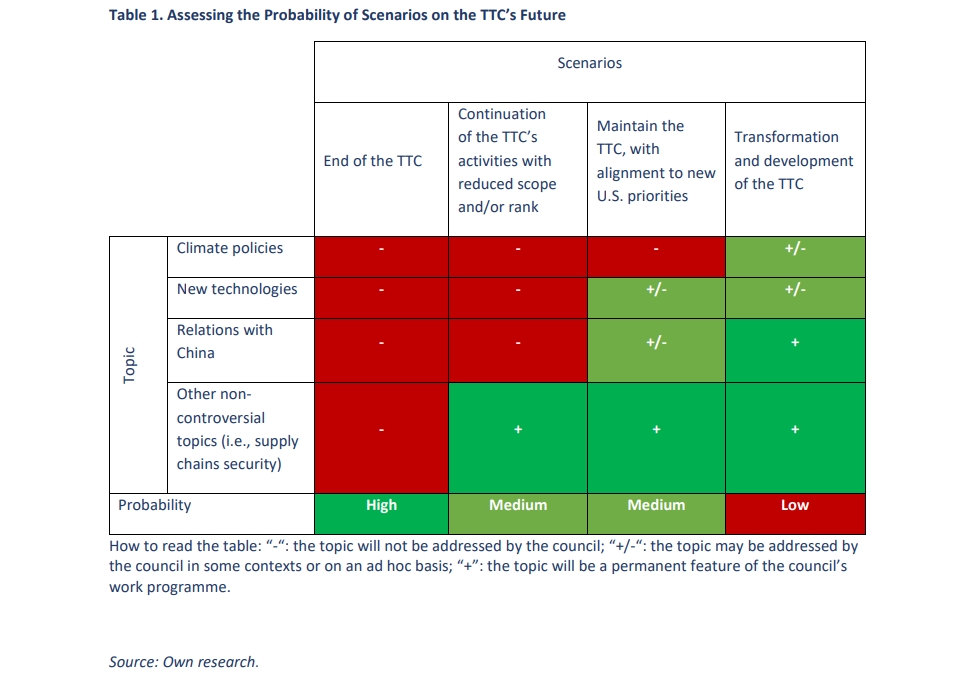
Perspectives. The TTC’s performance to date is rated better in the EU than in the U.S., and the EC is interested in further cooperation. Several scenarios are therefore possible (see Table 1 below).
An end to the council’s meetings seems most likely, especially if the Trump administration deems the format ineffective and incompatible with U.S. priorities (which include a reduction in climate policy and technology regulation or an emphasis on trade policy), and the Union chooses not to take diplomatic action to keep the council operating. The argument of limited effectiveness, however, may be decisive for the U.S. in light of the great concern the current president’s circle of advisors has for improving the efficiency of the federal administration. The actual dismantling of the TTC, however, would require formal steps, such as an official termination of cooperation within the council by either party. Given its limited importance to Trump, as well as its low public visibility, it is unlikely that the new administration will take the time to formally abolish the council. Rather, in this scenario, the U.S. government will ignore TTC meetings and the council will de facto cease to operate. This is already partially happening, as the council’s last meeting was held in April 2024, although according to the schedule so far, at least one should have taken place in late 2024 or early 2025.
Moderately likely then is the continuation of the TTC but, if anything, in a limited capacity and with a decline in its importance as a platform for transatlantic dialogue. This scenario is more likely given that the council is not a forum for discussing general trade policy, which is what Trump is most interested in, but rather specific solutions for specific areas of trade. Such a continuation would be possible under two options. The council could focus on topics that are not controversial but in the vital interests of the partners, such as securing supply chains. Its meetings could then be held rather less frequently and its rank lowered. The second option would be to keep TTC meetings at their current rank with an adjustment to the new U.S. priorities, such as dual-use technologies, 6G networks, or AI.
The least likely scenario, in light of the first days of Trump’s presidency, is that, given the administration’s interest in the development of new technologies, the council would become more important, addressing issues of high interest to the EU and the U.S. This could happen if the U.S. administration sees the council as an effective tool for pushing its trade policies, especially towards China, and promoting U.S. manufacturers.
The continued operation of the TTC, despite the challenges posed by Trump’s policies, represents an opportunity to maintain a transatlantic dialogue and cooperation in key technological areas of importance to the EU. Joint action between the EU and the U.S. in this area would allow the global market to be shaped more effectively. It is therefore advisable for the EC to enter into a dialogue with the U.S. administration on adapting the TTC to the new political realities, so as to prevent its dismantling. However, this cannot be done at any cost—the EU should look for programmes that the U.S. could implement with the council’s participation, but without harming European interests. These include, for example, joint tariffs on Chinese technology.
It remains in Poland’s interest to actively support the continuation of the TTC, especially in areas of key interests, such as the semiconductor market. In this regard, the government should coordinate with the new Commissioner for Technological Sovereignty, Security and Democracy Henna Virkkunen in seeking an extension of the TTC format, and thus strengthen Poland’s position in the EU forum.