Presidential Elections in Czechia Head to a Final Vote: About the Campaign and Post-Election Scenarios
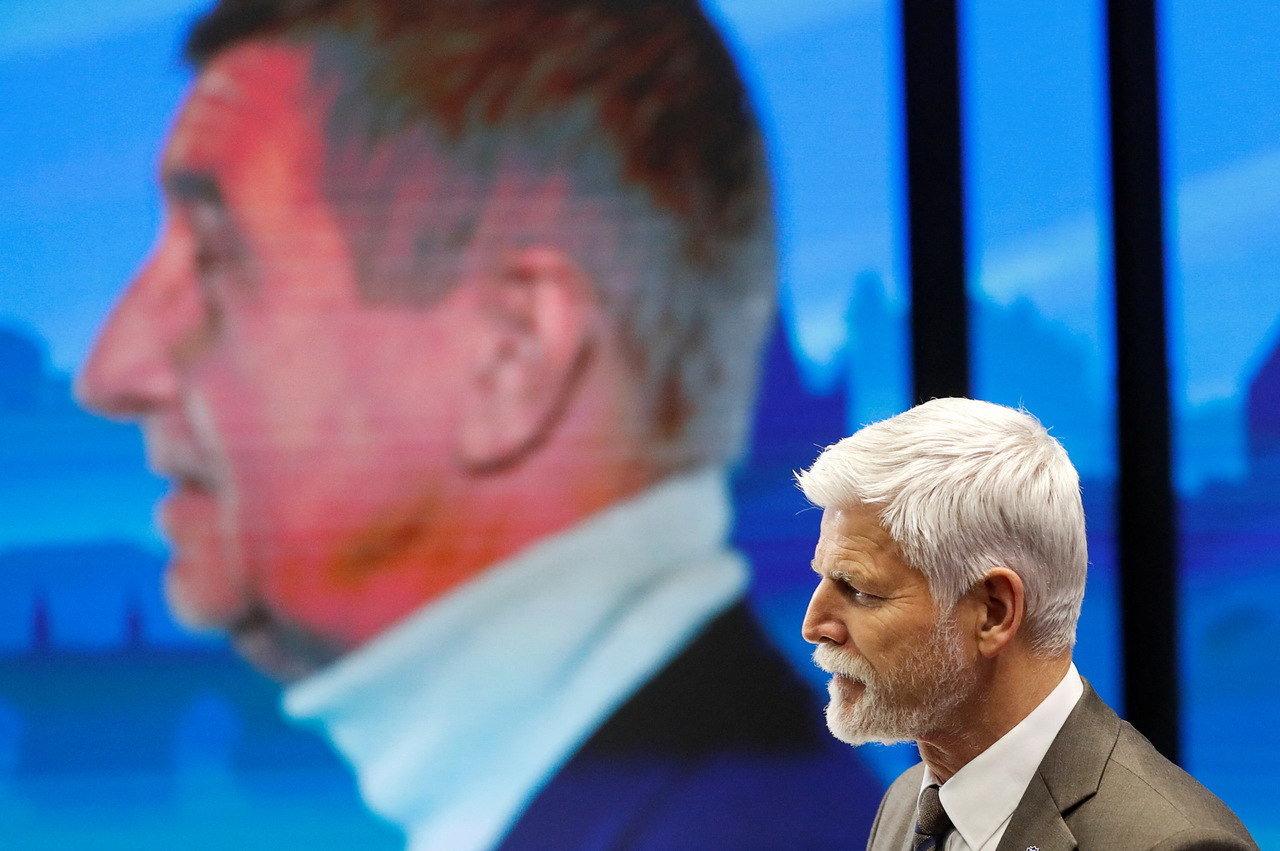
Despite the minimal difference in the votes cast in the first round of Czechia’s presidential election, retired Gen. Petr Pavel is the favourite. In the second round, scheduled for 27 and 28 January, he will face former Prime Minister Andrej Babiš, who managed to win voters from outside of his ANO electorate. Pavel’s victory would translate into more harmonious cohabitation with the government of Petr Fiala than the presidency of Miloš Zeman and would have a positive impact on regional cooperation, including with Poland, especially in the field of defence and support for Ukraine.
 DAVID W CERNY / Reuters / Forum
Pavel won the first round with 35.4% of votes, which was just 0.41 percentage points (p.p.) more than Babiš. The general is non-partisan, and while he has the support of four out of five parties in the ruling coalition, Babiš is the leader of the largest opposition party. The turnout in the first round was 68.2%—the highest since the country switched to direct presidential elections in 2013.
Zeman’s Legacy
The outgoing president, despite the limited prerogatives of the office, played an active role in Czech domestic and foreign policy in his two five-year terms, and also tried to expand his powers. He did this, for example, by allowing the Babiš government to function for many months without a vote of confidence (in 2017-2018) and by blocking some appointments, including professorships and ambassadorships. Some Czech constitutionalists consider his announced appointment of a successor to Pavel Rychetský, the president of the Constitutional Court, to be a violation of the powers of the head of state because the term expires in August this year, which is five months after the end of Zeman’s term of office. On the other hand, in law-making, the president has the right of veto, which can be rejected by a simple parliamentary majority, as was the case, for example, when adopting a budget amendment last year.
Zeman’s actions in the international forum often contrasted with the government’s position, which undermined the cohesion of Czech foreign policy. The outgoing president sought to strengthen relations with China and, before the February 2022 invasion of Ukraine, with Russia. He was also in favour of moving the Czech embassy in Israel from Tel Aviv to Jerusalem. He backed extended regional cooperation, including within the framework of the Three Seas Initiative, which he saw as an opportunity for the creation of the Danube-Oder-Elbe canal. Although Babiš, when he was prime minister, distanced himself from some of Zeman’s views on foreign policy, during the presidential campaign he managed to win the support of the head of state.
Election Strategies
Pavel received the support of his other opponents from the first round. The former rector of Mendel University in Brno, Danuše Nerudová (who received 13.92% of votes in the first round) called on her supporters to vote for Pavel, as did conservative Senator Pavel Fischer (6.75%), liberal Senator Marek Hilšer (2.56%), and entrepreneur Karel Diviš (1.35%). The vast majority of voters for these candidates declared that they will vote for Pavel in the second round. Nerudová and Fischer became involved in his campaign, going with him on a state tour, including to the Ústecký Region and Moravian-Silesian Region where Babiš won the first round. The former prime minister can also count on the majority of voters for Jaroslav Bašta (4.45%), the candidate of the far-right Freedom and Direct Democracy party, as well as support from the extra-parliamentary Communist Party of Bohemia and Moravia.
Babiš tried to demobilise Pavel’s voters through a negative campaign focused on the retired general’s communist past—although Babiš himself was a member of the Communist Party of Czechoslovakia. Babiš also noted the intelligence course Pavel took in the former Czechoslovakia in the late 1980s and asserted a lack of political experience. Pavel, on the other hand, cited abuses at the agri-food company Agrofert, which Babiš headed before he became a politician. However, just before the first round, the court of first instance acquitted the former prime minister of the charge of extorting subsidies from the EU.
Campaign Themes
Pavel made his military experience an asset in the fight for the office of president, who functions also as the commander-in-chief of the armed forces of the Czech Republic. His image was bolstered by past functions in national and Alliance ranks: chief of the Czech general staff (2012-2015) and the head of the NATO Military Committee (2015-2018). Pavel presents himself as a man enjoying international recognition, as evidenced by decorations, including the French Legion of Honour, which he received for supporting French soldiers during the war in Bosnia and Herzegovina in 1993.
Issues of international security became an important topic of the campaign. In Babiš’s opinion, the election of a former professional military man as president would entail the threat of Czech involvement in military operations in Ukraine. While presenting himself as a supporter of peace, Babiš simultaneously made contradictory statements regarding the commitment to the collective defence of NATO countries and proposed organising a summit in Czechia with the participation of Russia and Ukraine. According to him, his foreign contacts may help him with preparing such an event, including his relations with French President Emmanuel Macron, who received him at Elysee Palace just three days before the first round of the elections.
Although the president has limited powers in economic matters—extending primarily to appointing members of the Banking Council of the Czech National Bank—the topic became a visible element of the campaign. The public debate contributed to this, as it was focused on, among others, the increase in prices (inflation in December last year was 15.8%, year on year). Babiš presented himself as an experienced entrepreneur and finance minister (2014-2017), able to mitigate the negative economic consequences for citizens.
Babiš saw a chance to gain votes by highlighting the arrival of migrants to Czechia along the “Balkan” route. This followed the example of Zeman’s campaign five years ago. To illustrate what he described as the need to seal the EU’s external borders, the ANO leader met in mid-December last year with the President of Hungary Katalina Novák and with the President of Serbia Aleksander Vučić. He also called for the use of NATO forces for an “offensive alliance” to attack smugglers’ boats in the Mediterranean.
Conclusions and Perspectives
The nearly equal results for both candidates in the first round of the election do not mean they have similar chances to win the presidency in the second. Thanks to wide support from parties and candidates who lost in the first round, Pavel is the favourite. His position is additionally strengthened by a successful campaign and a less controversial past than in the case of his opponent. It will also be difficult for Babiš to suppress turnout among Pavel’s declared supporters and candidates from the first round who backed him.
Pavel’s victory would, in principle, mean more constructive cooperation with the government than in the case of a Babiš victory. In foreign policy, it would translate into an unambiguously pro-NATO and pro-EU stance on the part of the Czech authorities (also taking into account the postulate of the country’s entry into the eurozone). The general favours support for Ukraine (political, humanitarian and military) in its war with Russia. He opts for the former’s accession to the EU and NATO. Thus, his position would be consistent with the Fiala government’s policy towards Ukraine. At the same time, he tries to present himself as a supporter of dialogue, referring to his acquaintance with the chief of the Russian general staff, Valery Gerasimov, from the time when he conducted negotiations with him on behalf of NATO.
On the other hand, a possible victory for Babiš would mean difficult cohabitation with the government. Since the beginning of the campaign, Babiš, as the leader of the largest opposition party, has combined disavowing Pavel with criticism of the government. He tried to show that the general was a candidate put forward by Fiala’s government and that his election which would lead to too much concentration of power in the hands of one political option. Another consequence of a Babiš victory would be an internal crisis in his formation, which is strongly focused on the leader. Even in the event of a defeat, he will manage to strengthen his political position as the leader of ANO. The party, though, polled with less support than Babiš had in the first round of the presidential election.
From Poland’s point of view, Pavel’s election would contribute to strengthening regional cooperation in the field of security. It also would increase the international credibility of Czechia after Zeman’s presidency. The general links continued support for Ukraine with the security of Czechia and Central European countries, including Poland. A chance for a new opening in bilateral relations at the presidential level would be his announced planned visit to Poland as the second country after Slovakia (traditionally visited first by a new president) after his election. Despite Pavel’s criticism of the Visegrad Group, he will continue cooperation in this format during his presidency. Babiš, in turn, as prime minister, was among the greatest enthusiasts of cooperation in the V4 and was closer to the position of the Polish authorities, for example, on the issue of withholding the adoption of the euro, but he instrumentalised bilateral relations for internal use. This was evidenced by the use of the Polish-Czech dispute over the lignite mine in Turów before the Czech parliamentary elections in 2021. If he wins, his ambiguous position on the issue of support for Ukraine and allied commitments could weaken cooperation with Poland and would contribute to strengthening Czech-Hungarian relations.