One Big Beautiful Bill Forms the Foundation of Trump's Second Term
On 4 July, U.S. Independence Day, President Donald Trump signed what he calls the “One Big Beautiful Bill”, a signature piece of legislation that lays the foundation for the implementation of his political programme. The bill’s passage was not supported by any Democrats in either chamber of Congress and was also opposed by a handful of Republicans, who are now facing criticism and attacks from the MAGA community. Nevertheless, the passage of the bill is a success for the president and House Speaker Mike Johnson and Senate Majority Leader John Thune, who managed to maintain the required party discipline. The bill will provide Trump with additional tools to deliver on his campaign promises, alongside his widely used, and sometimes extreme, executive orders.
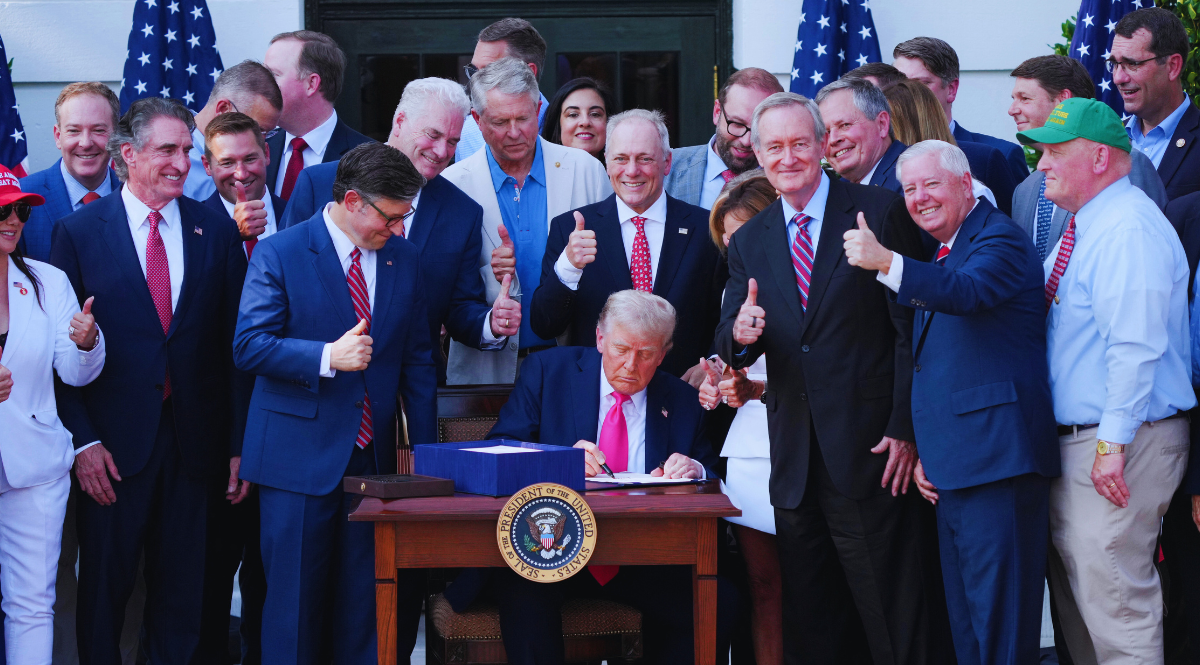 credit: Ken Cedeno / Reuters / Forum
What does the bill introduce?
Trump successfully convinced almost all Republicans to support the key elements of his political programme and conclude Congress’ six-month work on the bill before Independence Day, which he used for promotional purposes. The bill makes permanent the lower tax rates for higher income earners originally introduced by Trump in 2017, limits federal taxes on tips and overtime, as well as abolishes some specific existing tax breaks (e.g., related to renewable energy sources) and introduces new types of tax breaks. These are intended to improve the financial situation of Americans. However, these measures are expected to reduce budget revenues by almost $4.5 trillion over 10 years, which will be a challenge for future Congress’ in keeping the budget deficit from growing. The bill supports key Trump policies, including an additional $150 billion for military spending and $170 billion to strengthen border security and combat irregular migration. At the same time, it includes significant cuts in spending on social programmes (about $1.2 trillion), primarily the Medicaid healthcare and the SNAP food assistance programmes, which may lead to a decline in support for Republican candidates in the next election.
Why were Democrats against the bill?
Democratic politicians made it their primary goal to prevent, or at least hinder, the passage of the bill by Trump and the Republicans, whose ideas about taxes and the economy the Democrats consider harmful to the interests of voters who are not affluent and unfairly preferential to big business. Despite knowing that their chances of blocking the bill were slim, the Democrats wanted to link the bill’s cuts in social benefits directly to members of Congress who will be seeking re-election in the midterm elections in November 2026. The Democratic Party has put the emphasis on the Republicans’ responsibility for tax cuts for the wealthiest while the budget they voted for simultaneously reduces funding for, among other things, public subsidies for the poorest, affecting about 12% of the U.S. population in 2024. In addition, the Democrats’ strategy, which was ineffective in the face of Trump’s dominance of the GOP, which controls both chambers of Congress, was to attempt to create an internal split among Republicans by exposing the gap between the highest and lowest earners in their districts and by promoting the Democrats’ legacy of legislation increasing access to healthcare.
How might the bill affect Trump’s standing in the eyes of Americans?
The bill enables Trump to implement key elements of his political programme, which until now has been based exclusively on executive orders with limited legal force. In this respect, it will form the legislative foundation of his term in office.
One should therefore expect more decisive action from the administration, primarily in the areas of border protection and eliminating irregular migration, as well as further initiatives in cooperation with Congress and the majorities of Republicans in both houses of Congress (although this could potentially change after the midterm elections). However, the immediate effect of the bill’s adoption may be less enthusiasm for Trump and his administration. This will depend on the administration’s formulation of a clear message to the public and the clarification of doubts related to, for example, the legislation’s restrictions on access to the widely used Medicaid and SNAP programmes. Currently, the public’s main concern is Trump’s actions in the economic sphere, including the unclear course of U.S. customs policy and the resulting unpredictability of trade relations with America’s partners. Therefore, it cannot be ruled out that even a short-term increase in support for the president’s policies by a few percentage points will not change the continuing trend of rising dissatisfaction with Trump's policies.
What is the estimated impact of the bill on the U.S. economy?
The Congressional Budget Office estimated that the bill would increase the national debt by $3.3 trillion over the next decade, but Republicans argue that this analysis does not take into account their predictions of the impact of economic growth and the tax revenues it will generate.
The biggest beneficiaries of the bill will be tax groups that benefited from Trump’s first tax cut in 2017. These are primarily large corporations and individual taxpayers with the highest annual incomes. The elimination of subsidies for alternative energy production may slow the construction of new power plants of this type, which could translate into higher energy prices at the regional level. A factor that may have a positive impact on the economy will be the tax cuts for the middle class, whose increased spending drives demand in the domestic market. However, this benefit may be limited by rising living costs due in part to the probable need to obtain private health insurance after a person’s possible exclusion from the Medicaid programme. The passage of the bill has led to a boost in the stock of most companies, including those whose revenues affect Americans’ retirement savings and those planning investments, and thus increasing employment.