New defence agreement between Denmark, Greenland and the US
On 22 September this year, the governments of Denmark, Greenland, and the US concluded an agreement concerning Greenland’s security. One of the outcomes of the agreement will be to enhance Greenland’s strategic importance to US defence through safeguarding US economic and security interests on the island.
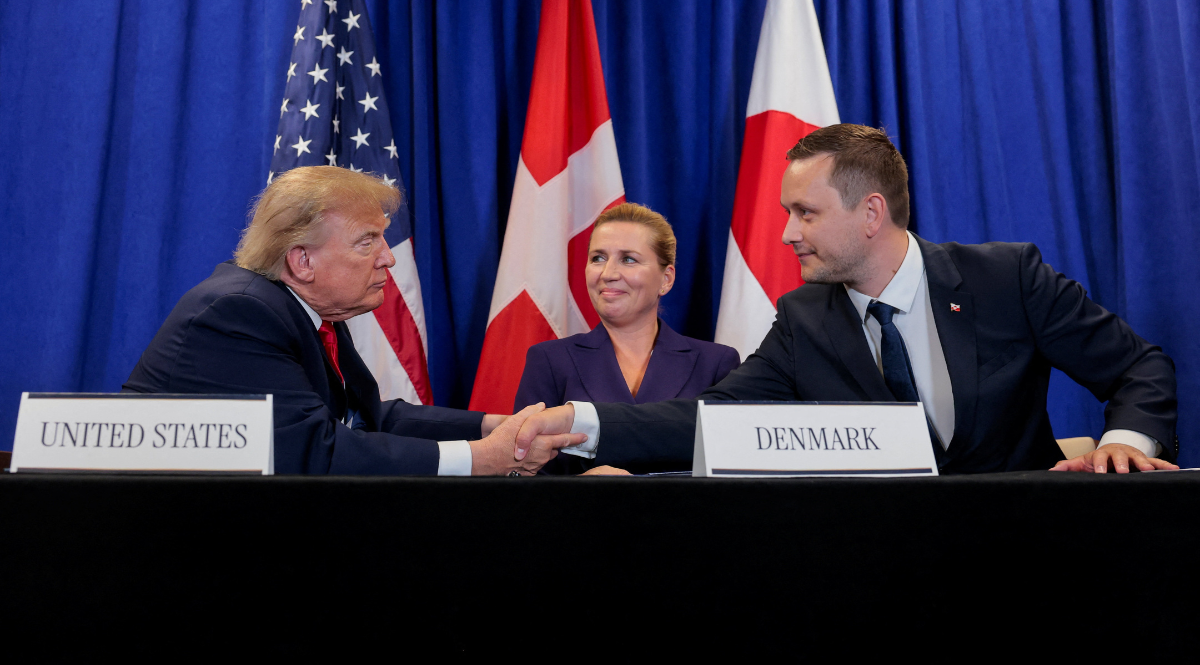 Kylie Cooper / Reuters / Forum
Why was the agreement signed?
Following tensions in relations between the US and Denmark—arising, amongst other things, from President Trump’s threat to seize the island by force and suggestions that Denmark and NATO lacked the capacity to effectively counter Chinese and Russian presence in the North Atlantic—both sides were keen to defuse the situation.
It was in the US’s interest to conclude an agreement that would enable the construction of new military installations in Greenland, alongside strengthening America’s strategic influence capabilities in the region—primarily out of concern over China’s growing interest, as well as the increase in Russian military activity in the Arctic. For Denmark, the aim of signing the agreement was to bring an end to the open dispute with the US over Greenland’s status, whilst maintaining the status quo of the island as a territory dependent on the government in Copenhagen.
The Danish authorities were also keen to ensure the involvement of the entire Alliance in guaranteeing the effectiveness of the agreement, whilst minimising the dispute between the Trump administration and the governments of the other NATO member states.
What are the provisions of the agreement?
The agreement supplements the 1951 US-Denmark agreement on the defence of Greenland (the island became a party to the agreement in 2004) and, first and foremost, reaffirms Denmark’s territorial integrity and sovereignty over the island, whilst recognising the right to self-determination of its inhabitants. A key issue is the US gaining access to the island to the extent necessary to defend NATO treaty territory and to build the US air defence system known as the Golden Dome. The United States will be able to build two new bases in the south and east of the island.
The agreement does not address economic issues, which Trump had emphasised in previous months, suggesting a need to take control of Greenland’s natural resources. At the same time, in accordance with the provisions of the document, non-NATO (apart from alliance partners) and non-EU countries will not be permitted to carry out investments on the island. Similar regulations apply to both temporary and permanent military presences. Should Greenland ever gain independence, Denmark and Greenland must ensure that the new state remains within NATO or, if necessary, applies for membership of the alliance.
Does the agreement change Greenland’s status?
The new agreement refers in several places to previously concluded agreements with the US, thereby recognising Greenland as a Danish autonomous overseas territory. Denmark retains its existing powers, meaning that the island’s formal status remains unchanged. However, restrictions on investment from countries outside NATO (and its allies) and the EU limit the Greenlandic authorities’ ability to engage in economic cooperation with companies from outside this group of countries. These restrictions primarily affect Russia and China, precluding entities from those countries from investing in sectors deemed critical in Greenland. Under the agreement, Greenland and Denmark will jointly select which investors from the group of eligible countries may cooperate with the island, an arrangement both sides consider beneficial. The Americans will merely be consulted on these matters, without any formal ability to veto Danish or Greenlandic decisions. Although the agreement restricts the list of investors, it is possible that Greenland’s own decision-making power in this area may increase due to the planned expansion of its authorities’ foreign policy powers.
Denmark’s commitment to keeping Greenland within NATO, combined with the planned expansion of the “Golden Dome,” strengthens the United States’ de facto decision-making power over the island’s future. This forms part of a broader US policy aimed at re-establishing control over the Western Hemisphere, which the Americans consider Greenland to fall within.
How might the agreement affect transatlantic relations?
The amicable resolution of the dispute and a reduction in tensions between European NATO members and the US over Greenland may, in the long term, strengthen not only the Alliance’s political message regarding shared interests in the Arctic, but also, as a result, lead to greater economic and military engagement by NATO members in the region. The dispute with the US itself prompted Denmark to significantly increase the presence of its armed forces on the island. Denmark’s closest allies among the Nordic countries have also stepped up their involvement. The dispute over Greenland has also fuelled discussion on securing other Arctic areas, such as the island of Jan Mayen and the Svalbard archipelago.
At the same time, tensions surrounding Greenland have led to a significant decline in trust in the United States, not only in Denmark but also in other allied nations. Restoring that trust will certainly be a major challenge for the US administration, and returning to the level of trust between allies that existed before the Greenland crisis may be a protracted process. This could lead to a further weakening of transatlantic ties, which would be particularly detrimental from the perspective of the countries on NATO’s eastern flank, including Poland.



.png)