
International Partners Rush to Support Haiti in Halting Crisis
On 11 March, representatives of selected Haitian groups and the Caribbean Community (CARICOM), the UN, and the U.S., among others, agreed to a rescue plan for Haiti in response to the abrupt erosion of public order in that country caused by attacks by armed groups. The top priority is stabilising the political situation by setting up an interim presidential council to replace the government of Prime Minister Ariel Henry. The council’s tasks are to introduce the UN-authorised multinational mission assisting the Haitian police in restoring order and to prepare the first elections since 2016. Strong political differences in Haiti and financial obstacles may stand in the way of these efforts.
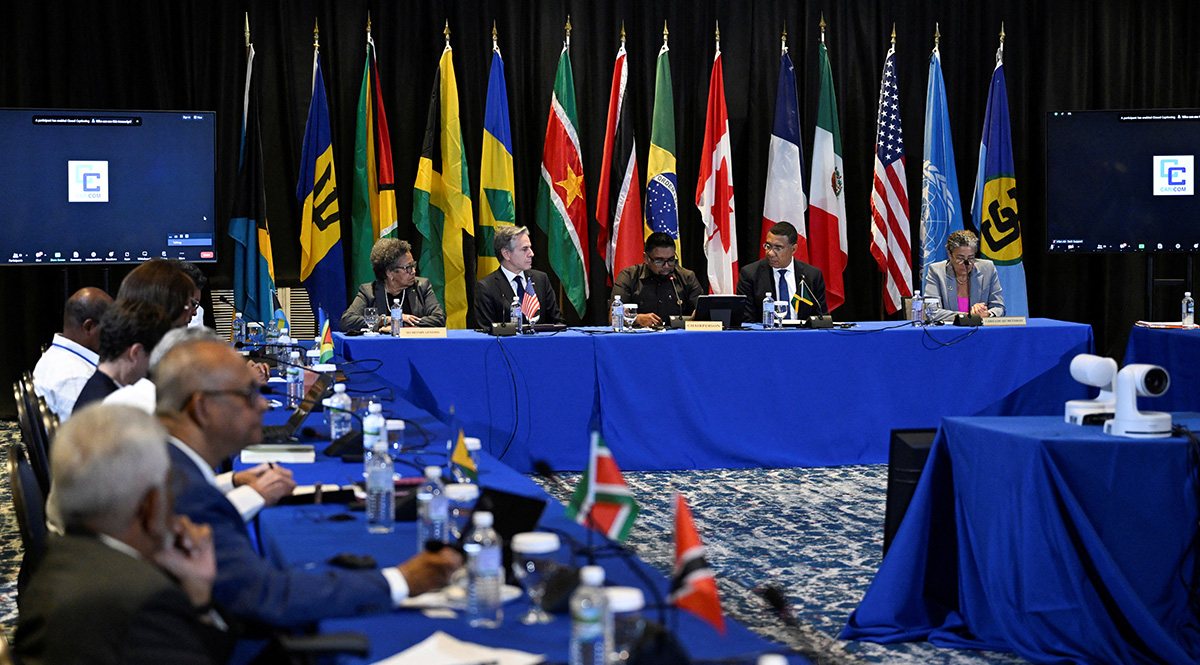 Andrew Caballero-Reynolds / Reuters / Forum
Coordinated attacks by Haitian armed groups in late February and early March seeking to force the resignation of Prime Minister Ariel Henry has deteriorated into a security and humanitarian crisis in Haiti. CARICOM, with Haiti as one of its 15 members, has been involved in the quest for an urgent solution. At the organisation’s leaders summit in Guyana (25-29 February), Henry failed to convince his partners to adopt his proposals to overcome the crisis with his continued rule. The Community has engaged in talks with representatives of seven Haitian communities, comprising various political, social, and business organisations. This group held an online discussion on 11 March with representatives of CARICOM, the UN, and the governments of France, Canada, Mexico, the U.S., and others gathered in Jamaica that led to the adoption of a stabilisation plan for Haiti.
Failed Attempts
With a population of nearly 12 million, Haiti is the poorest country in the Americas and highly vulnerable to natural disasters and their long-term effects. It has struggled with structural socioeconomic weaknesses and chronic political instability, exacerbated by armed groups, especially gangs, which have grown because of the lack of prospects and often with the support of politicians. The assassination of President Jovenel Moïse on 7 July 2021 complicated the situation. Two days earlier, he had nominated Henry as prime minister. Henry took office in mid-July 2021, but without the required parliamentary approval. He rapidly started to lose popularity because of his questionable legitimacy, controversial economic decisions (such as the abolition of fuel subsidies), and ineffectiveness in combating armed groups. His credibility was particularly undermined by the delay in holding elections.
In October 2022, he called for international assistance, including a force to help bring order, but finding a partner to lead such a mission was challenging. Canada and Brazil refused it and only in July 2023 did Kenya agree, declaring it could deploy 1,000 police officers. The UN Security Council (UNSC) approved the Multinational Security Support (MSS) mission on 2 October (China and Russia abstained). The main task of the mission, which is set for one year with the possibility of an extension, will be to support the local Haitian police, estimated at around 9,000 officers in 2023, in the protection of key infrastructure (such as airports and hospitals) and on-the-spot operations. Governments may join or fund the MSS on a voluntary basis. The UNSC also demanded the sealing of the arms embargo on Haiti, which it imposed in October 2022.
In January, the Kenyan Supreme Court questioned the legal basis for sending police officers to Haiti. The decision coincided with the boost in protests against Henry in his country. When he flew from Guyana to Kenya on 29 February to sign a memorandum of cooperation to remove obstacles to the deployment of the force, CARICOM announced that the prime minister had committed to calling elections, but only by the end of August 2025. This news exacerbated the situation in Haiti. A coalition of armed groups went on the offensive, assaulting police and public buildings, freeing several thousand prisoners and storming airports, among other targets, and continued the attacks in the following weeks. The leaders of an alliance of gangs called on Henry to step down and announced that they would block his return to Haiti. They rejected the MSS and demanded amnesty for themselves. The attacks have so far forced tens of thousands of residents to flee their homes. Henry has not been able to return to Haiti, remaining in Puerto Rico since 5 March. He did not attend the Jamaica talks, but announced he would resign once the transitional authorities were constituted.
The Stabilisation Plan and Challenges to Its Implementation
Establishing an interim presidential council (IPC) was the main provision of the 11 March arrangement. The body comprised seven members designated by each of the Haitian groupings that had developed the plan, and two non-voting members representing civil society and religious groups. People with a criminal record, subject to UN sanctions, or opponents of the MSS cannot be on the Council. The most important tasks of the IPC are to choose a new prime minister and a council of ministers, receive the MSS, and then organise the elections (IPC members are not allowed to be candidates).
Strong disagreements between the Haitian groups prolonged the completion of the list of members of the presidential council. Some participants criticised the IPC’s format, membership criteria, and even the lack of gang representation. The armed groups tried to undermine the process by threatening IPC nominees and extending attacks in the Haitian capital of Port-au-Prince. On 22 March, the newly-formed Council agreed with CARICOM the procedures to take over from Henry, and on the following day it began work on the composition of the transitional government and on other issues.
The MSS is expected to have several thousand personnel, but a lack of funding is hindering its launch. Apart from Kenya, which announced it could initially deploy 400 officers, other countries, for example Bangladesh, Barbados, Chad, Jamaica and Benin, which has pledged 1,500-2,000 troops, also expressed their readiness to join the MSS. The U.S. government estimates that a two-year mission could cost $515-600 million and has pledged $300 million in total, the highest contribution towards that goal. However, of the $40 million requested from Congress so far, only $10 million has been approved, with Republicans resisting further tranches arguing a lack of details about how the funds would be spent. Humanitarian assistance is also in limbo and by 26 March, only $44.6 million of the UN-estimated $674 million pledge had been received by the dedicated Haiti Fund.
Conclusions and Outlook
The plan to stabilise Haiti would not have come about without active international involvement, although it came with a significant delay and further aggravation of the crisis in Haiti. It is unclear to what extent the establishment of an interim government by the IPC will help in controlling the situation. There are fears that politicians linked to armed groups may come to power as the latter step up attacks in Haiti to pressure the authorities, retain influence, and avoid criminal responsibility. As well, the MSS as planned may not be enough to help Haitian forces restore security in the country.
The escalation of the crisis raises concerns about the negative effects on the region, particularly the influx of migrants and refugees from Haiti. For example, the neighbouring Dominican Republic maintains restrictions on the arrival and deportation of Haitians. The U.S. state of Florida and the British dependent territory Turks and Caicos have strengthened monitoring of maritime territories.
The U.S. Border Patrol’s statistics perfectly reflects the deteriorating situation in Haiti. In fiscal year 2022 (October 2021 to September 2022), it registered nearly 57,000 illegal Haitian immigrants, in the following year, nearly 164,000, and from October last year to February alone, 111,000. The threat also connects to international crime, including smuggling, given the limited state control in Haiti. Although the U.S. authorities have rejected calls for military intervention, on 21 March, U.S. Gen. Laura Richardson, who heads the Southern Command, did not rule out sending troops if it was part of an international solution.
Among the EU members, France stands out in the efforts to stabilise the situation in Haiti. Its minister for development aid and international partnerships attended the Jamaica meeting. The French government also declared it would fund courses in the French language (one of Haiti’s main languages along with Haitian Creole) for Kenyan MSS officers. The EU itself is one of the largest donors of humanitarian aid to Haiti and in the past two decades it has contributed more than €500 million. On 13 March, the European Commission, which supported the 11 March stabilisation plan and the MSS, announced €20 million for immediate humanitarian needs. It is advisable for the EU to further increase its visibility and financial commitment to Haiti, so it can reinforce its status as a key supporter of the least developed countries and fulfil the Union’s ambitions to strengthen its relations with partners in the Latin American and Caribbean region.


.jpg)
.jpg)