Georgian Authorities Consolidate Their Authoritarianism
The Georgian Dream (GD) party, which has been ruling Georgia for 13 years, is seeking to fully consolidate its authoritarian system in the coming months, a process that has been underway since last year's parliamentary elections. To this end, it is seeking to eliminate key pro-Western opposition parties and, by cutting off funding, non-governmental organisations and independent media. These actions will further deteriorate Georgia's relations with the EU, the US and NATO.
 Irakli Gedenidze / Reuters / Forum
Purges in the Georgian Political Scene
In October, GD, in line with declarations made before last year's parliamentary elections, submitted a request to the Constitutional Court (CC) to ban three main pro-Western opposition parties – the United National Movement, Lelo for Georgia and Ahali. The ruling party's motion was based on a report by an investigative committee of the de facto single-party parliament (the opposition considered the elections to be rigged and did not accept the seats allocated to it), which identified their activities as being to the detriment of Georgia and accused them, among other things, of attempting to undermine the constitutional order of the state. The ban will affect not only the parties themselves, but will also have indirect consequences for their members. Under the amended political parties act, the CC may prohibit them from forming new parties, running or joining other parties, holding office or taking up public positions. In response, the United National Movement and Lelo for Georgia submitted a request to the Constitutional Court to ban GD and declare the above-mentioned law, as well as the report of the investigative commission, unconstitutional. As the judiciary remains under the full control of the executive, these actions by the opposition will remain more of a political gesture.
In November this year, the Georgian prosecutor's office brought further charges against almost all the leaders of the pro-Western opposition: former Georgian President Mikheil Saakashvili, the leaders of the Ahali, Girchi-More Freedom, Strategy Aghmashenebeli, Droa and Lelo for Georgia parties (see table below). They have been charged with sabotage, aiding a foreign state in hostile activities, inciting a violent change in the constitutional order or overthrowing the government, and violating the constitutional order. Depending on the charges, they face between 3 and 15 years of imprisonment. The accusations also affected Giorgi Gakharia, Georgia's Prime Minister from 2019 to 2021, who has been in Germany since the end of June due to fear of arrest on charges of abuse of power during his tenure as Minister of Internal Affairs.
The politically motivated charges against the above-mentioned politicians are intended to permanently exclude them from political life and, together with the banning of key pro-Western opposition parties, lead to the de facto establishment of one-party rule in Georgia. Even the fact that the For Georgia party has decided to end its almost year-long boycott of parliament will not change this situation.
Combating Centres of Social Resistance
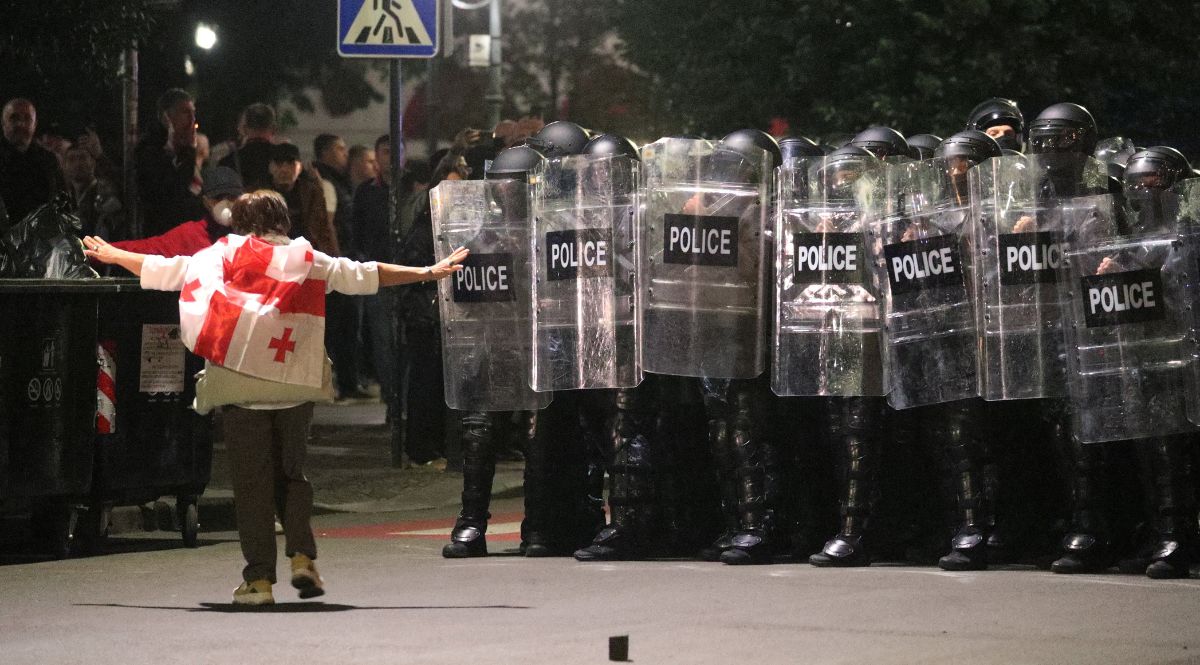
The repercussions of the GD are also aimed at civil society. For a year, the Georgian authorities have been constantly harassing protesters in the centre of Tbilisi. Initially, covering one's face and blocking the road during protests was punishable by a fine (of approximately PLN 7,500). In autumn this year, parliament imposed new penalties, this time involving imprisonment for up to 15 days (or one year in the case of repeat offences). The number of political prisoners in Georgia has now risen to over 200. This means that per 100,000 citizens, there are proportionally 11 times more political prisoners than in Putin's Russia.
In spring this year, following the adoption of new laws on so-called foreign agents and grants, a new wave of persecution of non-governmental organisations (NGOs) and free media began. Entities receiving foreign funding must register in the relevant database and apply to the authorities for permission to accept such funds each time. Most key NGOs have not complied with these requirements, which has drastically worsened their financial situation and forced them to limit or even suspend their activities. These organisations are subject to constant financial controls, and the authorities require them, among other things, to disclose information about their members and funders. At the end of August this year, the Georgian prosecutor's office froze the bank accounts of the seven most active NGOs working in the areas of human rights, media freedom and the rule of law, with charges of sabotage and actions against the constitutional order and national security. In addition, they have been the target of attacks by GD (following their description as traitors and agents of foreign influence) and experience cyberattacks and trolling on social media. Many of them have registered outside the country in order to circumvent the restrictive regulations.
The regime is trying to subjugate journalists by force. In addition to arrests while covering protests, on the pretext of blocking roads, many of them experience violence from the police or masked attackers. The founder and editor-in-chief of the Netgazeti and Batumelebi websites, Mzia Amaglobeli, a Sakharov Prize laureate sentenced to two years of imprisonment, has become a symbol of the struggle for free media. The two main independent television stations (Pirveli, Formula) and electronic media remain in a difficult financial situation. The repression has caused Georgia to drop 11 places in the 2025 World Press Freedom Index of Reporters Without Borders, to 114th place.
Under the pretext of improving the quality of education, GD continues to reorganise higher education according to its own needs, as it considers universities (academic staff and students, who constitute the dominant group of protesters) to be one of the key sources of opposition to its rule. Citing the excessive concentration of universities in the capital, Tbilisi, it plans to decentralise them, which will, in fact, give it the opportunity to remove inconvenient employees and academics. As part of its efforts to reduce cooperation with the West, it is also seeking to move away from the so-called Bologna process by shortening the length of higher education.
Conclusions and Outlook
GD’s goal is to establish a fully consolidated authoritarian political system in which no significant opposition to the current government can function. In the coming months, one may expect the effective elimination of key pro-Western opposition parties and the removal of their leading politicians from political life. Once this scenario has been implemented, there is a risk that GD will call early parliamentary elections. The ruling party's goal is to win a constitutional majority, which would be the symbolic culmination of the process of consolidating authoritarianism. Small pro-Russian groups (e.g. the Alliance of Patriots of Georgia, Conservatives for Georgia) may be allowed into parliament, where they would play the role of a licensed opposition and create the appearance of political pluralism.
All actions targeting political opponents create the risk of their political emigration, mainly to EU countries. Therefore, at this stage, Member States could already start working on potential aid packages for various opposition groups, combined with an efficient but thorough security screening.
The situation in Georgia requires a response from the international community. The OSCE could activate the Moscow Mechanism to investigate violations of democratic principles and human rights by the Georgian authorities. The EU, the US and the UK could impose sanctions on the Georgian authorities in the form of freezing their assets (businesses, real estate and financial resources in banks) in the West and banning them from entering their territory. If there are difficulties in adopting such measures at the EU level, individual Member States could also introduce restrictions at the national level, as Lithuania, Latvia and Estonia have done so far, but in order to strengthen their impact, coordination between these countries will be necessary. Any suspension or withdrawal of visa-free travel by the EU should only apply to the ruling elite, not to all Georgians, the vast majority of whom support their country's integration with the EU. NATO, on the other hand, could suspend its support instruments for Georgia and the work of the NATO-Georgia Commission until the country returns to the path of democracy and integration with the West.
Pro-Western Opposition Leaders Charged by the Prosecutor's Office
|
Coalition |
Party |
Position |
Name |
|
Coalition for Change |
Ahali
|
Co-leader of the party |
Nika Gwaramia |
|
Co-leader of the party |
Nika Melia |
||
|
Girchi-More Freedom |
Party leader |
Zurab Japaridze |
|
|
Droa |
Party leader |
Elene Khoshtaria |
|
|
Unity- to Save Georgia |
Strategy Aghmashenebeli |
Party leader |
Giorgi Vashadze |
|
Strong Georgia |
Lelo for Georgia |
Co-leader of the party |
Mamuka Khazaradze |
|
Co-leader of the party |
Badri Japaridze |
||
|
--- |
For Georgia |
Party leader |
Giorgi Gakharia |
|
--- |
United National Movement |
Former President of Georgia |
Mikheil Saakashvili |

(3).png)