Algeria returns to the Sahel
Over the past few months, Algeria has re-established diplomatic relations with junta-ruled Mali and launched its first overseas military mission since 1973—dispatching forces to Niger. This return to an active presence in the Sahel region is aimed at rebuilding its influence, which has been weakened in recent years. It is also a sign of the intensifying rivalry in the Sahel with the Haftar family, who rule eastern Libya, and whom the Algerians regard as regional proxies for the United Arab Emirates.
Since the early 1990s, Algeria has been building a strong position in the Sahel (the belt of countries south of the Sahara, stretching from Mauritania to Chad), including involvement in the fight against terrorism as the initiator of the Joint Committee of Chiefs of Staff (CEMOC) and as a mediator, for example, when brokering the 2015 agreement that ended the civil war in Mali. This influence waned during the final years of Abd al-Aziz Bouteflika’s rule (which ended in 2019) and the early days of the current administration under Abd al-Majid Tebboune. This period coincided with a growing regional security crisis, which set the stage for military coups in Mali, Burkina Faso and Niger (2020–2023). The pro-Russian juntas established during this period, which form the Confederation of Sahel States (AES), have proved remarkably enduring, despite sustained pressure from jihadist groups and other rebel factions. Consequently, though France is reluctant, a number of West African states, the US, the EU and Algeria are seeking ways to build pragmatic relations with these governments.
Involvement in Niger
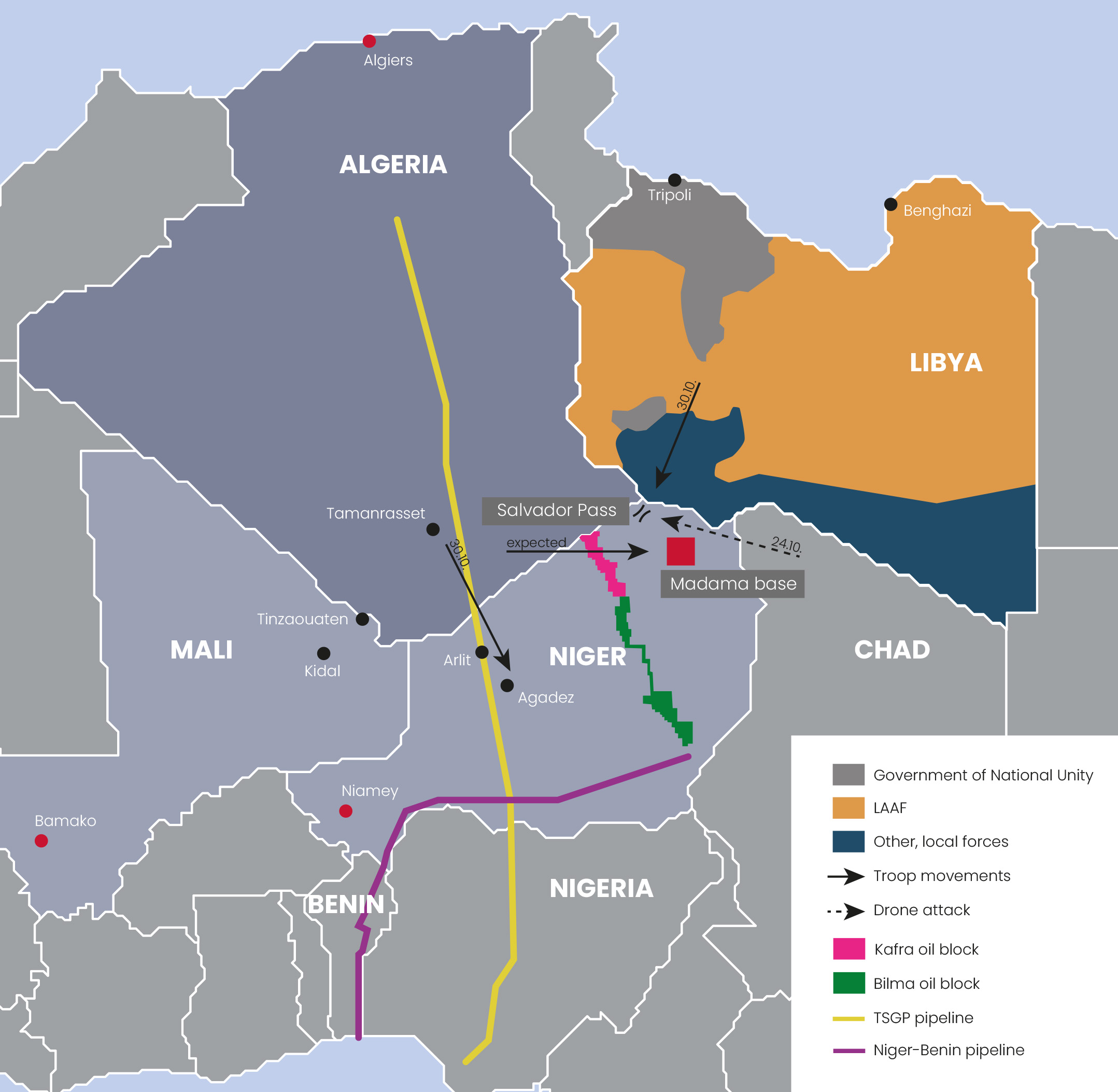
Until General Abdourahman Tiani’s coup in Niger in July 2023, Algeria had a substantial presence in the country’s oil and gas sector: the state-owned oil company Sonatrach held a licence to extract hydrocarbons in the Kafra block in northern Niger, and was part of a consortium tasked with building the Nigeria-Niger-Algeria gas pipeline (TSGP) to transport Nigerian gas to Europe. With this in mind, Algeria was initially open to dialogue, following the military’s seizure of power: it attempted to mediate between Niger and its neighbours in the ECOWAS bloc, and its president proposed a six-month plan to restore constitutional order. However, Niger’s new military-led leadership, determined to keep power in officers’ hands and pursue an anti-Western policy course, rejected these proposals and viewed Algeria with deep suspicion. This culminated in 2025, when, coordinating with their allies from Mali and Burkina Faso, they recalled their ambassador from Algiers.
Efforts towards rebuilding relations began in early 2026, with Tiani visiting Algiers, and the two countries subsequently signed more than 20 economic agreements, particularly in the energy sector. Sonatrach expanded its presence in Niger—it was invited to redo the feasibility study on the Bilma oil field in the south of the country, which is of key importance to Niger. In June, a power station—financed by Algeria and built by the Algerian company Sonelgaz in just 70 days—also began operating, supplying electricity to the capital, Niamey.
Alongside the restoration of economic relations, the two countries also resumed military cooperation. In August, Algeria handed over four attack helicopters to the Nigerien army, and in response to an attempted coup against General Tiani’s junta at the end of that month, it sent four Su-30 fighter jets as a deterrent against the rebels. These were stationed at Air Base 101 in Niamey, where forces from the Russian Africa Corps are also present. On 21 October, the authorities of both countries signed a protocol on military cooperation, and four days later an emergency session of the Algerian parliament was convened to approve the deployment of troops to Niger. Officially, the mission is primarily intended to ensure the safety of Algerian companies.
Algeria’s first foreign military mission since the 1973 Arab–Israeli War began in the days that followed. Algerian forces swiftly moved into the towns of Arlit (on the TSGP route) and Agadez, protecting fuel tankers belonging to another Algerian oil company, Naftal, which had begun delivering fuel at prices below market rates as previously agreed. The main concentration of Algerian forces will be stationed at the former French base at Madama, near the junction of the borders of Niger, Libya and Chad.
Involvement in Mali
Sharing nearly 1,400 km of border with Mali, Algeria has treated the northern part of Mali as an area where it can influence local ethnic and political alliances. In 2015, thanks to Algerian mediation, the civil war that had broken out following the overthrow of the Gaddafi regime in neighbouring Libya in 2011 was brought to an end. One of the consequences of this agreement was the de facto removal of the northern part of the country from the control of the Malian authorities. Tuareg separatists from Mali benefited from Algeria’s support and their proximity to the Algerian border.
Algeria’s position in Mali was compromised in 2023, when the Malian junta, with the support of the Russian Wagner Group, resumed the conflict with Tuareg separatists—now operating under the banner of the Azawad Liberation Front (FLA). This renewed offensive brought the fighting, as well as drone attacks, right up to the Algerian border. In April 2025, following the downing of a Malian reconnaissance drone by Algerian forces, the two countries severed diplomatic relations.
Russia had long been pressing for a reconciliation between Algeria and Mali, as its military partnership with the Malian junta—viewed with open hostility in Algeria—was blocking its ability to gain greater influence over the larger, wealthier and militarily stronger Algeria. Finally, in July this year, thanks to Niger’s mediation and Russia’s involvement, the parties reinstated their ambassadors and reopened their airspace. In August and September, the prime ministers paid reciprocal visits, opening the way for current negotiations on security cooperation and joint economic projects.
Regional rivalry
Algeria’s return to the Sahel is taking place against a backdrop of growing regional rivalry. This rivalry is playing out on several fronts. One of these is the rivalry between Algeria—the most important ally of the internationally recognised Libyan government in Tripoli—and the rival Libyan power centre in Benghazi, in the east of the country, led by General Khalifa Haftar (Commander-in-Chief of the Libyan Arab Armed Forces, LAAF) and his family. This is linked to a separate, though related, process of a broader reconfiguration of alliances within the Middle East and parts of Africa. Within this framework, rival Saudi and Emirati-Israeli blocs are consolidating. General Haftar and his son Saddam have close ties with the United Arab Emirates (UAE). Algeria regards the UAE’s continued expansion and the growing regional influence of the Haftars as a threat, and has accused these forces of being behind the attempted coup in Niger in August. From Algeria’s perspective, the attempted takeover threatened not only newly secured contracts in that country, but could also have led to an encirclement by the Emirati-Israeli bloc from a third front, adding to the proximity of Haftar’s fiefdom on its eastern border and Morocco—which joined the Abraham Accords and drew closer to Haftar’s LAAF—on the West.
This is why, for example, in early October, the Algerian president, whilst signalling the possibility of sending troops to Niger, declared that his country was ready to defend its southern neighbour “at any cost.”
This points to strategic motivations. The Madama base is well-suited to exerting influence over Libya and Chad (which has close ties to the UAE and the Haftars), for example through Libyan and Chadian rebel movements. The LAAF and their allies are opposing these plans: first, drones were launched from Chad at targets near the border area known as the ‘Salvador Pass’—a key route on the way from Madama to Libya—and then eastern Libyan commandos appeared there. In an effort to defuse tensions, on 1 November, the Prime Minister of Niger, Ali Lamine Zeine, arrived in Benghazi for talks with Saddam Haftar.
Just as Algeria is seeking ways to exert pressure on the LAAF, the authorities in Benghazi are forging alliances to put pressure on Algeria. They are seeking, for example, to gain influence over the Tuareg rebels of the FLA in Mali and the Tuareg communities in southern Algeria, and to strengthen cooperation with Morocco.
Conclusions and prospects
Algeria has shifted from a policy of isolating the ruling juntas in the Sahel states to one of political rapprochement and active engagement in Niger and Mali. As a result, it is not only securing contracts for its companies and regaining the influence it has lost in recent years, but is also attempting to curb the regional expansion of the Emirati-Israeli bloc and their ally—General Haftar’s LAAF. Whilst the economic boost linked to Algerian investment and aid will benefit the Sahel states, regional rivalry may result in the fuelling of further local proxy conflicts and hinder the talks on the unification of Libya being held under US auspices.
Algeria’s return to playing an active role in the Sahel does not, for the time being, weaken Russia’s current military position in the region. Both the Algerian-Malian and Algerian-Nigerien rapprochements are advantageous for Russia: in the former case, it affords Russian forces greater freedom of action in northern Mali, whilst in the latter it strengthens a junta with which it shares close political ties.
At the same time, Algeria’s military presence in Niger may help to stabilise that country, where extremist groups linked to al-Qaeda and the Islamic State are active. It also increases the chances of the central section of the TSGP gas pipeline being completed, the commissioning of which would help the EU to diversify its energy sources.